Community Corner
Variety Children's Hospital Patient Talks Polio, Coronavirus
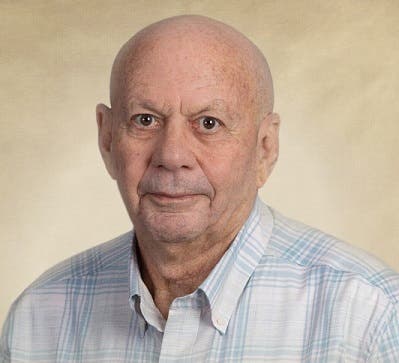
Bob Grant, who grew up in Miami, spent his youth at the Variety Children's Hospital. He was a control subject for Dr. Salk's polio vaccine.


MIAMI, FL — When the Variety Children’s Hospital was founded in Miami in 1950 to treat children with polio, it brought some much-needed hope to Bob Grant and his family.
He was around 7 years old when the hospital opened its doors for the first time. By then, Grant had been living with polio for nearly five years.
To this day, nobody knows how he got it, he said. “Because we didn’t know where it was coming from. We weren’t allowed to go to beaches, public swimming pools. Trash. We couldn’t go near trash cans, trash lids. They had no idea where it was coming from.”
Find out what's happening in Miamifor free with the latest updates from Patch.
He added, “And there were no promising treatments in sight.”
At Variety, though, he had access to new therapies — sometimes experimental — and even had a brush with Dr. Jonas Salk as a control subject in the famed virologist’s tests that led to the discovery of a polio vaccine.
Find out what's happening in Miamifor free with the latest updates from Patch.
Last year, as the hospital, today called Nicklaus Children’s Hospital, prepared to celebrate its 70th anniversary, Grant, 77, who now lives in Pinellas County, Florida, was at the top of their list to help create a series of promotional videos. He was, after all, the second patient ever admitted to the hospital when it opened and the only patient from that era still alive.
As they talked to him, hospital staff realized he had a wealth of stories and memories to share from the early days of the hospital and invited him to record additional interviews, thinking they could eventually release a short documentary about the hospital, he said. They also asked him to attend an anniversary bash in March.
By the time this event rolled around though, the coronavirus pandemic was in full swing and Florida was in lockdown mode. Plans for the anniversary celebration were put on hold, but as the state battled the spread of COVID-19, Grant couldn't help reflecting on his youth growing up directly affected by another viral outbreak.
Grant was born in Washington, DC as World War II was ending. His father, who served in the military, was based at the Pentagon, where he oversaw a range of activities, including air and sea rescue and military blimps.
With the war ending, companies offered jobs back to the soldiers who worked with them before serving in the military. His father’s previous employer offered him a position — in Mexico, though. Not wanting to raise a family outside the United States, his father took a role with National Airlines, instead, and the company assigned him to their South Florida corporate office.
As his father wrapped up his wartime duties at the Pentagon, Grant and his mother moved to Miami a few months early to set up their new home.
He was about 2 years old when they moved and polio was “a brand-new epidemic,” he said. “Kind of like coronavirus, now.”
Little was known about it, including how it was contracted, he said.
During an afternoon beach trip, his mother watched him limp down the shore. She asked if he hurt himself or if he fell.
“My answer was ‘No’ and ‘No,’” Grant said.
When the limp continued, she took him to Bethesda Naval Hospital — now the Walter Reed National Military Medical Center — in Maryland. Doctors diagnosed him with polio and said he’d never walk again.
“But can he swim?” asked his mother.
His mother was a championship swimmer who competed in the 1932 Olympics before she was married to his father, Grant said. “She lost, but she was there.”
Not knowing what else to do, she often took her son swimming. Decades later, Grant realizes she had unknowingly been leading him through intense physical therapy that allowed him to eventually walk again.
“I found out years later when it came time for me to walk, I could because I didn’t atrophy as much as (others) had,” he said. “I was getting therapy and we didn’t know it.”
By 1950, polio was so rampant that a hospital aimed solely at treating and eradicating the disease was needed. The South Florida chapter of Variety, a show-business funded children’s charity group, supported the construction of such a place, which became Variety Children’s Hospital.
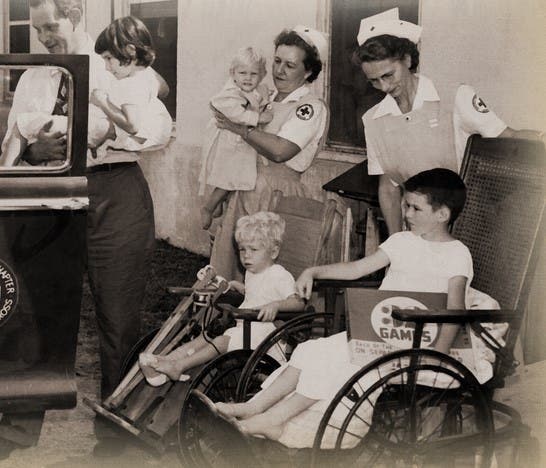
Grant was in and out of the hospital — he doesn’t even know how many times — as a child. He recalls staying in different wards, which were large rooms with 12 beds in a circle.
“The beds were set up like they were around a clock,” he said. “It helped nurses deal with us at once. We did everything together. Therapy, games. So, we were a gang.”
Since it was funded by celebrities, stars would often show up for a visit.
“They’d tell us, ‘So and so is here, we need a picture. Who wants to go?’” he said. “Nobody ever wanted to go. I’d say, ‘Send the next guy.’’”
Among the celebrities he met were radio personalities Arthur Godfrey and Don McNeill, comic actress and singer Martha Raye, and the band the Vagabonds.
While the children in his wards were sick, they weren’t as ill as those that relied on the iron lungs, a negative-pressure ventilator that helped them breathe. The only identifying marker that Grant and his ward mates were unhealthy was their difficulty walking.
“We weren’t throwing up, bleeding, pus infected,” Grant said. “To look at us you’d never know there was anything wrong with us.”
Despite his illness, he remembers his time in the hospital with his friends fondly. His most prized possession was a multi-game board so they could play chess, checkers or numerous other games whenever they wanted. And they’d race their wheelchairs down the hallways and play out in the front yard on sunny days.
“We’d go out there and roll around the driveway in the sunshine, chasing the taxi cabs,” Grant said. “It was a strange life.”
The hospital would introduce different therapies to him and the other children. So little was known about polio that doctors were willing to try just about anything, he said. “The therapies sound kind of bizarre when you look at them now. Back then, they figured they’d give it a shot.”
Some days, hospital staff would have the kids soak in tubs of ice water.
“Then they’d take you out, bundle you up, dry you off and put you back in bed,” he said.
Another therapy involved a portable washing machine that was rolled from bed to bed to heat and soak blankets, he said. Then, staff would cover the young patients in layers of plastic and hot, wet blankets.
“That was in addition to the swimming pool therapy and manipulative therapy on a table,” Grant said. “They were doing all sorts of things hoping something would work.”
As experts worked to create a polio vaccine, he was also chosen to be part of the testing.
“I was one of Dr. Jonas Salk’s boys, his babies, his kids,” Grant said. “He was working on a cure for polio or at least a prevention, a shot like you get your flu shot. That’s to prevent you from getting the flu. Well, he wanted the same thing to prevent you from getting polio.”
Salk had children serving as control and test subjects for his vaccine throughout the country. The virologist wanted to see if the environment would affect it, Grant said. “Cold and rainy in Seattle. Hot and dry in Arizona. I was South Florida. Hot and moist.”
As one of the South Florida control subjects, he didn’t receive the shot, he said. “They wanted to see what I would do without it.”
Grant never got to meet Salk but appreciates being a part of history.
“And I never did get the shot,” he added. “I think, as it turned out, I made my own antibodies.”
The hospital stays stopped by the time he was about 11 or 12, he said. “I started walking again and transitioned back to society.”
Still, his illness followed him wherever he went. He studied alongside other children affected by polio at the Roosevelt School for Crippled Children in Miami, he said. “A lot of us died. Most everybody died. If Mary’s desk was empty, we knew where Mary was. My first girlfriend died, Nancy Bishop.”
Grant and the other students were used to the death surrounding them, he added. It was a way of life.
Often, their teachers would tell them, “’So-and-so died last night. Open your books to chapter five,’” he said. “And we just moved on.”
Today, as coronavirus continues to spread across the globe and new vaccines for the disease roll out, Grant, a funeral director living in Seminole, Florida, reflects on his youth.
When he first heard about the coronavirus appearing in China at the end of 2019, back when it was still considered an epidemic limited to a specific area, his first thought was, “I don’t care about something 7,000 miles away. That’s not gonna bother me.”
Then it spread into other Asian countries.
“I thought, ‘Uh oh,’ and then I heard the word ‘pandemic,’” he said. “I flashed back. Here we go again. I’ve been there, done that, don’t want to do it again.”
And Grant can’t help but make comparisons between the two global illnesses that have impacted his life so profoundly: COVID-19 and polio.
“It was a different time and a different disease,” he said. “When we had the (polio) virus, it was clearly visible. We had crutches, canes, braces, traps and even so far to have iron lungs. We were extremely visible. It caused many to be afraid of it. They didn’t know if we were contagious, but you could see us. You could have someone with COVID standing right next to you and you’d never know it.”
Those that test positive for COVID-19 are isolated, Grant said. It creates an “out of sight, out of mind sort of thing. Kids are out there having parties and not taking it seriously because they haven’t seen it. If someone has (coronavirus), they’re whisked away to a hospital where they die alone.”
He added, “It’s killing a lot of people and they still don’t take it seriously.”
With new vaccines on the market, though, he’s hopeful they will get the virus under control.
“A vaccine ended polio. That’s what’s gonna have to happen here,” Grant said. “The vaccine is going to have to end this because we’re not going to do it. If we could follow the rules, it would die a natural death, but we can’t.”
Get more local news delivered straight to your inbox. Sign up for free Patch newsletters and alerts.