Politics & Government
Miami-Dade Does Not Consider Itself 'Sanctuary City'
Possible designation of Miami-Dade County is under review by the Department of Justice.


MIAMI — President Donald Trump may have acted swiftly to target so-called sanctuary cities and jurisdictions, but Miami-Dade officials are worried that the county may be unfairly lumped in with cities that openly shield undocumented immigrants from prosecution.
The county appears on a map of sanctuary jurisdictions published by the Center for Immigration Studies, which has obtained some of its funding from the U.S. Census Bureau and the U.S. Justice Department and claims to be an independent, non-partisan, non-profit research organization.
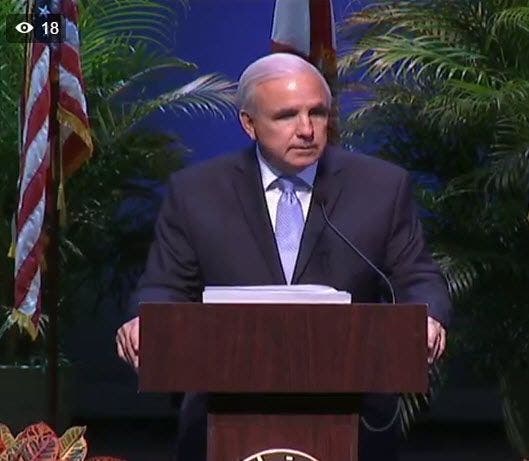
"I don’t believe we’re a sanctuary city," asserted Miami-Dade County Mayor Carlos A. Gimenez in a television interview. "And so, maybe it’s a question of definition. If that’s the case, then we need to get together with the federal government."
Find out what's happening in Miamifor free with the latest updates from Patch.
County spokesman Mike Hernandez took to Twitter on Wednesday evening to clarify the mayor's position.
"@MayorGimenez does not believe @MiamiDadeCounty is a sanctuary community," Hernandez tweeted. "We cooperate with the federal government on immigration matters."
Find out what's happening in Miamifor free with the latest updates from Patch.
He added that Miami-Dade's potential designation as a sanctuary community is under review by the U.S. Department of Justice. "We expect to hear back soon," according to Hernandez.
The reaction followed President Trump's signing of an executive order earlier Wednesday that will withhold federal funds from local jurisdictions that offer sanctuary to illegal immigrants. The president signed the executive order during a ceremony at the Department of Homeland Security.
Sanctuary cities and counties are called that because they offer sanctuary to illegal immigrants, refusing to turn them over to federal officials for deportation. Most sanctuary cities and counties have also passed laws preventing employees from even turning over information to immigration officials.
Miami-Dade County is among 10 jurisdictions that face a June 30 deadline to change their so-called sanctuary policy or risk having to return some $13 million in federal grant money, according to the Center for Immigration Studies, which lists the county on a map of sanctuary jurisdictions.
Inclusion on that map is based on a 2013 Miami-Dade resolution — R-1008-13 — that requires the federal government to agree in writing to reimburse the costs of honoring detainment orders in the case of undocumented immigrants. It also limits the county's compliance to only those inmates who have previous convictions for forcible felonies under Florida law or those inmate facing a pending charge on a non-bondable offense.
For the Center's purposes, it defines sanctuary jurisdictions as those cities, counties and states that have a law, ordinance, policy, practice, or rule that deliberately obstructs immigration enforcement, restricts interaction with federal immigration agencies or shields illegal aliens from detection.
The Miami-Dade resolution was based on a legal interpretation at the time that officials are not legally bound to comply with federal detainment requests.
When the resolution was passed, Miami-Dade officials maintained that blanket compliance with detainment requests could "undermine trust between local police officers and the immigrant community" and that compliance with such requests had already cost the county more than $1 million in 2011 and more than $600,000 in 2012.
Such claims were dismissed by the Center in a December 2016 report that recommended among other actions cutting federal funding for jurisdictions that refused to enforce federal detainment orders.
President Trump's executive order on Wednesday reinstated an Immigration and Customs Enforcement program known as Secure Communities, under which ICE would target undocumented immigrants.
The order also directed the State Department to take whatever steps necessary to make countries take undocumented immigrants back — including withholding visas to people from that country.
And, in the case of jurisdictions like Miami-Dade County, it directed that federal funds be withheld from cities and counties that don't cooperate with immigration officials.
The order didn't specify which funds would be withheld, saying only that federal funds would be withheld unless required by law for law enforcement purposes.
Sources said that the most likely funding target would be the various grants given to local governments through the Justice Department and the Department of Homeland Security. Both agencies administer billions in grant money.
Such grants include Homeland Security's Urban Area Security Initiative that helps cities prepare for acts of terrorism and the Edward Byrne Grant Program that was named for a New York City police officer killed in the line of duty. The latter provides funding for a range of programs, including crime victim assistance, drug patrols and drug treatment.
Photo of Miami-Dade County Mayor Carlos Gimenez courtesy of Miami-Dade County.
Get more local news delivered straight to your inbox. Sign up for free Patch newsletters and alerts.