Politics & Government
Fidel Castro Dead at 90; Miami Erupts in Spontaneous Celebrations
The streets of Miami erupted in celebration the day Raul Castro announced the death of his brother on state television. (PHOTOS and VIDEOS)


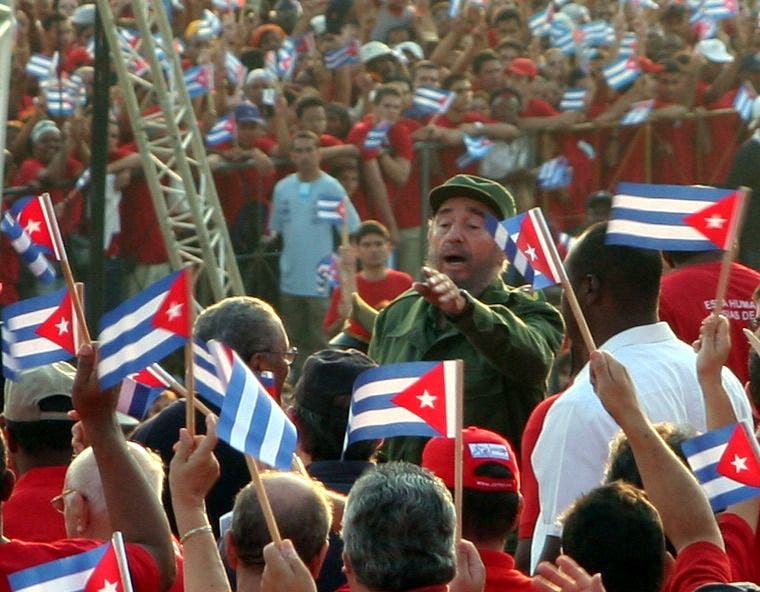
MIAMI, FL — Spontaneous celebrations broke out throughout the Little Havana section of the city and in the homes of Cuban-Americans here as news of the death of former Cuban President Fidel Castro began spreading around 1 a.m. on Saturday morning.
Castro's brother, Raul, addressed the Cuban people on Friday night in Spanish to inform them of Fidel Castro's passing at 10:29 p.m. local Cuban time. The news rapidly traveled the 330 miles or so from the shores of Cuba to the shores of Miami.
Castro was one of the most hated figures among Cuban-Americans, particularly in and around the city of Miami, which is home to a large community of exiled Cubans.
Find out what's happening in Miamifor free with the latest updates from Patch.
Many came to the United States on small boats to escape Castro's oppressive Communist government, and they longed for the day when the sun would set on his regime.
As news of Castro's passing began to spread throughout the Miami area, hundreds — perhaps thousands — of people spontaneously spilled onto the streets of Calle Ocho in Little Havana and nearby Hialeah in what had the look and feel of New Year's Eve. Some people blew whistles. Others honked car horns, popped open champagne bottles and banged pots and pans.
Find out what's happening in Miamifor free with the latest updates from Patch.
They quite literally danced in the streets throughout the night.
Miami police blocked traffic and allowed the celebration to continue through the early morning hours as people shared stories of hope and of the generations that came before them.
Congresswoman Lleana Ros-Lehtinen, who represents Miami's 27th Congressional District, said she hoped Castro's death will serve as a "new beginning" for the island nation and its people.
"One tyrant is gone but another tyrant remains," she said, referring to Castro's brother, Raul, who now serves as president. "The Cuban people have been shortchanged for too long to continue down this horrid path."
As is the case with many Americans with ties to Cuba, Ros-Lehtinen arrived in the United States when she was just 8.
"When I heard the news a few hours ago, I thought of my father, and I thought of all those generations that have come and gone," she said on local television shortly before 3 a.m. "What we’re celebrating is the opportunity of a new beginning, the hope of a new dawn for the people of Cuba."
"My family has waited for this day I think since they arrived in this country in 1962," one man told Local 10 News. "I'm here for those who were not able to see this day happen."
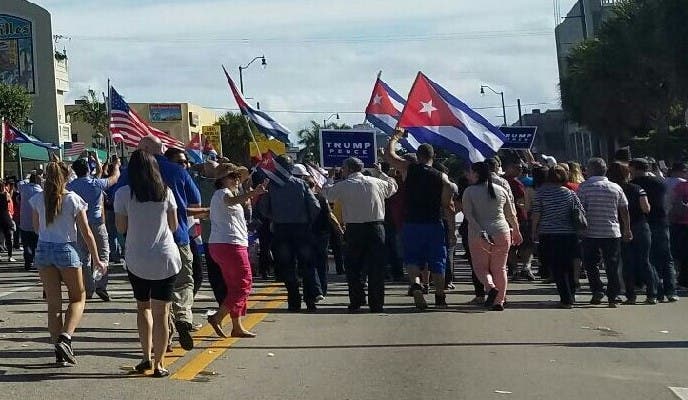
Revelers take to the streets of Miami's Little Havana following the death of Fidel Castro.
Photo courtesy of Miami Police Department.
Miami-Dade Mayor Carlos A. Giménez, who came to America when he was just 6 years old, said one of the first calls he made was to his 94-year-old father, who suffered personally under Castro.
"I can still see the pain in my father's eyes. Hopefully this will help alleviate it a little bit and hopefully the end of the Castros will come sooner rather than later," he said on local television, pointing to the human rights violations that have taken place under Fidel Castro's rule. "How many thousands of others died in the Florida Straits trying to escape his tyranny? His hands — his whole body — is drenched in blood just for him to maintain power."
Giménez said that Cuban people lived in constant fear under Castro.
"He patterned himself after Hitler in the way the state was set up. You had citizens spying on each other," the mayor explained. "You wouldn’t know who you’d be able to speak your mind to."
"Let's make sure we demonstrate and show our feelings," added Hialeah Mayor Carlos Hernandez in another television interview. "It's a great day for Cubans here, Cuban-Americans."
Miami Mayor Tomas Regalado said the streets will remain closed around Little Havana as long as the celebration continues.
"It’s the meeting place of the Cuban exiles, and it has been historically the place to protest. But tonight it’s a celebration," he told a television news crew. “We’re planning to keep the street closed at least through Saturday if the people keep coming — and they will."
Regalado, who came to the United States in a 1961 airlift out of Cuba, said he too is celebrating with other Miamians. He was particularly pleased to see so many young people in the crowd.
"We are not celebrating the death of a human being. We’re celebrating the death of a dictator," he explained. "People have the right to celebrate. I know people may think that this is rude . . . . The fact of the matter is that this man really hurt millions of people inside and out of Cuba. For me, it’s a good day."
Florida Gov. Rick Scott spoke with President-elect Donald Trump on Saturday morning and offered his help "in any way to support a pro-democracy movement" in Cuba following the death of Castro.
"After decades of oppression, the Cuban people deserve freedom, peace and democracy," Scott said. "I have met so many Cubans who have come to Florida to flee the tyranny, brutality, and communism of the Castro brothers’ oppressive regime and now is the time to look at policy changes that will demand democracy in Cuba.
"Today’s news should usher in an era of freedom, peace and human dignity for everyone in Cuba and the state of Florida stands ready to assist in that mission."
Florida's two U.S. senators also weighed in on Saturday from differing sides of the political spectrum.
U.S. Sen. Marco Rubio, a Republican, remembered Castro as an "evil, murderous, dictator, who inflicted misery and suffering on his own people," while Sen. Bill Nelson, a Democrat, urged the coming Trump administration to continue along the path started by President Obama, though he didn't mention the president by name.
"Now that Fidel is gone, the U.S. should continue to press hard against his brother, Raul, and continue to take steps to support the Cuban people until he provides basic rights and freedoms to all people of Cuba," Nelson said. "In the meantime, the new Trump administration should continue the policy of opening travel and communication with Cuba."
While anti-Castro sentiment runs high in Florida, a recent study by Florida International University found that a majority of Cuban-Americans in Miami-Dade County opposed the continuation of the decades-long embargo of Cuba.
A majority of respondents also favored increasing economic relations with Cuba and lifting travel restrictions.
Some people took to Twitter to voice their feelings about the death of Fidel Castro:
I don’t really ask for much, but I wanted to be in Chicago when the Cubs won the World Series (X) and Miami when Castro died.
— Dieter Kurtenbach (@dkurtenbach) November 26, 2016
Fidel Castro died and Miami is going to have the biggest party ever recorded
— CO Baevid (@DavidThaGoat) November 26, 2016
Fidel Castro is dead and Miami is going crazy, Little Havana is lit! My mother fled Cuba because of him... Cubans take the W tonight
— Nacho (@OneCheesyMofo) November 26, 2016
Fidel Castro died and Miami is partying in the streets setting off fireworks I love the world sometimes
— fiend queen✨ (@YeahIBeTaylor) November 26, 2016
At long last Fidel Castro is dead! Hope he is rotting in hell. The celebration in Miami is going to be huge #CastroIsDeadParty
— David (@D_Lo96) November 26, 2016
No one sleeping in little Havana tonight #miami pic.twitter.com/9oFWWg7Boi
— Laura Juncadella (@laujunca) November 26, 2016
Celebrations continue in front of @VersaillesMiami. SW 8th Street between 34th and 37th Avenues closed to traffic. #CubaSinFidel pic.twitter.com/gsLAOUFRfq
— City of Miami (@CityofMiami) November 26, 2016
Below are some scenes from the streets of Miami of the celebrations:
Photo by Vandrad at the German language Wikipedia.
Get more local news delivered straight to your inbox. Sign up for free Patch newsletters and alerts.