Neighbor News
The Bushmen Don't Want Your Shit: An American in Africa Reflects Upon the Culture of Accumulation
Erin Smith Aebel, partner at Tampa law firm, Shumaker, Loop & Kendrick, LLP, recounts her experience visiting the Bushmen in Namibia.

I’m not exactly an ascetic. I have a personal shopper and make-up artist, I get my hair and nails done every week, and my favorite uniform is a dress and heels.
I am a business lawyer who works in a large urban law firm. My work requires me to network and to keep track of business developments and new regulations. I also have to be constantly connected. I joke that my iPhone is an additional organ of my body.
But I am eternally curious. I am fascinated by other cultures and what they can teach me. So, when my family wanted to go on an African safari to see the wildlife I signed up with ulterior motives. I wanted to meet and study people.
Find out what's happening in New Tampafor free with the latest updates from Patch.
I chose Namibia because it is a relatively safe country in a continent that has its share of political strife and disease. Namibia is a developing country with more than 25% of the population living in poverty and more than 13% of the population HIV positive, it is situated at the bottom left of the African continent and is slightly larger than the State of Texas. Its population is 2 million.
While I was excited to see a culture so different than my own, I admittedly felt self-conscious about how I might be perceived. I was concerned about the disparity between my material wealth and their lack of “things”. I was feeling sorry for people I had not yet met.
Find out what's happening in New Tampafor free with the latest updates from Patch.
After 21 collective vaccinations, my husband, two children and I took three planes across two continents and landed in Windhoek, Namibia’s quaint European capital city. After a few days of recuperation, we travelled into more remote parts of Namibia, which eventually lead us to the Bushmen or San people.
“Bushmen” is a term applied by Western colonialists to describe the indigenous hunters and gatherers of Southern Africa. While less recognized in the West, “San” is considered a less pejorative term than Bushmen and will used in the remainder of this article.
In order to get to the San I had to face some fears--including managing the lack of toilets for 8 or more hours at a time and flying with my precious children in a tiny third world airplane. Namibia has few paved roads so this is the only means of travel that makes sense.
After landing our tiny plane in a grass field, we got into a land rover and drove several more hours into the bush on extremely bumpy and dusty roads. We finally hit our campsite.
We were on land that the country of Namibia documented as owned by the San. But from their perspective, it was always their land. The San have lived in Southern Africa for more than 20,000 years. They are one of the last hunter and gatherer cultures in the world.
They live the original lifestyle of humans on Earth. Consider rejecting thousands of years of human “development”. The current Namibian government recognizes the importance of their unique culture and takes measures to protect it.
Their only “modern” convenience was access to a clean water tank, which the San shared with the visitor’s camp where we were staying. They sleep in mud huts with no electricity. And the village was an extended family of over 100 people with men, women and children living in a collaborative and communal lifestyle.
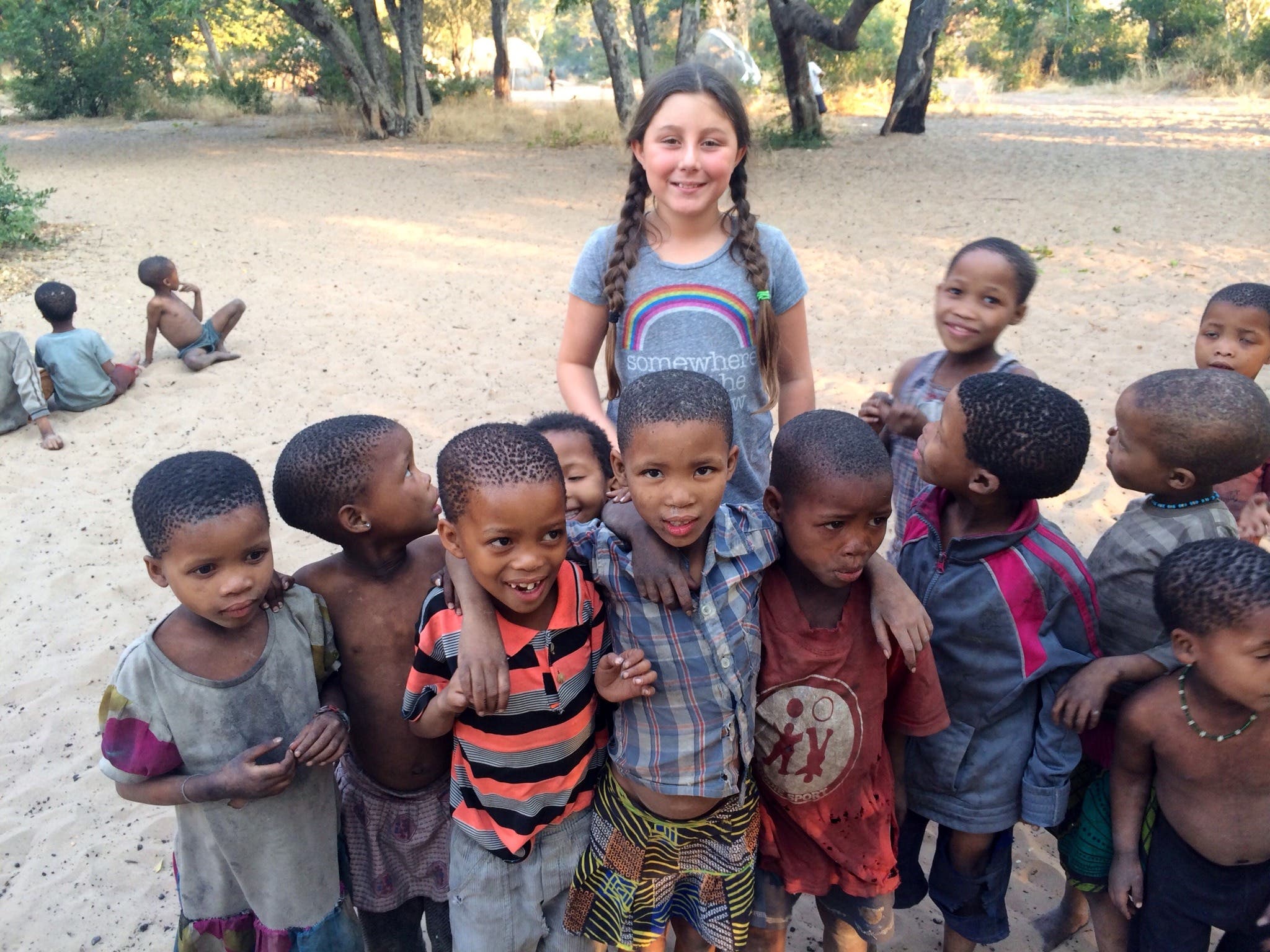
The San children immediately adopted my kids as playmates and taught them their games. There are no toys. But there are trees to climb and soft dirt to fall in. My kids got filthy. In America I would be mortified, but they were so happy to have the freedom to run around outside and get totally dirty that I let it go. The children at the camp I observed were very happy. No whining or tears. Their parents were nearby but I saw no helicopter parenting or scolding. The kids were left to be kids and played from sun up to sun down.
The next day we went hunting with the San. Our two male guides donned loin cloths, thin sandals, a bow and arrow and a long hook (for pulling critters out of holes). They passed over long distances of land while we trekked behind for four hours. They showed us where they find wild melon, nuts and water in a giant root. We learned how to make fire without matches and how they make bows and poison arrows for large animals. When they have meat they gorge themselves because they may not have meat again for weeks.
While all of this is totally fascinating, the thing that struck me the most was how happy and kind the San were to each other and their visitors. My husband asked one of the hunters through an interpreter what made him happy. The hunter was confused by this question. It seemed to us that he lived in a state of perpetual happiness punctuated by periods of hunger or illness.
There’s not much more in stark contrast to the American culture of accumulation than how the San live. I thought how sad it would be for the San to live in a concrete building, work and an office and buy their groceries at a store. And what would they do with all of the “things” we have. They feel they have everything they need to live.
Instead of feeling sorry for these people who lived in mud huts in the third world, I questioned my own western materialism and ideas of happiness. I imagined that the San were doing charity by teaching urbanized and materialistic Americans to live off of the land as hunters and gatherers with low environmental impact. They must feel sorry for me because I didn’t have the freedom to live on the land as they do.
Back in the U.S. I am working hard at my law practice, saving for my kids’ education, and going on the occasional shopping spree. But now I question the substance of my decisions. Even when I speak with my clients, I ask them “what do you really want?” Is it material wealth, a sense of justice, or to be left alone to live your life as you see fit?
It is easy to get caught up in the accumulation of things. I have seen first hand how materialism can become an unsatisfying burden. Particularly for lawyers whose financial success is measured in 10 minute increments. The San would find your things useless and cluttering.
When my life gets stressful I go back to those few days in the Bush. This tempers my decisions. My culture has not changed but my perspective and priorities have. I still enjoy the finer things a modern, urban life affords me but if my high heels hurt, I take them off. And when faced with a decision over purely material things I ask whether by having this “thing” can I share it with others and create more joy? I think about how completely silly the San would find me. Then, I brush it off like dust from the Bush and get back to work.
Erin Smith Aebel is board certified as a health law specialist by the Florida Bar. She represents physicians, hospitals and other healthcare providers in business law, including fraud and abuse, Stark, HIPAA and licensure issues arising from joint ventures, acquisitions and changes of ownership. Erin has also worked with diagnostic imaging centers, pharmacies, weight loss clinics, clinical laboratories and medical spas, among others.