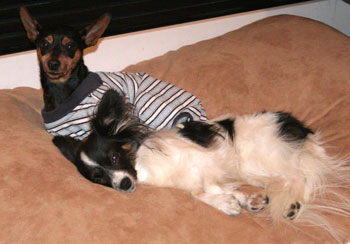
What comes to your mind when I say “small dog?” Do you envision a little dog sitting on your lap, doing cute tricks for her dinner, going places with you where large dogs are not allowed? Or do you think of a yappy, ankle-biting nuisance? People have their preferences in dogs, just as they do in homes and cars. Most small dog owners are totally infatuated with their tiny companions and cannot imagine how others live with their big, shaggy, drooling beasts. It’s a good thing there are dogs who meet the criteria for each of us.
A dog is classified as “small” if her weight falls under 20 pounds. One site lists as many as 90 different breeds categorized as small. The AKC has a Toy Group, but is quick to point out that small dogs also exist in other groups as well. Truly, size is the only common factor between all of these dogs as distinguishing characteristics are just as diverse for the little guys as it is for the big ones. There are, however, some common training principles which should be considered when working with our smaller companions.
House Training – The basic rule on how often to take a dog outside when house training her is 1 hour for every month of age plus one hour. For example, a four month old puppy should go out at least every 5 hours. This may be unreasonable for a small dog and she may need to go out more often. They have tiny bladders, but may still consume a great deal of water and food. If you work and cannot take the dog out often enough, consider hiring a dog walker or using piddle pads in an exercise pen. Expecting the puppy to hold indefinitely can cause health problems. Disappointment that she relieved herself before you could get her out can have a poor effect on your relationship, too. Please don’t buy into the old adage that small dogs cannot be house trained – they can be, but it will take some time and effort on your part.
Find out what's happening in New Tampafor free with the latest updates from Patch.
Loose Leash Walking – Many of the toy breeds are not equipped to take long distance walks with their owners, but they do need to go on walks. If you intend to put in some miles, take a small walk with the dog first, then take her home and give her a nice stuff Kong to work on as your head out to add some distance to your workout. When your dog is in the learning phase of walking politely on leash, reinforcement for staying by your side is necessary. Rather than breaking your back to lean down and deliver the treat by hand, use a long-handled wooden spoon with some peanut butter, squeeze cheese, or cream cheese on the bowl and drop the end down so the dog can have a quick, reinforcing lick of the spoon. A small dog bouncing everywhere on leash is a hazard as she can cause someone to trip and fall.
Exercise – As noted above, distance may not be a small dog’s friend, but that doesn’t mean she doesn’t need exercise! Small dogs excel in many sports – agility, rally, lure coursing, just to name a few. They can also be quick to figure out brain games, exercises in which the dog must figure out how to retrieve a toy or treat by manipulating a puzzle. All dogs need mental stimulation and exercising the mind is almost as exhausting for dogs as physical exercise!
Find out what's happening in New Tampafor free with the latest updates from Patch.
Behaviors – There are several that need to be addressed. Just because they are small, doesn’t mean certain behaviors are acceptable. Jumping up on a person is no more proper for little dogs than it is for big ones. Clothes can be ruined, skin can be broken. Teach “four on the floor” and a jump into arms on cue. Growling, biting, snapping – none should be condoned just because the dog will not inflict a wound as large as a 100 pound dog might. If the dog is doing this, it’s time to see a behavior consultant immediately. Remember, practice makes perfect, so end the behavior soon!
Fear in small dogs is understandable. Imagine being a small person in a land of giants. Worrying about being stepped on, gobbled up by larger beings – not exactly the stuff sweet dreams are made of. It is the responsibility of any owner to help her dog be confident. That means not cuddling the little dog just because a larger dog walks in. Work your small dog with larger dogs known to be calm and accepting. There may be times in public when a big dog poses a threat, but you should calmly pick up your little dog and walk away to a safe area. Please do not make a fuss – it may come across to your dog as validation that she does have something to fear.
None of us like to think of a time when our dog may have to be rehomed. If it were to ever happen, the chances of your dog finding a new family will be increased if she has good manners and is a pleasure to live with. Don’t let the size of your dog make you write off behavior. Training is mandatory for a great life in human society regardless of size!