Politics & Government
Amendment to Abolish Grants Rejected
A record crowd came to watch the charter review board consider abolishing grants and limits on petition drives.
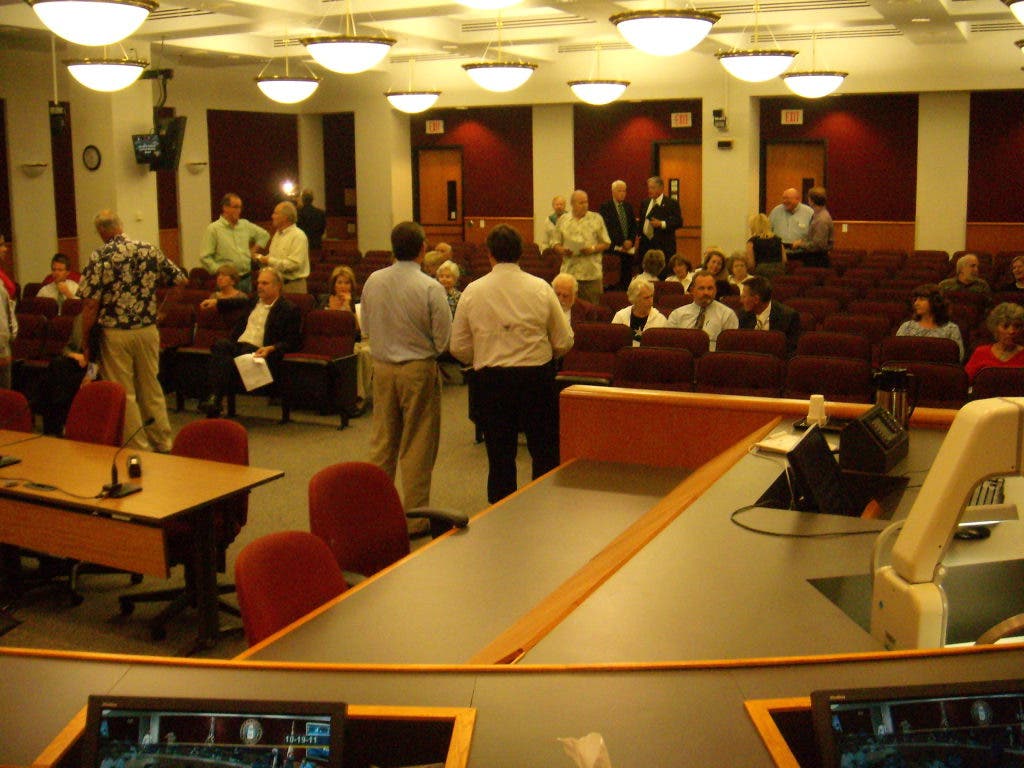

It was the largest crowd in 25 years at the Sarasota County Charter Review Board meeting Wednesday night. The crowd was there to address a charter change proposal to abolish the county’s ability to grant money to nonprofit organizations.
The change was promoted by Kathy Bolam, who has campaigned for several months to end county support for . Her campaign culminated Wednesday night when the idea failed by a vote of 5-2.
After the vote, Bolam said she would begin a petition drive to use the referendum provision of the county charter to put the ban in place.
Find out what's happening in Sarasotafor free with the latest updates from Patch.
She will need 13,219 valid signatures on petitions. And she’d better hurry, because the charter board is considering changing the petition process, too.
Bolam has expressed outraged by the roughly $9 million the county spends annually for a variety of health and human service contracts awarded to nonprofits.
Find out what's happening in Sarasotafor free with the latest updates from Patch.
“The current commissioners are not interested in a restriction on their ability to dispense our tax dollars,” she told the committee. “Spending in our country is out of control.”
She asked those in the audience who agreed to stand, and approximately 30 people rose. She was responding to a gesture by opponents.
Benny Weaver, vice chair of the Community Alliance of Sarasota County representing 56 nonprofits had earlier asked opponents in the audience to stand, and about 25 did.
Twenty of the 67 counties in Florida have home-rule charters, which is like a local Constitution. The other counties are governed solely by state law.
Sarasota is the only charter county with a permanent charter review board, meeting as it wishes. Its members are selected in partisan elections. All the current members are Republicans.
At times, the meeting took on the tone of a debate between tax-and-spend conscious conservatives and the already-in-office conservatives.
Meanwhile the people who deal daily with the homeless, the mentally ill, the homebound elderly, addiction recovery and other recipients of county money – tried to make their plea to keep the grants in place.
Frank Escobar is president of the of Sarasota, serving more than 700 clients. “Our budget works out to $1 per day per client. Who else can do it for a dollar-a-day?” he asked. “You will hurt those people most in need in Sarasota.”
Attorney Dan Bailey was the first to speak. He drew a clear distinction on what the amendment would do. “This amendment would allow the county to contract only with for-profit agencies,” he said.
The discussion delved deep into the purpose and function of government. “Philanthropy is not a role of government,” said Rich Swier, a conservative blogger. “It’s spending public money on charity.”
His vision sharply contrasted with former Sarasota mayor Molly Cardamone. “The role of government at all levels is the health, safety and welfare of its citizens,” she said. “I don’t consider as a charity.” She is a member of the organization’s board, which helps people fight addictions.
The county is obligated under state law to provide some social services. Decades ago it had a welfare department. But the county found it cheaper – considering payroll, benefits and retirement costs – to contract those services to nonprofits.
Erin McCloud with the said there are 10,000 visits annually to their health clinic, staffed with 100 volunteer professionals. “And in our nutrition program, we provided 125,000 meals to homebound and hungry seniors,” she said.
Several speakers, including former Sarasota police chief Peter Abbott, said the grants save money by keeping people out of the criminal justice system. “We were looking at $55 million for a new jail,” he said. “We were arresting 2,500 people a year downtown for quality-of-life violations. With these programs, we’re making 600 arrests. That saves a great deal of money. Don’t tie your hands. You can do the practical thing, or you can do the right thing.”
On and on it went for more than two hours. Pro and con, back and forth. And in the end, the board refused by a 2-5 vote to move the proposal forward. Bolam’s next step is a petition drive.
Charter Board Chair Cathy Layton said, before the vote, “The Charter Review Board is not a dumping ground for philosophical discussions.”
Petition Process Questioned
With the Bolam Amendment out of the way, the board went on to consider other proposed charter amendments. One was kicked back to committee because of timing issues. The charter now requires an election within 60 days after a successful petition drive.
More Than a Majority?
Of more significance is a proposal to require any charter amendment to achieve a 60 percent approval at the polls for success. This, too, took public heat and support. Eric Robinson, former chair of the county Republican Party, urged approval. He cited “the whimsical nature of special interest groups putting things in the charter.”
That immediately drew the ire of the Bolam Amendment supporters, as well as opposition from Rich Swier. ”Should we elect people with 60 percent? If you raise the bar, you harm the ability of people to change their charter,” he said.
Cynthia Crowe said, “This proposal is outrageous. It’s a way to stifle the voices of the people.” But others, including Bruce Dillon, said the U.S. Constitution could not be changed by a simple majority. “It should be tough to change the charter,” he said.
The charter board, in the end, voted 5-3 to send the idea of a 60-percent victory margin for a charter change referendum to a study committee. The meeting was nearly over. Only open-to-the-public remained.
An Inconvenient Truth?
Rich Swier then stepped forward to propose a charter change to abolish all county ordinances linked to sustainability and global warming. “This would save the county tens of millions of dollars,” he said. “We have policies based on bogus and fraudulent science. We need to start at a lower level to rescind them.”
Based on the charter board’s arcane and self-imposed rules, Swier will return on January 18 in Venice with 20 minutes to promote his charter/climate change proposal.