Community Corner
Rescued Pygmy Whales Remain In Critical Condition
Two rare pygmy killer whales rescued Wednesday, Aug. 29, are receiving 24-hour critical care at Mote Marine Laboratory in Sarasota.


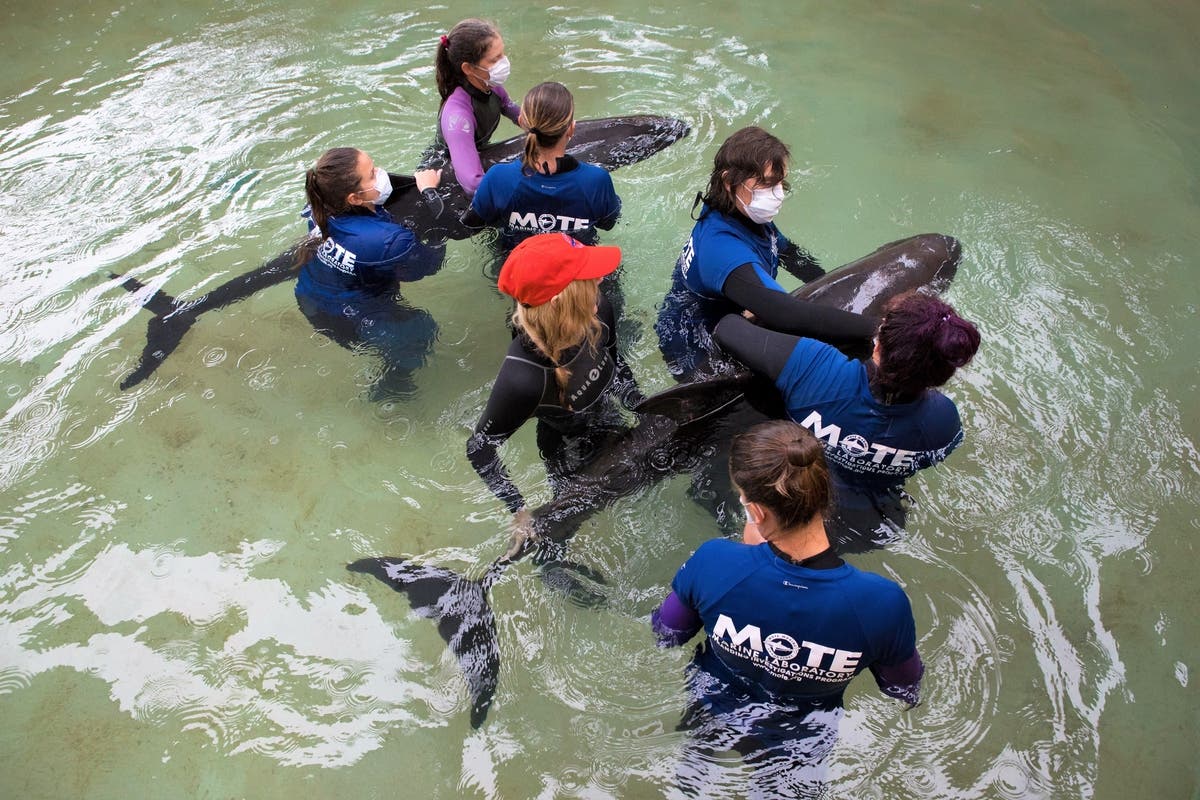

SARASOTA, FL -- Two rare pygmy killer whales rescued Wednesday, Aug. 29, are receiving 24-hour critical care at Mote Marine Laboratory in Sarasota.
The whale were found stranded on the beach in the 1500 block of Gulf Boulevard in Sand Key. Clearwater firefighters and staff at the Clearwater Marine Aquarium rushed to stabilize the whales until they could be transferred to Mote (see related story).
The whales — nicknamed “Thunder” and “Lightning” because they arrived at Mote during an afternoon thunderstorm on Aug. 29 — remain in critical condition as of Thursday, Aug. 30.
Find out what's happening in Sarasotafor free with the latest updates from Patch.
Thunder has been able to swim unaided for stretches of time, while Lightning frequently needs to be supported by caregivers in the water. The whales have shown some interaction with each other — positive signs for this social species — but at this early stage, their prognosis is unclear and can change at any time.
Why the whales stranded is unknown.
Find out what's happening in Sarasotafor free with the latest updates from Patch.
“Pygmy killer whales are offshore, deep-water animals that are rarely observed and little understood. I they are sighted around the coast, they are generally in trouble,” said Gretchen Lovewell, manager of Mote’s Stranding Investigations Program.
Thunder and Lightning were rescued from the beach and transported to Mote by rescuers from Clearwater Marine Aquarium,
Part of the National Marine Mammal Stranding Network, Mote’s Stranding Investigations Program provides rapid response 24-7 to reports of stranded marine mammals and sea turtles in Sarasota and Manatee counties and assists in other areas as needed by the network, rescuing animals found alive and recovering those found deceased to conduct thorough necropsies designed to advance knowledge and conservation of their species.
Jane's Refuge: The Hospital for Dolphins and Whales at Mote Marine Laboratory is dedicated to providing care to stranded dolphins and small whales with the goal of returning these animals to the wild and gathering knowledge to benefit their species in the process.
In their medical pool at Mote, Thunder and Lightning are receiving constant monitoring and care, physical support from caregivers as needed, fluid therapy and diagnostic tests to guide their treatment.
“So far we are providing antibiotics, fluids and treatment for parasites, and we’re testing for other concerns that might affect this offshore species,” Lovewell said.
A bloom of Florida red tide algae (Karenia brevis) continues along southwest Florida, but so far the whales have shown no behavioral signs of exposure to red tide neurotoxins.
“We will take blood samples and, if possible, fecal samples to send to a lab that will test for red tide toxin exposure," Lovewell said. "The results will likely take weeks, as samples are being tested from many animals in many areas now."
The pygmy killer whale is a small member of the oceanic dolphin family. They are often confused with false killer whales and melon-headed whales. This species is found primarily in deep waters throughout tropical and subtropical areas of the world. Until a live animal was discovered in 1954, pygmy killer whales were known only from two fossil skulls for over a century. Not much is known about them and they are considered naturally rare.
This month, Lovewell and colleagues in Mote’s Stranding Investigations Program have recovered an unusually high numbers of deceased animals with suspected or confirmed red tide exposure.
“It’s been a herculean task for our small staff and trained volunteers — responding to several times our usual number of calls and conducting recoveries and necropsies continually, while simultaneously working with our hospital on 24-hour critical care for Thunder and Lightning, which will continue for the duration of their stay,” said Mote President and CEO Dr. Michael P. Crosby.
Critical care for just one whale costs thousands of dollars per day — and Mote is caring for two. At the same time, the Lab as a whole is responding to multiple ecological emergencies: the long-lasting red tide bloom along southwest Florida requiring intensive monitoring, research and outreach; the related spike in wildlife mortality that demands attention at virtually all hours; and a record outbreak of coral disease in the Florida Keys requiring unprecedented, scientific response.
While emergency government aid is helping with parts of the response efforts, it cannot close the gap facing Mote as a nonprofit. Anyone wishing to donate can click here.
Credit: Conor Goulding/Mote Marine Laboratory
Mote staff and volunteers care for two pygmy killer whales found stranded in Clearwater Beach Wednesday.
(For more local news from Florida, click here to sign up for real-time news alerts and newsletters from Patch. If you have an iPhone, click here to get the free Patch iPhone app; download the free Patch Android app here.)
Get more local news delivered straight to your inbox. Sign up for free Patch newsletters and alerts.