Community Corner
Spotted Eagle Rays Under Study In Gulf Of Mexico
Mote Marine Laboratory released two acoustic tagged spotted eagle rays off Longboat Key Tuesday, adding to an ongoing research effort.


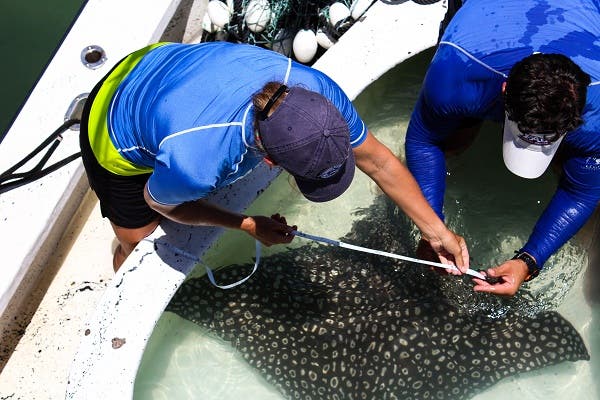
Sarasota, FL — The scientists at Mote Marine Laboratory are hoping an ongoing study will help them learn a lot more about one of the more unusual critters that call the Gulf of Mexico home.
To that end, Mote scientists fitted two spotted eagle rays with acoustic tags and released them off Longboat Key Tuesday. The tags are hoped to provide information about the creatures’ life history, population status and reproduction. The release is part of the “first-ever comprehensive spotted eagle ray conservation project in the Gulf of Mexico,” Mote explained in a media release.
Spotted eagle rays are found naturally in Florida and are considered protected in the state’s waters, the Florida Fish and Wildlife Conservation Commission said on its website.
Find out what's happening in Sarasotafor free with the latest updates from Patch.
“This is probably the easiest ray to identify,” the state said.
The creatures have a wingspan of up to about 10 feet and may weigh up to 500 pounds. Their maximum total length is about 17 feet from tip of the snout to the end of the tail, the state said. While considered a non-aggressive species, the state does warn that spotted eagle rays do have a defensive venomous barb at the base of their tail.
Find out what's happening in Sarasotafor free with the latest updates from Patch.
Mote’s spotted eagle ray research project began in 2009. Since it began, scientists have learned that waters around Sarasota are home to all sizes of spotted eagle rays from pups to adults. Some rays have been found to stay in the area while others migrate elsewhere and return after months or years, the release said.
“Mote scientists have also noted a declining then stabilizing trend in numbers of rays observed in aerial and boat surveys, which indicates a need for continued monitoring of this species’ status,” Mote noted.
While spotted eagle rays do enjoy protection from harvesting while swimming in Florida waters, they are not so lucky when they venture beyond the limits. The creatures are harvested in Mexico and Cuba as food, Mote's release said. That, combined with their “extremely” low rate of reproduction makes them a “vulnerable species."
At present, scientists do not have a lot of information about this species, including its distribution, feeding habits, growth rates, migration and reproductive biology. This is why Mote began the collaborative research project back in 2009.
Gathering information on spotted eagle rays is “crucial” because the creatures are a good indicator of the overall health of the ecosystem, Mote’s Kim Bassos-Hull, a senior biologist, said.
“Their primary diet is composed of mollusks (clams, oysters, snails etc.) and understanding how they impact this resource and their connection to other trophic levels such as predators is important for safeguarding the overall health of our oceans," she said. "Also, there are probable impacts from targeted fisheries in nearby countries such as Mexico and Cuba, where people consume spotted eagle rays, and understanding population structure is important to managing them in the region.”
Since its study began, Mote has tagged and released about 540 spotted eagle rays off Southwest Florida.
Other organizations involved in the study include the Georgia Aquarium, the University of Havana’s Center for Marine Research, the California Academy of Sciences, El Colegio de la Frontera Sur in Campeche, Mexico, and the University of South Florida Sarasota-Manatee. The National Aquarium in Baltimore, Disney Worldwide Conservation Fund and the Save Our Seas Foundation have also helped provide support for the project.
To find out more about Mote Marine Laboratory, visit it online.
Photo courtesy of Mote Marine Laboratory
Get more local news delivered straight to your inbox. Sign up for free Patch newsletters and alerts.