Community Corner
Unlikely Duo Meets Online, Travels To Poland To Help Ukrainian Refugees
"It might not make sense, but it's working," a Sarasota woman's newfound friend said after the two met in Poland for the first time.


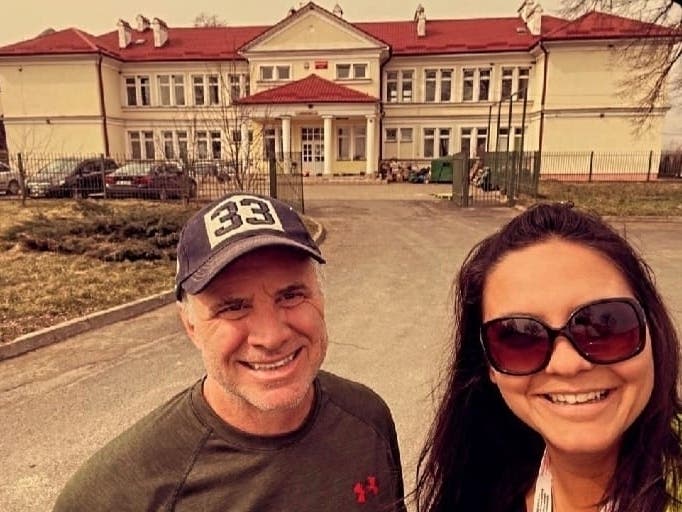
SARASOTA, FL — Since war broke out in Ukraine more than a month ago, Adelia Moyano has been distraught over the news she reads daily about Russia’s invasion of the country.
Though the Brazilian immigrant, who now calls Sarasota home, doesn’t have any ties to Ukraine or Eastern Europe, the violence “touched me deeply,” she told Patch. “I couldn’t sleep. It really affected me a lot. I kept thinking, ‘I really wish I could do more.’”
While she could donate money to aid organizations and other groups assisting Ukrainian refugees, she couldn’t shake the thought that she should do something more hands-on during the humanitarian crisis. These thoughts became more pervasive after she saw a news segment about an American man who flew to the Poland-Ukraine border to help.
Find out what's happening in Sarasotafor free with the latest updates from Patch.
“He didn’t speak Russian. He didn’t speak Polish, Ukrainian, nothing,” Moyano said. “But he didn’t let that stop him.”
She joined a Facebook group of volunteers helping Ukrainian refugees both at the country’s border and by donating money to the cause and posted about wanting to travel to Poland to help in person.
Find out what's happening in Sarasotafor free with the latest updates from Patch.
“Within a matter of 30 seconds, this guy, Bill, posted the same thing. It was 2 a.m. on a Tuesday and nobody else is awake, but we posted the exact same thing,” she said.
“She thinks it’s fate. I think it just happened and here we are,” Bill Kelleher told Patch.
Closely following the news since the invasion began, he was also horrified by what was happening in Ukraine.
“This is a horrific situation. Millions of people are being bombed out of their homes, bombed out of their country. They have nowhere to go and now they’re crossing the border,” Kelleher said.
He and Moyano chatted online a bit before getting on the phone early the next morning. It didn’t take long for the two to come to the same conclusion — they should go to Poland together.
The pair couldn’t be more different, she said. “I’m single in Florida. He’s this 60-year-old grandpa, who’s married, across the country.”
Kelleher, who splits his time between Arizona and the Chicago area, said, “Out of the entire universe how is it that this woman from Brazil who’s 36 is running around Poland with this 61-year-old guy from Chicago?”
Getting to work
The pair flew into Krakow on Saturday afternoon, meeting for the first time, and have been doing anything they can to help refugees and aid organizations ever since.
“It might not make sense, but it’s working,” he said. “We know it’s working. We see the impact we’re making.”
Both are driving rental cars along the border, traveling the length of the country, day in and day out, as Ukrainian refugees continue to flood Poland. They’re not affiliated with any specific organization, though they’ve been vetted by the Polish military. Instead, they help wherever they can, moving from one aid group or refugee camp to the next.
“We’re in it to win it, helping out any way and every way we can,” Kelleher said.
The only thing they know with certainty each day is that somebody, somewhere will give them a task, often many tasks. Sometimes, they split up and work alone, while on other occasions they tackle jobs together.
“All day, every day with needs, needs, needs, needs, which is why I’m here,” Moyano said.
Neither has a background in humanitarian aid. She worked for corporate America and is in between jobs. He’s a high-net-worth investment adviser. Even while he’s in Poland, he continues to work with his clients in the evening, when it’s daytime in the U.S.
“I have no skills for this at all,” Moyano said. “I’m not special. I don’t speak Polish. I have no heritage in Europe at all. I know nobody here. I have no relationship with Ukraine. I’m just a regular person who saw how badly this help is needed here right now.”
Their tasks vary, she said. Sometimes, Moyano picks up refugees once they’ve crossed the border to bring them to short-term housing. Sometimes they’re asked to pick up much-needed groceries and other items that will eventually be driven into the war-torn country or run other errands.
“We’re available for anything that needs to be done,” she said.
A network of volunteers
They’re both amazed by the army of volunteers keeping the millions of Ukrainians crossing the border — mostly women and children — safe and comfortable while the war continues in their homeland.
Volunteers arrive from all over the world, daily. Most are from Europe, Poland in particular, Moyano said.
“The Polish people have been amazing,” she said. “If there weren’t volunteers here, you would see 2 million people dead on the border right now. They provide them food. They provide them shelter. Many of these (refugees) have walked the entire way. I’ve heard of families that haven’t eaten in seven days. Yesterday, I saw 25 orphans arrive to a shelter. It’s horrific, really horrific. And they really, really need help.”
Kelleher called Poland’s volunteers bringing aid to these displaced people “absolutely amazing.”
“As far as I know, the whole country is pitching in and helping Ukraine,” he said.
Long-term housing plans
With no end to the war in sight, they’re also thinking about long-term housing solutions for the refugees. Many of the makeshift shelters — located in spaces such as converted gyms, grocery stores, train stations and schools — only offer them a place to stay temporarily, anywhere from two to five nights, he said. “They’re constantly rotating people in and out.”
Moyano added, “They have to open the beds quickly to others who have just arrived. And they need money to rent places for longer stays. It’s very costly.”
She and Kelleher are raising money through GoFundMe with the goal of helping some refugees pay for longer-term housing. The funds will also be used for food and other supplies for both refugees and those still in Ukraine.
“We thought there was maybe a way we could provide some kind of help to Ukrainian mothers and children for a more long-term, stable environment,” he said.
Most refugees want to stay in Poland, as close to the border as possible, she said. “They don’t want to leave. We all hope the war will end soon and they can go home.”
Beyond helping to pay for rent, they’re trying to come up with creative housing solutions as well.
Kelleher is a member of Love Home Swap, a global home swap organization.
“It’s a real community,” he said. “We let people stay at our properties and we stay at theirs. We’ve created a lot of friendships doing this. I thought maybe there was a way to tap into that for these refugees and we could find people who want to help but are not sure how besides writing a check.”
He learned that many homeowners in neighboring countries who participate in Love Home Swap were already housing refugees, but some weren’t, and he slowly began making connections where he could.
They both plan to stay in Poland for about a month and will continue to help any organization or camp they can while also contemplating how to provide longer-term housing.
“We want to uplift them at a time these families need it the most and show them that they’re not alone,” said Moyano. “The world is behind Ukraine. The world wants to help. And we’re just doing our part.”
Get more local news delivered straight to your inbox. Sign up for free Patch newsletters and alerts.