Community Corner
1st Black Man Lynched In Tampa Remembered With Historical Marker
Tampa's mayor said the marker in memory of lynching victim Robert Johnson is a reminder of where society has been and how far it has to go.


TAMPA, FL — A Black man proven innocent of a rape charge, but nonetheless snatched from a jail cell and lynched by white vigilantes, is now honored with a historical marker in Tampa. Nearly 90 years after Robert Johnson died, his fate has been publicly acknowledged.
The Tampa-Hillsborough County Equal Justice Initiative hopes the historic marker will ensure that the injustice that took place 86 years ago in Tampa is never forgotten.
Tampa Mayor Jane Castor, state Rep. Diane Hart, D-Tampa, Tampa City Council member Luis Viera joined members of the initiative in unveiling the marker at Doyle Carlton Drive and West Laurel Street on the Tampa Riverwalk to remember Johnson, the first Black man lynched in the city of Tampa.
Find out what's happening in Tampafor free with the latest updates from Patch.
The Lynching Of Robert Johnson
On Jan. 28, 1934, at the height of the Jim Crow era, 40-year-old Johnson was wrongly arrested for raping a white woman in the Belmont Heights area.
According to 1934 newspaper accounts, although Johnson was quickly cleared of any involvement, the police did not release him. Instead, he was accused of stealing chickens, and remained in jail.
Find out what's happening in Tampafor free with the latest updates from Patch.
Two days later, on Jan. 30 at 2:35 a.m., Tampa police Deputy Constable Thomas Graves placed Johnson in the front seat of his police car to transfer him from the Tampa city jail to the Hillsborough County jail.
Although transfers didn't normally take place during the early-morning hours, Graves said he chose that time so he could "finish a day's work and sleep late in the morning," according to a Jan. 31, 1934, article in the Tampa Daily Tribune.
The Tribune said Graves was driving down a deserted street in downtown Tampa when three cars appeared.
"At first I thought it was a traffic jam and tried to drive out of it," Graves later testified before a grand jury. "By this time, there was a car on either side of me, and before I realized what was happening a man got out of either car, jumped on the running board of my car, and threw open the front doors at the same time. The man at my left caught me by the mouth and whirled me over the back seat of my car. This man and the other one then got in the back seat and forced me down on the floorboard, one holding his foot on my neck."
Graves said his assailants took his gun and forced him to remain on the floor of his police car as one of the men drove the car to a location 20 minutes away. There, they ordered Graves out of the car and the kidnappers drove on to a wooded location off Sligh Avenue near the Hillsborough River, where Johnson was shot four times in the head and once in the body.
Founder and executive director of the nonprofit Montgomery, Alabama-based Equal Justice Initiative, Bryan Stevenson, did extensive historical research on the atrocities of the Jim Crow era while writing his best-selling book, "Just Mercy: A Story of Justice and Redemption," soon to be a feature film.
Started in 2018, the Equal Justice Initiative is dedicated to creating new spaces, markers and memorials that address the legacy of slavery, lynching and racial segregation.
Stevenson said lynchings didn't necessarily mean the victim died by hanging.
According to James E. Butler, who wrote "Lynch Law: An Investigation into the History of Lynching in the United States" in 1905, one of the first academic studies on the subject, an extralegal murder committed by any means constitutes a lynching.
He said the events related by Graves were common during the lynchings of that era.
"During this era of racial terror, in which lynchings of Black people were frequent and largely unpunished, it was not uncommon for lynch mobs to seize their victims from jails, prisons, courtrooms or out of police hands," Stevenson said. "Though they were armed and charged with protecting the men and women in their custody, police almost never used force to resist white lynch mobs intent on killing Black people. In some cases, police officials were even found to be complicit or active participants in lynchings."
The headline in the Tampa Morning Tribune on Jan. 31, 1934, read "Gang Kills Negro After Taking Him From Officer."
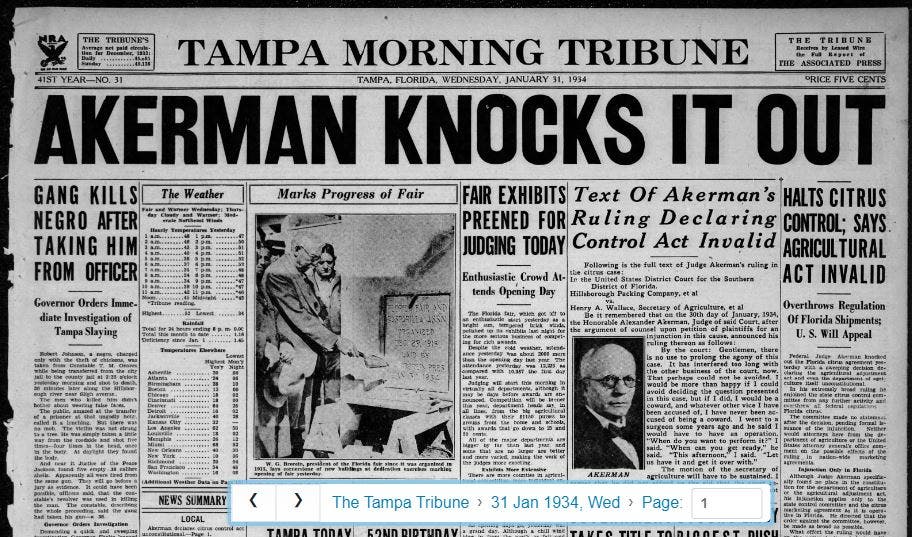
The article described in detail the events leading up to Johnson's death.
"Robert Johnson, a negro, charged only with the theft of chickens, was taken from Constable T.M. Graves while being transferred from the city jail to the county jail at 2:35 o'clock yesterday morning and shot to death 30 minutes later along the Hillsborough River near Sligh Avenue.
The men who killed him didn't bother about wearing false faces.
The public, amazed at the transfer of a prisoner at that ungodly hour, called it a lynching. But there was no mob. The victim was not strung to a tree. He was simply taken a little way from the roadside and shot five times — four in the head, once in the body. At daylight they found the body and near it Justice of the Peace Jackson found five empty .38 calibre shells. Apparently all were fired from the same gun. They will go before a jury as evidence. It could have been possible, officers said, that the constable's revolver was used in killing the man. The constable, describing the whole proceeding, said the gang had taken the gun — a .38."
Graves said Johnson never begged for mercy or broke down, despite knowing the fate that awaited him.
"I heard (Johnson) say only one thing," Graves said. In response to one of his kidnappers saying, "You know you did it," Johnson replied, "Yes, white folks, but I am sorry."
According to the Tribune, "30 Tampa citizens had gathered to witness the victim's execution." After Johnson was fatally shot, the Tribune said all those involved piled into about 15 cars and took off, leaving Johnson's body behind.
In his testimony, Graves said he phoned the sheriff's office after the kidnappers released him. He then walked to the nearby home of a justice of the peace, and the two men searched for Johnson's body with flashlights, finally finding Johnson around daybreak.
Justice Left Unserved
Word quickly spread of what had taken place, prompting then-Florida Gov. David Sholtz to call for an investigation.
The Tribune said Scholtz sent a telegram to Hillsborough County Sheriff Will Spencer, saying, "I have just been informed of the lynching of Robert Johnson, negro, in your county today, but have no report from you. We do not condone the crime of lynching in Florida. I am holding you responsible for the immediate and diligent investigation of this crime to the end that those persons guilty of this murder shall be brought to speedy justice under the laws of this state."
Scholtz sent a similar telegram to Hillsborough County State Attorney Rex Farrior: "You are expected to use every agency and function of your office to detect and bring to speedy justice those guilty of the lynching which took place in your county today. I am wiring Sheriff Spencer along the same lines and expect sincere and earnest cooperation between you in the matter."
Farrior immediately sent the case to the grand jury, which was already in session, giving the jury the following instructions: "Lynching is as much a matter for investigation by the grand jury as murder and other capital crimes. We must not tolerate such a happening that spreads a blot on Tampa's history. We expect to dig to the bottom of it, and if the evidence is produced pointing to persons who had part in it, indictments will be returned."
The day after Johnson was killed, the grand jury met in an all-day session and heard from 12 witnesses, among them Graves and his brother, Tampa police Constable Hardy Graves, who was questioned by the grand jury for 4 1/2 hours, according to a Feb. 3, 1934, article in the Tallahassee Democrat.
During Hardy Graves' testimony, the grand jury learned that Tom Graves had no authority to transfer a prisoner, wrote the Democrat. In fact, he only worked for the Tampa police as an assistant to his brother on a special commission that had expired weeks earlier.
The grand jury was also suspicious of Tom Graves' testimony that he'd been badly bruised during the kidnapping. When they examined him a day later, they found no bruises or other injuries.
Instead of attempting to find those guilty of committing the lynching, the grand jury focused on whether the Graves brothers took part in a conspiracy to lynch Johnson.
Scholtz and Spencer said they were certain Tom Graves knew “every man in the crowd.”
But, in the end, the grand jury said there was no evidence of a conspiracy. And no one was ever prosecuted for Johnson's death.
"By failing to apprehend and punish the Tampa lynchers, officials did nothing to discourage
other vigilantes. In fact, in the two years following the Johnson slaying, there were three recorded lynchings in Florida," wrote University of South Florida historian Walter Howard in a paper published in 1984.
"In the final analysis, the white citizenry of Tampa and Florida officials did not genuinely support vigorous prosecution of lynchers when the victim was Black," Howard said.
Robert Johnson's Legacy
Outraged by the outcome of the grand jury investigation, the Tampa Urban League and the Hillsborough County branch of the NAACP called on the mayor, chief of police, Farrior and Scholtz "to use every means to fix responsibility for the act" and "make life more secure for the Negro citizens of Tampa, Hillsborough County and Florida.”
The national press also criticized Florida officials. The Pittsburgh Courier wrote that the Johnson lynching was a “death-dealing orgy” and “cold-blooded murder” that “aroused the ire of the entire nation.”
Newspapers urged the passage of the federal Costigan-Wagner antilynching bill, introduced in 1933, arguing that Johnson's case showed how powerless state authorities were to deal with lynchings.
It wasn't until this year, 87 years later and after more than 200 attempts, that Congress finally passed legislation criminalizing lynching and making it punishable by up to 30 years in prison.
On March 29, President Joe Biden signed the Emmett Till Anti-Lynching Act, named for a 14-year-old boy who was abducted, tortured and lynched in Mississippi in 1955.
Remembering Victims Of Lynching
Viera said he was appalled when he heard the story of Johnson's lynching.
“He wasn’t just murdered,” Viera said. “He was lynched because he was Black. That should not be ignored.”
Two years ago, Viera began advocating for a memorial to be erected to remember all six Black men known to have been lynched in Hillsborough County between the 1850s and the early 1900s.
As part of that effort, he called for the official cause of death on Johnson's death certificate to be changed from "gunshot wounds" to "lynched" to reflect what actually took place.
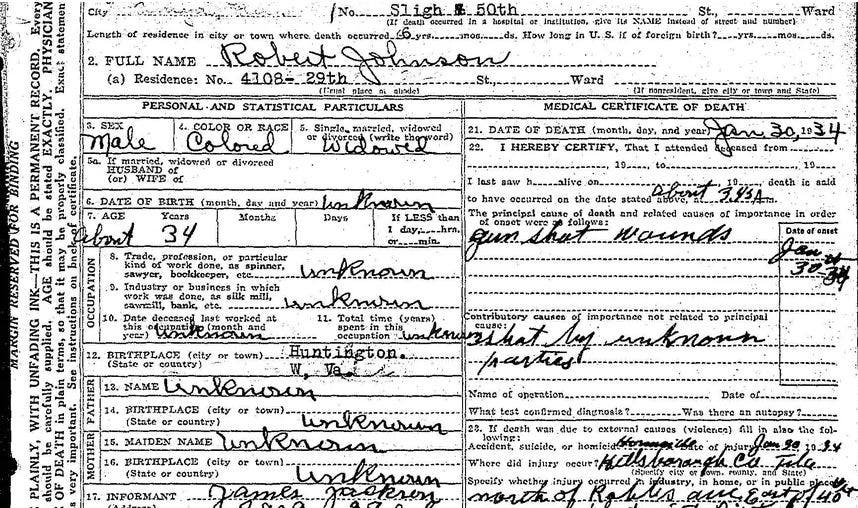
“The memorial is about making sure that we have a statement of culpability, and I think part of that process includes amending the death certificate. He died from a lynching," Viera said.
Hillsborough County NAACP President Yvette Lewis agreed.
“We need to tell the full story about our history, even if it makes you uncomfortable,” she said.
In its report, "Lynching in America," the Equal Justice Initiative said Florida had the second-most racial lynchings per capita of any state in the country.
Researchers with the initiative have documented 4,075 racial lynchings in Alabama, Arkansas, Florida, Georgia, Kentucky, Louisiana, Mississippi, North Carolina, South Carolina, Tennessee, Texas and Virginia between 1877 and 1950.
To give lynching victims the justice they were denied all those years ago, in 2018 the Equal Justice Initiative unveiled the National Memorial for Peace and Justice in Montgomery and has begun providing memorials with the names of lynching victims to every county where a racial lynching occurred. Residents only need to petition the Equal Justice Initiative to obtain a memorial.
Since 2017, 67 memorials have been erected in counties in New Jersey, Kansas, Pennsylvania, Tennessee, Maryland, Mississippi, Kentucky, Alabama, South Carolina, Georgia, Texas, Missouri, Virginia, Ohio, Oklahoma, Minnesota, Colorado, Louisiana, Arkansas, Oregon, Nebraska, Indiana and Florida.
Florida cities and counties that have requested and received memorials include:
- Gainesville, Alachua County, at the Martin Luther King Jr. Community Center, remembering four Black men who were lynched.
- Gainesville, Alachua County, in front of the Alachua County Administration Building commemorating eight Reconstruction-era lynching victims.
- Newberry, Alachua County, at Freddie Warmack Park in remembrance of nine lynching victims.
- Tallahassee, Leon County, in Cascades Park, remembering four lynching victims.
- St. Petersburg, Pinellas County, at the intersection of Martin Luther King Jr. Street and 2nd Avenue South, remembering lynching victim John Evans.
- Orlando, Orange County, in front of the Orange County Regional History Center, honoring July Perry.
Tampa Mayor Jane Castor thanked Viera and fellow members of the Tampa-Hillsborough County Equal Justice Initiative for bringing Hillsborough County's first memorial to Tampa, saying this acknowledgement of Johnson's lynching is long overdue.
"Historical markers are unceasing reminders of how far we have come as a community and, unfortunately, of how far we still have left to g0," she said.
Get more local news delivered straight to your inbox. Sign up for free Patch newsletters and alerts.