Health & Fitness
Eastern Equine Encephalitis Detected In 2 Hillsborough County Horses
Thirty to 45 percent of people who contract Eastern equine encephalitis will die, making it the most serious mosquito-borne disease in U.S.



HILLSBOROUGH COUNTY, FL — The Florida Department of Health in Hillsborough County has issued an advisory to Hillsborough County residents after two horses in northwest Hillsborough tested positive for Eastern equine encephalitis, the most serious of the mosquito-borne viruses for humans.
While there's a vaccine for horses that is 80 to 90 percent effective, there is no vaccine to treat people who contract the disease, making it fatal in up to 45 percent of cases.
Hillsborough County Mosquito Management Services and the Florida Department of Health-Hillsborough is monitoring the area where the horses contracted Eastern equine encephalitis and are taking steps to eradicate the mosquito species carrying the virus.
Find out what's happening in Tampafor free with the latest updates from Patch.
This is the third advisory of a mosquito-borne virus issued by the DOH-Hillsborough this summer.
On Aug. 10, the DOH issued an advisory after dengue fever was confirmed in residents who traveled out of the country and, on Aug. 19, the county issued an advisory after West Nile virus was detected in two sentinel chickens.
Find out what's happening in Tampafor free with the latest updates from Patch.
Risks From Mosquito-Borne Viruses
The DOH-Hillsborough says an average of 40 people are infected with mosquito-borne viruses each year.
In Florida, mosquitoes have been known to transmit:
- Chikungunya
- Dengue fever
- Eastern equine encephalitis
- St. Louis encephalitis
- Malaria
- West Nile virus
- Yellow fever
- Zika
For the majority of people, symptoms include fevers, joint pain, joint swelling, back pain, rashes, headaches, nausea, vomiting, diarrhea, fatigue and redness around the eyes.
Some people who contract Eastern equine encephalitis develop seizures, neurological deficits or comas. People with severe encephalitic can go into a coma. About 30 to 45 percent of people with Eastern equine encephalitis will die, making it the most serious mosquito-borne disease in the United States.
Of those who recover, many will suffer lasting effects. People under the age of 15 or over 50 are at the greatest risk for severe disease.
In unusual cases, Chikungunya infection can involve the brain, eyes, heart, kidney and other organs. Fatal infections are rare, however, many patients have chronic joint pain, arthritis, loss of energy and depression lasting weeks to years. Those at greatest risk for severe illness include newborn infants, those over 65 years of age and those who have other health conditions.
Dengue fever can be a painful, debilitating disease but is rarely fatal. Dengue hemorrhagic fever is a rare but more severe form of dengue infection that can be fatal if not recognized and treated.
People with malaria commonly experience flu-like symptoms such as fever, chills, sweats, headache, nausea and vomiting, body aches and general malaise. Depending on the species of mosquito, it can be life-threatening.
Yellow fever ranges in severity. The infection can lead to shock, bleeding and kidney and liver failure. Severe infections can be fatal.
Less than 1 percent of people infected by West Nile virus develop the most severe form of the disease, neuroinvasive WNV, which may involve meningitis and encephalitis and can cause irreversible neurological damage, paralysis, coma or death. Persons at greatest risk for severe illness include newborn infants, those over 65 years of age, and those who have other health conditions.
Most St. Louis encephalitis infections are unapparent. Symptoms can range from fever with a headache to meningitis, encephalitis and coma. People over the age of 50 seem to be at greater risk for severe disease.
Zika virus disease is generally mild, and severe disease requiring hospitalization and deaths are uncommon. A Zika infection during pregnancy can cause serious birth defects. And in severe cases, it can cause swelling of the brain or spinal cord or a blood disorder that can slow clotting.
A New Weapon To Fight Mosquitoes
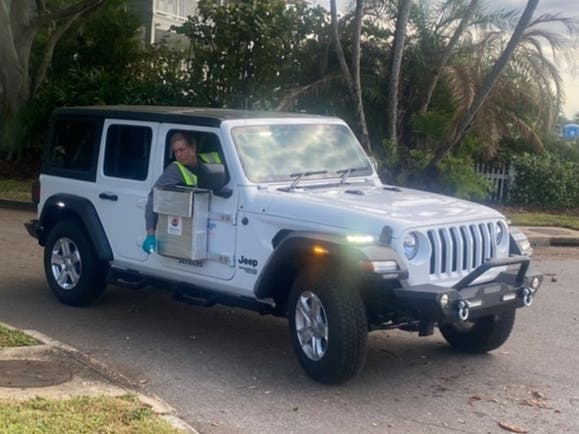
Among the newest weapons in the county's fight against mosquitos is an innocuous 2022 Jeep Wrangler.
But this isn't just any Jeep Wrangler. It is outfitted with a driver's seat on the right side to enable members of the mosquito team to drop golf ball-sized briquettes of long-lasting mosquito larva treatment into catch basins and storm drains to eliminate mosquitoes in their larval stage, before they are old enough to bite and breed.
The Jeep has a basket that hangs off the driver's door to carry the briquettes, so the driver can drop them into storm drains along the road. The briquettes dissolve in the standing water, which can be a breeding ground for mosquitoes, including those that spread illnesses.
This new technique enables the mosquito management team to fight mosquitoes efficiently and cost-effectively.
Hillsborough has more than 60,000 storm drains that are all potential breeding grounds for mosquitoes. Treating all of those drains on foot or stopping a vehicle at each drain and applying the treatment is both inefficient and unsafe.
A Year-Round Battle
Mosquito control teams conduct more than 20,000 larvae inspections each year to control mosquitoes that may carry illnesses.
Throughout the year, the mosquito control teams use various methods to eradicate mosquito larvae on more than 21,000 acres and adult mosquitoes on more than 1,072,000 acres.
To detect increases in disease-carrying mosquitoes, the mosquito control team monitors 30 mosquito traps located throughout the county.
Additionally, the mosquito control department maintains several sentinel chicken coops and draws blood from the chickens once a week, which is tested for antibodies to viruses.
See related story: West Nile Virus Detected In Hillsborough County; Advisory Issued
The mosquitoes that transmit viruses are partial to blood from birds so Hillsborough County's sentinel chickens serve as an early warning of the presence of potentially serious viruses that can be passed on to humans, horses, dogs and other animals.
Chickens are ideal for detecting mosquito-borne viruses. While chickens can be infected with the viruses and produce the antibodies, they don't experience the illness and are unable to transmit the viruses to uninfected mosquitoes.
On average, the county's mosquito control team performs more than 8,600 inspections of known mosquito larval production sites and responds to more than 5,500 customer service requests each year.
Tools used to fight mosquitoes include traps, biological control bacteria that naturally occur in soil called Bacillus thuringiensis israelensis, larvae-eating fish, larvae-destroying briquettes and spraying pesticides from the ground and by helicopter.
Quick Response Is Crucial
Once a virus is confirmed in a human, the mosquito control staff goes into combat mode, responding quickly to eliminate the mosquitoes that are spreading the virus using the following steps:
- When a resident tests positive for one of the eight dangerous mosquito-borne diseases, the physician contacts the Florida Department of Health in Hillsborough County to begin a community plan.
- Within hours: the DOH alerts Hillsborough County of the location of a suspected or confirmed case of a mosquito-borne illness.
- Within a few hours, the mosquito control team informs residents in the surrounding neighborhoods about the potential danger of mosquitoes and mosquito-borne illnesses.
- The team also performs inspections of properties to make sure there are no breeding sites in containers around the home of the person who tested positive. The inspection team will visit anywhere from 35 to 150 properties, depending on the density of the population. If a resident is not home at the time of the inspection, the team will leave a hanger with information on how to protect a family from mosquito bites.
- The team also sets specialized mosquito traps designed to collect the species of mosquito that is implicated in the transmission of the illness. The traps collect live mosquitoes that will be returned to the mosquito control lab to be tested for dengue or West Nile virus. Some mosquito samples may be sent to the state public health lab to be tested for Zika, Eastern equine and St. Louis encephalitis.
- By that evening, mosquito patrol will spray the neighborhood and surrounding neighborhoods to eradicate the species of mosquito that carries the disease. This treatment is done in the evening when mosquitoes are most active. Specialized trucks are deployed to apply insecticides to control both mosquito larvae and adult mosquitoes.
- Mosquito control will treat these same neighborhoods for up to three consecutive days to reduce adult mosquito populations.
![]()
Hillsborough County
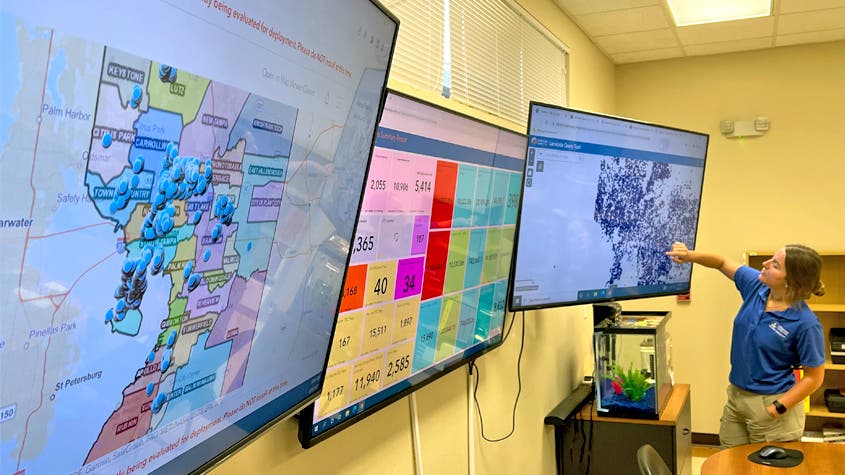
Hillsborough County Mosquito Management Services team members keep track of mosquito populations at their headquarters.
How To Protect Yourself
Residents are urged to do their part in the battle against mosquito-borne viruses including:
- Drain standing water from garbage cans, house gutters, buckets, pool covers, coolers, toys left outdoors, flowerpots or any other containers where sprinkler or rainwater collects.
- Discard old tires, bottles, pots, broken appliances and other items in yards.
- Empty and clean birdbaths and pet water bowls at least twice a week.
- Protect boats and vehicles from rain with tarps that do not accumulate water.
- Maintain swimming pools in good condition and chlorinated.
- Empty plastic swimming pools when not in use.
- Cover your skin with socks, long pants and long sleeves.
- Apply mosquito repellent to bare skin and clothing. Repellents with DEET, picaridin, oil of lemon eucalyptus, para-menthane-diol, 2-undecanone and IR3535 are effective.
- Use mosquito netting to protect children younger than 2 months old.
- Check and repair screens on doors and windows. Keep them closed and use air conditioning when possible.
Click here to submit a request for mosquito mitigation.
Get more local news delivered straight to your inbox. Sign up for free Patch newsletters and alerts.