Community Corner
FL Biologist Discovers Species Of Salamander That Parachute From Trees
Aerial behavior has never been observed until now in the 4-inch wandering salamander Aneides vagrans, which is native to California.


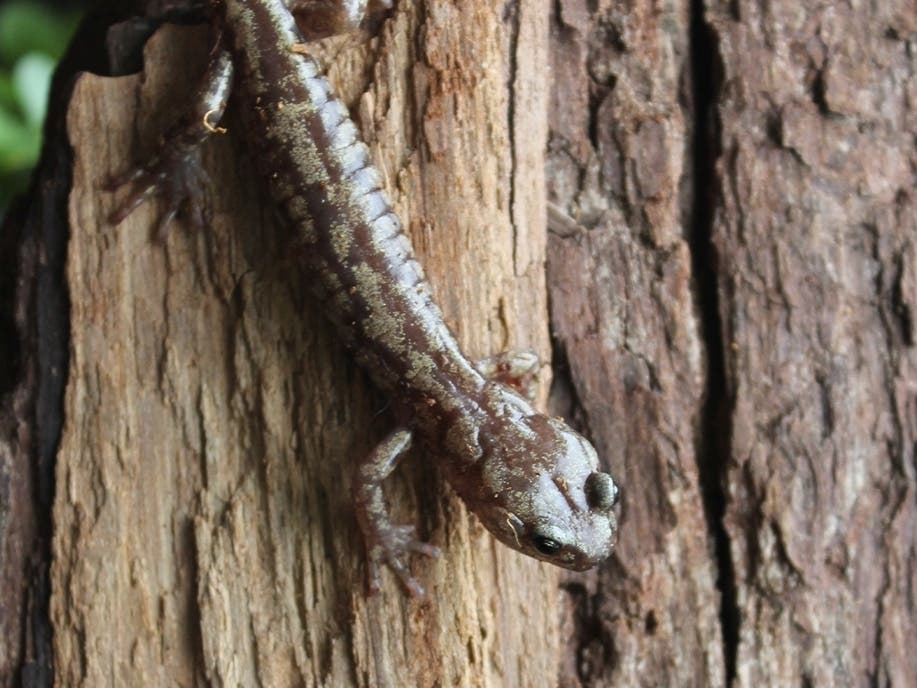

TAMPA, FL — Leaping lizards. A University of South Florida biologist has discovered a species of salamander in California that can parachute out of the world's tallest trees and land safely on the ground.
Christian Brown, a doctoral candidate in biology at USF, has spent four years studying the 4-inch wandering salamander, Aneides vagrans, which is native to California.
The small, intrepid amphibians live in the redwood forest where the majestic coastal redwood, Sequoia sempervirens, grows as tall as 400 feet.
Find out what's happening in Tampafor free with the latest updates from Patch.
Through evolution, these salamanders have mastered a unique method of moving quickly from the treetops to the ground below.
“A surprising and efficient way to get around. That’s what we’ve got here,” Brown said. “You’re expecting salamanders to crawl or swim, but you’re certainly not expecting them to parachute and be able to control their descent and move horizontally in the air and glide.”
Find out what's happening in Tampafor free with the latest updates from Patch.
There are hundreds of species of salamanders living around the world, but Brown is the first to document this aerial technique used by the wandering salamander, a technique they mastered through evolution.
Brown said the wandering salamanders whip their tail, right their body and maintain an upward posture to glide down the trees. Instead of spinning out of control, these lizards have learned to precisely control their descent using the same techniques skydivers use to parachute to the ground.
“If we hadn’t been looking at these animals this closely for this long, we never would have seen it,” Brown said.
With the help of fellow biologists, Brown began reconstructing the movements of salamanders in 2018 inside the animal flight lab at the University of California, Berkeley. Together, the team studied the gliding postures of the salamanders inside a wind tunnel box.
Over several trials, they witnessed the salamanders generate lift and slow their vertical speed up to 10 percent while falling – a discovery that Brown says was a total surprise.
The salamanders have a basic four-legged body – with no webbing or skin-flaps traditionally seen in animals with aerial behaviors. Instead, they maneuver behaviorally.
“It goes to show that morphology alone doesn’t necessarily indicate functionality,” he said.
He hopes this encourages researchers to take a second look at organisms they may have previously viewed as incapable of aerial behavior.
“It's an inspiring, iconic species that I think could get people thinking about the canopy world more and get us moving towards not just protecting the existence of redwoods, but trying to get us back to a point where canopy ecosystems thrive," he said.
Brown plans on continuing to monitor the salamanders and any environmental changes. Right now, the coastal redwoods are considered endangered and, therefore, the wandering salamander is inherently threatened.
Brown said climate change is also expected to impact the fog patterns in the canopy, which could harm the salamanders, which rely on the fog’s moisture to breathe.
After graduation, Brown plans to pursue a post-doctoral fellowship to examine the relationships of genotypes, environment and phenotype, ultimately hoping to find out if falling is shaping the exceptionally long legs and large feet of the wandering salamanders, a physique different than most species of salamanders.
In the meantime, Brown is partnering with Alex Kirk of the USF Carney Lab to generate three-dimensional images of the salamanders to examine the features that make them aerodynamic.
Get more local news delivered straight to your inbox. Sign up for free Patch newsletters and alerts.