Crime & Safety
Floridians Are Most Mellow Drivers In Country, According To Study
As the busy Labor Day weekend gets underway, drivers should chill out, put on some music and enjoy the scenery while traveling.


TAMPA, FL — With seemingly endless traffic jams, drivers who refuse to use their turn signals, interminable red lights, slow pokes driving in the fast lane, lousy weather conditions and teens driving with one hand on a cell phone, it's no wonder drivers have a white-knuckled grip on their steering wheels these days.
But just how bad are the driving conditions in Florida compared to other parts of the county?
It turns out, they're not as bad as Floridians perceive them to be.
Find out what's happening in Tampafor free with the latest updates from Patch.
To find out, HiRoad Assurance Co. collected 1.3 million driving-related tweets posted from around the country and used an AI tool, TensiStrength, to detect the tweeters' stress levels.
The analysis showed that Jacksonville is the city with the least stressed-out drivers in the country with 32.7 percent of all driving-related tweets indicating stress by the AI tool.
Find out what's happening in Tampafor free with the latest updates from Patch.
But the biggest surprise in the report is that Tampa ranks second in the country and Miami sixth, with 36.1 percent and 37.5 percent of tweets, respectively, indicating stress.
"In general, it seems that Florida is the most serene state in the country with three cities figuring in the top 10 of the least stressful cities to drive in," said HiRoad Vice President Steve Harris.
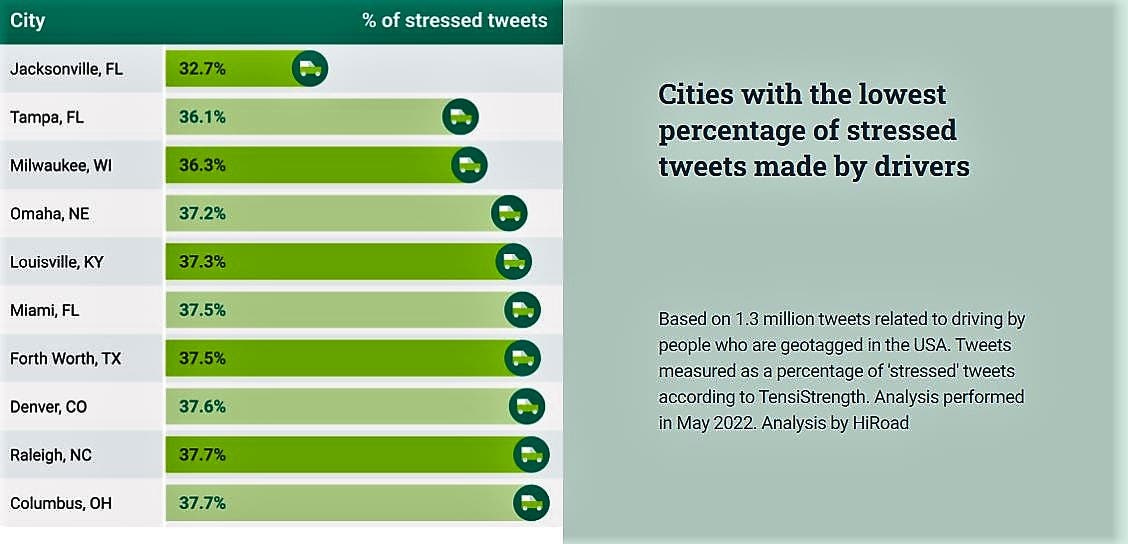
In contrast, Portland, Oregon, ranked first for the most stressed-out drivers in the country with nearly half (47.6 percent) of the driving-related tweets in Portland registering as stressed, with Chicago following in second place and New York City ranked third.
To find out what stresses drivers out the most, the AI scanned tweets for specific phrases such as potholes and speeding.
Rain came out on top, with 56.5 percent of tweets about driving in the rain registering as stressed, according to the TensiStrength tool.
General bad weather conditions and snow also rank highly as stressful factors, ranking second and third, respectively, at 55.6 percent and 52.7 percent.
And that stressor can lead to accidents, according to the Federal Highway Administration. One in five crashes every year are due to weather conditions.
Next in order are drivers using their cell phones (50 percent), traffic (49.3 percent), fog (48.4 percent), potholes (47.2 percent), cyclists (45.9 percent), drivers speeding (45.7 percent) and drivers swerving (43.2 percent).
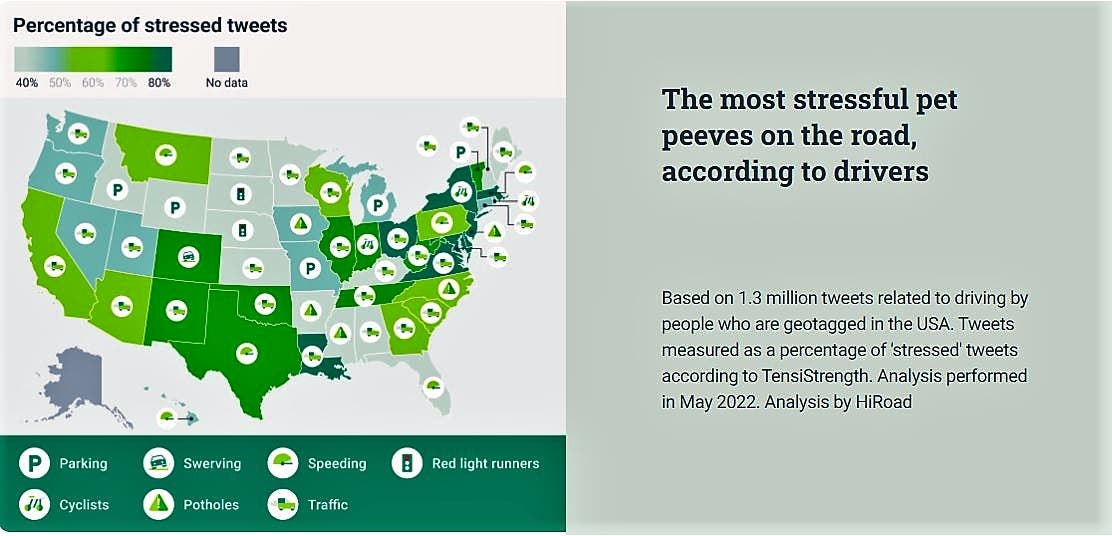
Florida's biggest pet peeve when it comes to driving, according to the HiRoad study, is speeding, with 46.5 percent of tweets by Florida drivers registering as stressed. Speeding also ranked as the second biggest stressor among drivers nationally.
When it comes to the most stressful days to drive, HiRoad's analysis showed that Floridians think Sunday is the worst day to drive.
While Floridians love to complain about traffic on Interstate 4, it didn't even make HiRoad's list of highways that stress drivers out the most.
That honor goes to Interstate 90, passing through Chicago and continuing into Indiana. The study showed this stretch of highway stressed out 45.7 percent of drivers.
Most Stressful Highways
- Interstate 90 from Chicago to Indiana — 45.7 percent
- Interstate 605 in Los Angeles — 44 percent
- Interstate 110 in Los Angeles — 42.4 percent
- Interstate 5 in Los Angeles — 42.2 percent
- Interstate 405 in Los Angeles — 42.1 percent
- State Road 57 in Los Angeles — 42.1 percent
- Interstate 15 in Las Vegas, Nevada — 41.6 percent
- Interstate 10 in Phoenix-Mesa, Arizona — 41.6 percent
- State Road 60 in Los Angeles — 41.5 percent
- Interstate 69 in Houston, Texas — 41.3 percent
Chicago also ranked first for cities with the worst traffic jams with on the INRIX 2021 Global Traffic Scorecard with an index score of 4. New York has an index score of 5, Philadelphia and Portland both had index scores of 11, San Francisco and Washington, D.C. scored 17, Seattle, Washington, scored 22, Providence, Rhode Island, scored 24, Los Angeles scored 27, and Houston scored 30.
What's clear from the study, said Harris, is that driving is no fun.
“This study reveals that 41 percent of tweets about driving registered as stressed when we applied an AI analysis," he said. “That’s a large percentage, showing us that thousands of drivers in the U.S. are likely experiencing stress while driving on a daily basis."
While stress may be unavoidable when you get behind the wheel, HiRoad provided some tips on how to make driving a bit more enjoyable:
Avoid peak traffic and give yourself extra time.
Nobody likes sitting in bumper-to-bumper traffic. When the clock’s ticking and you’ve got somewhere to be, driving at rush hour can be a very stressful experience. If you’re planning a trip, avoid peak hours if you can and schedule extra time to account for any unexpected traffic. If you know ahead of time where there may be congestion on the road, look up alternative routes and plan extra time accordingly.
Play some relaxing music.
An easy way to make your car environment as zen as possible is to play some relaxing or upbeat music. One study found that playing music while driving can reduce stress and its effect on the heart. Prepare a playlist that’s guaranteed to chill you out ahead of time.
Switch your phone to "Do not disturb."
Driving requires 100 percent of your attention, which is why it can be stressful if your phone starts ringing and buzzing on the passenger seat and you’re unable to answer it. Unless you’re safely using your phone’s GPS system, switch your phone off or put it on "Do not disturb mode." In states like Florida, getting caught with your cell phone while driving can also lead to hefty fines.
Don’t drive angry.
According to one study by the Virginia Tech Transportation Institute, driving while angry increases your crash risk by nearly 10 times. Aggressive driving (or road rage) is one of the leading causes of serious accidents on the road. Before getting behind the wheel when you're angry or upset, take a walk to calm down.
If you find yourself getting angry while driving, take some deep breaths and allow your muscles to relax rather than tense up. Pull over and take some time to calm down with some relaxing music if your emotions are running too high to drive safely.
Take care of yourself off the road.
You can’t drive safely if you’re exhausted. A lack of sleep not only causes a loss in concentration but can make you more irritable.
An unhealthy diet and not drinking enough water can also cause fatigue and make concentrating difficult behind the wheel, so looking after your overall health can reduce the likelihood of making driving errors.
Methodology
Twitter data was collected between May 12 to May 25. Each tweet was scanned with TensiStrength, an AI tool developed by Mike Thelwall at the University of Wolverhampton. The tool detects stress levels in short pieces of text and assigns it a stress level score.
Get more local news delivered straight to your inbox. Sign up for free Patch newsletters and alerts.