Crime & Safety
Killer's Query, 'Did You Find Her?' Led Authorities To USF Student's Body In 2017
Domestic violence victim Shyeanne Lewis was a 23-year-old University of South Florida student when she died after being stabbed 20 times.


TAMPA, FL — On April 22, 2017, 24-year-old Hector Acevedo’s spontaneous question to deputies — “Did you find her?”— sparked an investigation that led to his girlfriend’s body and ultimately to Acevedo’s conviction for first-degree murder.
On Wednesday, Judge Michelle Sisco sentenced Acevedo to life in prison without the possibility of parole for the murder of 23-year-old Shyeanne Lewis.
Hillsborough County Assistant State Attorneys Scott Harmon and Jessica Couvertier led the prosecution during Acevedo’s four-day trial in September.
Find out what's happening in Tampafor free with the latest updates from Patch.
“I’m proud of our team for making sure this monster won’t ever hurt anyone again,” Hillsborough State Attorney Andrew Warren said. “This is the most painful kind of reminder that we all need to do everything we can to keep the people we love safe from domestic violence. This is top-of-mind for all of us in the justice system, not only during Domestic Violence Awareness Month, but every day—and we need members of the community to keep being our eyes and ears, supporting survivors who need help.”
On April 22, 2017, Acevedo called his mother and told her he wanted to kill himself. She picked him up, brought him to her home and called a relative who works for the Hillsborough County Sheriff’s Office for help. That deputy called for on-duty deputies, and Acevedo was taken into custody for his own protection under the Baker Act.
Find out what's happening in Tampafor free with the latest updates from Patch.
When deputies arrived, Acevedo was carrying a pistol and had blood on his clothes and legs, along with abrasions on his knuckles and a knife wound on his left palm.
While being escorted out of the house, Acevedo made the spontaneous statement, “Did you find her?”
Acevedo initially would not respond to questions about who he meant, but he later told deputies his girlfriend’s name and address.
In April 2017, Lewis was studying marine biology at the University of South Florida while working two jobs to support her studies.
After getting no response at the door of her apartment at the Andover Club apartments on East Busch Boulevard, Hillsborough County Sheriff’s deputies and Tampa police officers forced their way in. Inside, they found Lewis covered in blood and laying on her bedroom floor, the victim of a vicious and brutal attack. Two knives were recovered in the bedroom along with evidence that the killer had tried to wash blood off of himself in the bathroom.
The Hillsborough Medical Examiner’s Office determined the victim suffered several dozen stab wounds to multiple areas of her body. Additionally, Lewis had blunt impact injuries to her face, arms and hands, indicating she'd been beaten.
Acevedo told Tampa police detectives that Lewis hit him and he punched her in the face. Acevedo said Lewis then armed herself with a kitchen knife and Acevedo then “disarmed” her. He said the next thing he remembered was seeing Lewis lying on the bedroom floor, covered in blood.
DNA analysis determined that Lewis's blood was on Acevedo’s undershirt, knees and foot.
A 12-member jury found Acevedo guilty of first-degree premeditated murder after two hours of deliberation on Sept. 23.
During a hearing on Wednesday, several of Shyeanne’s friends and family members spoke to the judge about the pain they still feel from losing her, nearly five years later.
Through most of the proceeding, Acevedo sat hunched over in his chair, hands folded in front of him, staring at the floor.
Shyeanne’s friend Sylvia Jennings spoke directly to Acevedo.
“A monster took my daughter’s godmother away, and I cannot forgive you. It’s very evil. You have no right. What made you feel like you had the right to take someone’s only child away?” Jennings asked.
Shyeanne’s uncle, Richard LaCagnina, recalled a conversation he had with Acevedo while Acevedo and Shyeanne were dating.
“I spoke to you about how hard of a worker she was—maintaining two jobs, along with taking full classes at USF. I told you you had a special lady in your possession, not once, but twice that night … What goes around comes around. You had no right to do what you did. She did not deserve it. And now we’re here today to get justice for ‘Shy-Shy.’ It’s time to accept the consequences,” LaCagnina said.
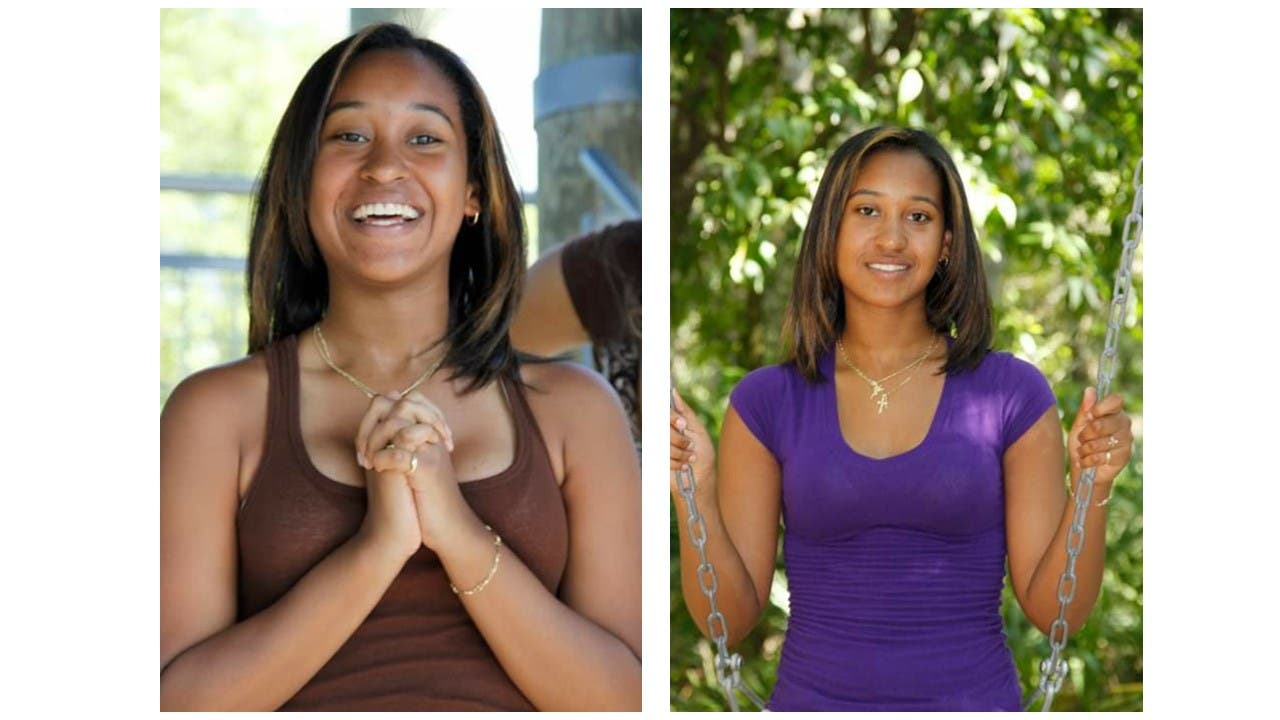
Shyanne Lewis was a 23-year-old University of South Florida students when she died after being stabbed 20 times.
Shyeanne Lewis’s mother, Angela Martin, was the last to speak. She showed the judge two framed photos of her daughter — one a high school senior photo of Shyeanne with her dog Precious, and the other the last family photo Shyeanne ever took.
“It’s 1,635 days since you took my baby from me. It’s been 1,635 days since I’ve heard my baby tell me she loves me. Her poise, her laughs, her jokes. My niece will never know her big cousin. I’m so angry, I’m hurt, I’m lost without my baby. She’s my everything, my world. When you took her, you took me, too,” Martin said.
“The holidays are the worst because my baby loved the holidays," Martin said. "On Mother’s Day, I get up and I go sit under a tree so I can spend time with my daughter, looking at her picture on a stone. That’s not fair. That’s not right. I hope and I pray that you get what you deserve because my baby didn’t deserve what you did to her.”
The judge, on the verge of tears, spoke to Shyeanne’s mother.
“I don’t know how you had the strength to sit through this trial and listen to the evidence and listen to the savage way in which your daughter died," Sisco said. "That only happens out of the deepest and truest mother’s love. That is a show of complete fidelity to your daughter."
After Acevedo was led away in chains, Martin shared some of her loving memories of her daughter Shyeanne. Martin described Shyeanne as caring—toward people as well as animals—hard-working and joyful.
“She was serious when she wanted to be, or when she had to be, when it comes to her studies. But when she was at home, she liked to lay around on the couch, lay her legs across my legs. She was just like a kid at home. A kid at home, but serious outside when she had to be,” Martin said.
“I want everybody to remember her beautiful smile," Martin said. "Her silly laugh. One of her friends said that if somebody’s upset, all she had to do is to walk in a room and, just, smile, and the whole room would just light up.”
National Domestic Violence Awareness Month
National Domestic Violence Month was launched in October 1987 as a way to connect and unite individuals and organizations working on domestic violence issues while raising awareness for those issues.
Over the past 30-plus years, legislation have been passed throughout the country to provide support to domestic violence victims and hold their abusers accountable.
According to the Centers for Disease Control and Prevention, one in four women and one in seven men will experience severe physical violence by an intimate partner in their lifetime.
In 2019, 105,298 crimes of domestic violence were reported to Florida law enforcement agencies resulting in 66,069 arrests. During fiscal year 2019-20, Florida's certified domestic violence centers provided 563,721 nights of emergency shelter to 13,250 survivors of domestic violence and their children.
Many more survivors of domestic violence do not report their abusers to the police or access services at domestic violence services due to shame, fear or being prevented from doing so by their abusers. For this reason, we may never know the true extent of abuse in our country and in our state, according to the Florida Department of Children and Families.
With the added stresses caused by the coronavirus pandemic including job loss and fear of losing their homes, law enforcement authorities said they're seeing an increase in domestic violence cases throughout Tampa Bay.
The Pinellas County Sheriff's Office alone responded to 4,365 domestic violence calls between January and Oct. 7.
Like this article? Sign up for our newsletter and get it delivered every weekday. It's free!
“Unfortunately, our county is on one of the saddest top 10 lists: we are ranked sixth or seventh in the state for the numbers of reported domestic violence incidents,” said Kirk Ray Smith, president and CEO of the nonprofit Hope Villages of America, based in Clearwater.
The Haven at Hope Villages of America is one of 42 certified domestic violence centers in Florida that provide confidential emergency shelter for victims as well as counseling, support groups and other services.
“Our hotline receives more than 4,000 calls annually with requests for assistance," Smith said. "The Haven provides safety, security, emergency shelter and support for approximately 300 women and children each year. We also serve nearly 17,000 women and children annually through our outreach center.”
Also known as RCS Pinellas, the Haven at Hope Villages can be reached at 727-584-3528 or through its hotline at 727-442-4128.
Other nonprofit shelters, resources and referral services for domestic violence victims in Tampa Bay include:
- The Spring of Tampa Bay is also certified by the Department of Children and Families. It is one of the largest of Florida’s 42 certified domestic violence centers and the first domestic violence agency in the United States to have an accredited on-site school for resident children. Call 813-247-SAFE
- CASA - Community Action Stops Abuse- in Pinellas County operates a 24-hour crisis hotline and emergency shelter, offering community support groups, providing courtroom advocacy and assisting the Child Protective Investigative team. Call 727-895-4912.
- Crisis Center of Tampa Bay helps people facing challenges or trauma resulting from sexual assault, suicidal thoughts, domestic violence, financial distress or emotional or situational problems. Call 813-964-1964
- Alpha House of Tampa offers homeless pregnant women and mothers with young children safe housing and the tools they need to become self-sufficient and effective, responsible parents. Call 813-875-2024.
- Alpha House of Pinellas County at 727-822-8190.
- Mary & Martha House in Ruskin at 813-645-7874.
- The Salvation Army Domestic Violence Program of West Pasco at 727-856-6498
- Sunrise Domestic and Sexual Violence Center at 352-521-3358 or the hotline at 352-521-3120.
- Victims can also seek help by calling the national Domestic Violence Hotline at 1-800-799-7233, which responds to domestic violence calls 24/7.
Other services for domestic violence victims:
Florida Department of Children and Families Office of Domestic Violence Program hotline at 1‐800‐621‐4202 or 800-500‐1119.
Hillsborough County State Attorney's Victim Assistance Program at 813-272‐6472.
Pinellas County Sheriff's Office Victim Services at 727-582-6259.
Anyone Can Be A Victim Of Domestic Violence
“It’s important to remember that this could be you, your sister or mother at any point in time,” said Smith. “Help is essential to their survival and for them to thrive later in life."
Domestic violence almost always involves various forms of control – physical, sexual, emotional, psychological economic, etc.
Domestic violence is not isolated to people who are married. It occurs with dating adolescents, same-sex couples and adults living together. The defining characteristic is that they share an intimate relationship.
In all cases, the abusers want to establish power and control over the victim.
Signs of an abuser:
- Threatens to hurt victim or their children.
- Refuses to let the victim have contact with family or friends.
- Throw things or destroy the victim's personal belongings.
- Accuses the victim of having affairs.
- Tell the victim he or she is stupid, fat, ugly or calls them names.
- Blames the victim for causing all their problems.
- Says the victim never does anything right.
- Abandons the victim, leaves the victim places or locks them out of their residence.
- Takes or hides the victim's keys, important papers or mail.
- Forbids the victim from working or denies the victim money for necessary things for the victim or the victim's children.
- Forces the victim to take part in unwanted sex.
- Hits, kicks, shoves, grabs or shakes the victim or victim's children or generally reacts to problems in a violent manner.
Signs of escalating danger:
- Abuse happens more often.
- Abuse gets rougher.
- Abuser tries to choke the victim.
- There is a gun in the home.
- Abuser uses drugs such as cocaine or heroin.
- Abuser threatens to kill self or others.
- Abuser is drunk often.
- Abuser hits when woman is pregnant.
- Abuser is jealous, suspicious or possessive.
- Abuser gets into fights with other people.
- Abuser hurts or kills pets.
Under Florida law, a domestic violence victim has the right to:
- Ask a law enforcement agency to file a criminal complaint, if one has not already been filed.
- Go to court and file a petition requesting an Injunction for Protection from Domestic Violence. This involves completing forms, which the victim must swear to, that explain to the judge what type of protection the victim needs and who is abusing the victim.
- Have legal fees waived.
- Seek free legal services through the Florida Domestic Violence Legal Aid hotline.
Get more local news delivered straight to your inbox. Sign up for free Patch newsletters and alerts.