Traffic & Transit
Construction Ahead: State To Begin Adding Lanes To Interstate 275 North Of Interstate 4
The $85.3 million project will add one lane in each direction to I-275 from north of I-4 to north of Hillsborough Avenue (U.S. 92).


TAMPA, FL — Beginning Monday, Oct. 25, the Florida Department of Transportation's contractor, Lane Construction, will begin constructing additional lanes on Interstate 275 as part of a long-debated capacity improvement project.
The $85.3 million project will add one lane in each direction to I-275 from north of Interstate 4 to north of Hillsborough Avenue (U.S. 92), a length of 2.5 miles.
Construction activities are taking place during the daytime and nighttime hours. Work requiring lane closures will occur at night between 9 p.m. and 6:30 a.m.
Find out what's happening in Tampafor free with the latest updates from Patch.
Occasionally, interstate ramps may close at night between 11 p.m.and 5 a.m. for overhead signage and underpass work. Advanced warning signs and electronic message boards will assist drivers traveling through the area.
The project is expected to be finished by early 2026.
Find out what's happening in Tampafor free with the latest updates from Patch.
This section of Interstate 275 has long been a sore spot for residents of Historic Old Seminole Heights, Tampa Heights and surrounding communities.
When it was constructed in 1973, it literally divided the community and, residents contend, led to blight around the interstate.
During a series of public meetings, residents complained that adding lanes to the highway would only exacerbate those problems, adding to noise, air and water pollution, presenting more safety concerns for users, especially bus riders, bicyclists and pedestrians, and becoming even more of a looming presence in the communities than it already is.
To alleviate those concerns, the FDOT agreed to provide dedicated auxiliary lanes from the I-4 ramps to north of Dr. Martin Luther King, Jr. Boulevard and one general purpose lane in each direction from north of Dr. Martin Luther King, Jr. Boulevard to north of Hillsborough Avenue.
New sound barrier walls with brick and sand coral facings will be constructed along most of the corridor. (To see the locations of the new barriers, click here.)
The underpasses at Floribraska Avenue, Lake Avenue, Dr. Martin Luther King Jr. Boulevard, Chelsea Street, Osborne Avenue and Hillsborough Avenue will be improved to make them more pedestrian friendly with wider sidewalks and bright under-deck lighting.
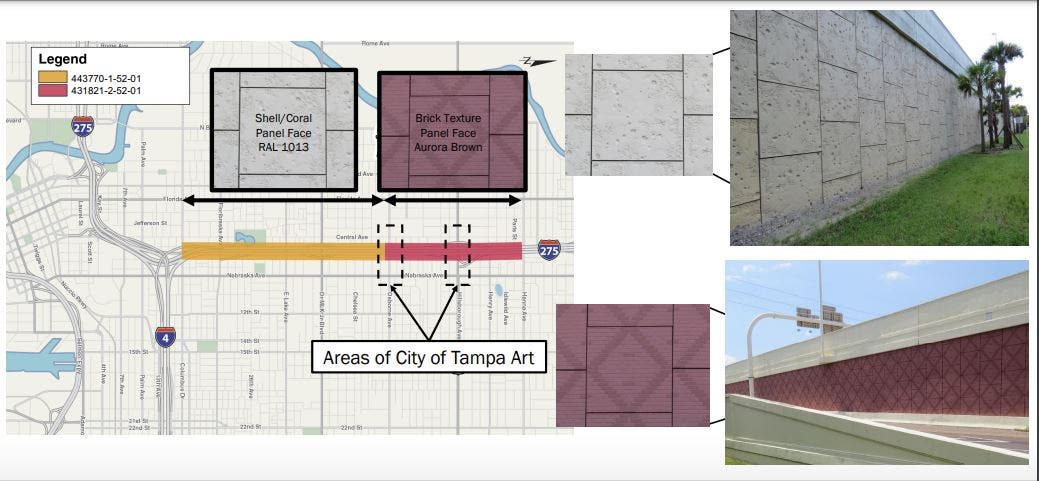
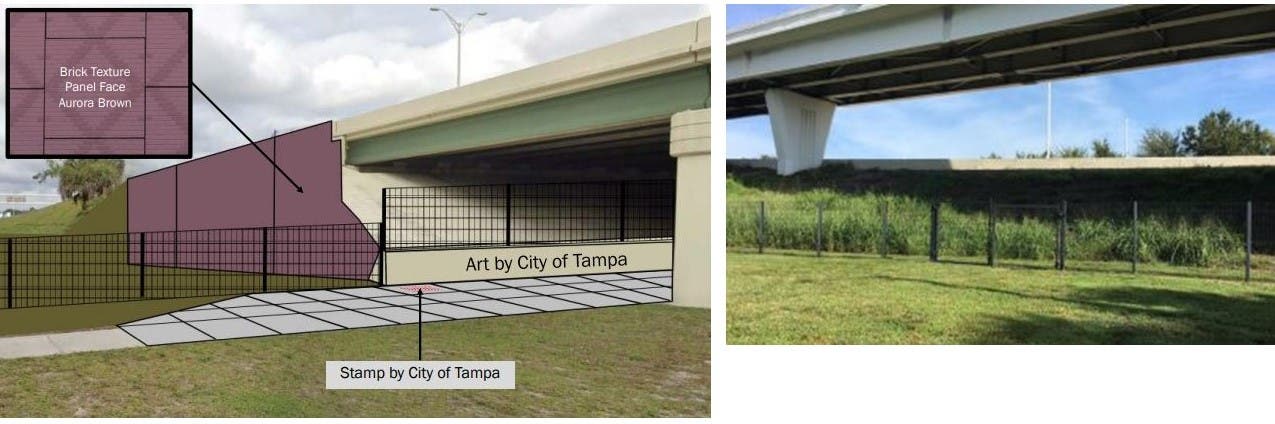
Portions of the sloped embankment under bridge ends will be removed and the FDOT will use vertical walls to open the space. In some places, these walls will be painted with community murals.
The bridge structures will be painted, lit with LED lighting and include special black vinyl-covered metal fencing fencing to increase safety and prevent people from entering underpass areas. The FDOT also has a landscaping plan for the corridor.
Also planned is the installation of Intelligent Transportation System devices.
Intelligent Transport System devices consist of technology designed to prevent traffic congestion and reduce travel time.
According to the Intelligent Transportation Society of America , ITS involves the use of security cameras, sensors, automatic number plate recognition and speed cameras that can alert drivers to the best routes to avoid crashes and tie-ups, reroute traffic in response to road conditions or weather emergencies, adjust speeds and signal timing on roads and turn lights green when a bus approaches. ITS can even be tied into the navigation systems of modern vehicles with GPS technology.
The FDOT is also providing opportunities for future transit along this corridor by widening both the inside and outside shoulders to provide flexibility for transit bus operations.
All of the improvements will be completed will take place within the existing right-of-way.

Modernizing Tampa's Interstate System
The improvements are part of the Tampa Bay Next interstate modernization initiative in Hillsborough and Pinellas counties intended to ease congestion in the fifth fastest-growing metropolitan area in the nation.
According to the Tampa Bay Economic Development Council, nearly 41,800 new residents (an average of 115 a day) moved to the Tampa metro area in 2020.
Traffic projections show average daily traffic doubling along some sections of Interstate 275 by 2040.
Like this article? Sign up for our newsletter and get it delivered every weekday. It's free!
With that in mind, at a news conference Sept. 13, Florida Gov. Ron DeSantis, joined by Senate President Wilton Simpson, R-Trilby, House Speaker Chris Sprowls, R-Palm Harbor, and Florida Department of Transportation Secretary Kevin Thibault, announced he was accelerating construction of enhancements to the I-275/I-4 interchange, long-awaiting improvements to the Westshore interchange and the reconstruction of the Howard Frankland Bridge connecting Tampa and St. Petersburg.
The projects represent a $2 billion investment in Tampa Bay.
“The Tampa region is growing exponentially, and it’s important that we support that growth with strong infrastructure,” DeSantis said, adding that the three projects represent "a historically significant investment in the region’s transportation network.”
Sprowls said moving up construction of the Westshore interchange project is vital to keep traffic moving in Tampa Bay.
“Accelerating the project is a critical step to address one of the most important Tampa Bay transportation issues in my lifetime," he said. "The impact of this announcement cannot be overstated.”
“The Westshore and downtown Tampa interchange projects will directly enhance mobility in the region, and I am eager to get these projects completed much earlier than previously planned," Thibault said.
Tampa’s two major interchanges – the Westshore and the downtown interchanges – were built in the 1960s and have only had intermittent operational improvements since then.
Thibault said they no longer function properly and cause traffic backups on the interstates that affect the arterial roads and local streets. When drivers are sitting in gridlock on the Howard Frankland Bridge, Veterans Expressway, I-275 north of downtown or I-4 east of downtown, that congestion is primarily caused by increased demand and the funneling effect at these two interchanges.
2 Top Transportation Priorities
Earlier this month, the Hillsborough Transportation Planning Organization unanimously endorsed moving ahead with the two interchange projects.
Tampa council member Harry Cohen said he is especially looking forward to the completion of the Westshore interchange improvements.
"This is going to be transformative," he said. "It's going to be transformative for the airport, for people to commute over the Howard Frankland Bridge and go through the Westshore interchange. Hopefully, it's going to make a big difference from a safety point of view as well."
Tampa’s Westshore interchange has long been one of the region’s top transportation priorities.
The modernization of the Westshore interchange will allow efficient, safe and reliable travel for the more than 4,000 businesses, 96,000 employees and the countless visitors who come from the Tampa International Airport.
The project will add lanes to the interchange and bring toll lanes from the northern end of the Howard Frankland Bridge through downtown Tampa, reducing congestion at the Howard Frankland Bridge, the Courtney Campbell Causeway, the Veterans Expressway and the entrances and exit to Tampa International Airport.
The FDOT said the early phases of this project represent more than $560 million in direct investment in the local economy, and with the future phases coming online soon, this investment will exceed $1.2 billion.
Originally the project wasn't scheduled until 2028. The infusion of state and federal funds announced by DeSantis has allowed it to be moved up to 2023.
Equally crucial, said Thibault, is reconstructing the bottleneck at I-275, I-4 and the downtown Tampa interchange (known as Malfunction Junction), considered one of the most perilous stretches of road in Tampa Bay with hundreds of crashes each year.
Currently, drivers that use the downtown Tampa interchange experience significant backups regularly.
The interchange is a key chokepoint that has been identified as one of the most congested interchanges for freight in the country. According to a study by the American Transportation Research Institute, Malfunction Junction is No. 64 among the country's top 100 bottlenecks for the trucking industry.
While traffic can typically flow between the two highways at about 45.7 mph, that speed drops during afternoon rush hour, falling to below 40 mph between 4 p.m. and 6 p.m.
The interchange is one of only two in the state to make the research institute's bottleneck list. The other is in Jacksonville, at the intersection of Interstates 95 and 10, which landed at No. 95. The annual survey ranks truck bottlenecks by measuring truck speeds and truck volumes based on GPS data from more than 1 million freight trucks.
The FDOT plans to add new shared-use paths along the north and south sides of Interstate 4 as part of its downtown interchange improvement project in Tampa and include more options for other forms of transportation, such as more trails to connect Tampa's Central Business District, the Tampa Heights neighborhood and Ybor City.
The official downtown interchange project bid announcement will be posted Oct. 22 and the final price submission for companies is due June 7, 2022.
The Florida Department of Transportation projects a 25 percent reduction in crashes on Interstate 275 and a 9 percent reduction in crashes on Interstate 4 when the interstate improvements are completed. Additionally, the improvements to the interchange represent an investment of more than $150 million into the local economy.
Easing Tampa Bay's congestion all hinges on the reconstruction of the Howard Frankland Bridge, called one of the region’s most important transportation projects.
The bridge was first built in 1959, and is now more than 60 years old. FDOT is adding enhancements and capacity to the bridge that will modernize the connection between Pinellas and Hillsborough counties.
See related stories:
Get more local news delivered straight to your inbox. Sign up for free Patch newsletters and alerts.