Crime & Safety
Memories Of Horror At Surfside Linger After Rescue Work Finished
"I was very, very thankful to be home," Lt. Robbie Northrop said. "That experience makes you want to hug your children closer."


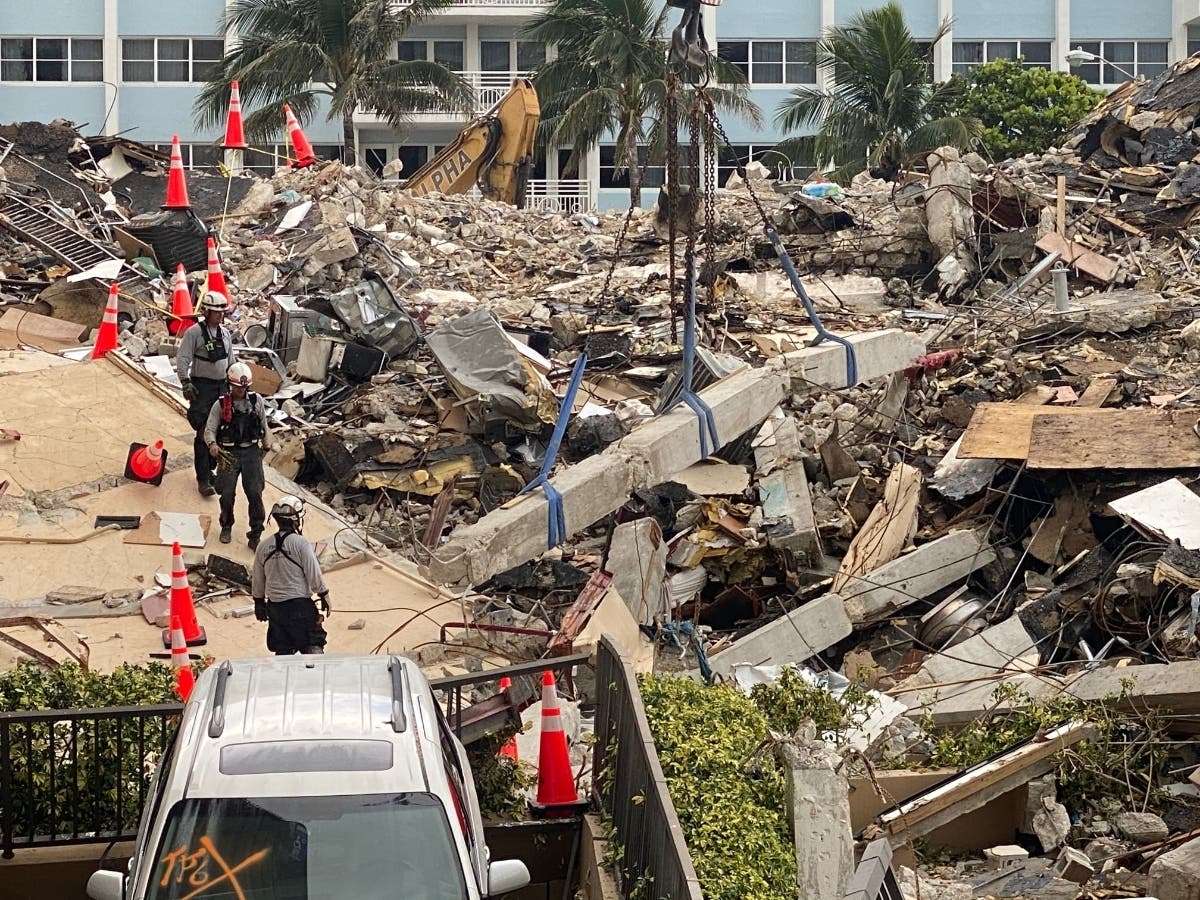


TAMPA BAY, FL — The 12-hour days of digging through rubble, breaking up huge chunks of concrete and removing buckets of debris are over.
But for members of Florida Task Force 3, the memory of pulling broken bodies from the collapsed condominium complex and the anguish on the faces of family members awaiting word of their loved ones will linger in their memories long after their deployment in Surfside.
In the midst of Fourth of July festivities, the excitement surrounding the Tampa Bay Lightning's pursuit of the Stanley Cup and preparations for the arrival of Tropical Storm Elsa, members of the Tampa Bay task force quietly returned home after seven days in Surfside.
Find out what's happening in Tampafor free with the latest updates from Patch.
The only parade welcoming the task force after seven days of grueling, gut-wrenching work recovering the bodies of those who perished in the building collapse was their own convoy of 24 18-wheelers, shuttle buses and rescue vehicles that rolled into Tampa Saturday, July 3.
The 72 members of Florida Task Force 3, made up of members of the Hillsborough County, St. Petersburg and Tampa fire rescue crews, are one of 28 search-and-rescue teams around the country trained and accredited by the Federal Emergency Management Agency to respond to man-made and natural disaster.
Find out what's happening in Tampafor free with the latest updates from Patch.
The Tampa Bay team was among nearly 400 members of eight Florida task force teams deployed to the Surfside disaster, the largest non-hurricane deployment of rescue crews in Florida's history.
Since FEMA formed the National Urban Search & Rescue Response System in 1989, the Florida task forces teams have been deployed to some of the biggest catastrophes in the country's history.
Task force members were sent to the Twin Towers following the Sept. 11, 2001, terrorist attacks; to New Orleans in August 2005 after Hurricane Katrina struck, killing more than 1,800 people; to Texas in August 2017 when Hurricane Harvey produced catastrophic flooding and took the lives of more than 100 people; and to the earthquake and tsunami in Haiti Jan. 12, 2010, that left more than 200,000 people dead.
In between deployments, members undergo intensive training throughout the year to hone their skills rescuing people from floods, cave-ins, collapsed tunnels, buildings and trenches.
Members are trained to navigate around live electrical wires, in waters infested with poisonous snakes and alligators or contaminated by toxic chemicals, through hazardous materials and in and on top of structures that could collapse without warning.
Out of all the scenarios they train for, however, a building collapse is the most dangerous, according to FEMA, because of the instability of the structure and the possibility of a secondary collapse or a rescue worker falling into a void.
"A structural collapse is one of our most intense disciplines," said Tampa Fire Rescue Lt. Robbie Northrop, a member of the Tampa Bay task force for 10 years. "It's dangerous work."
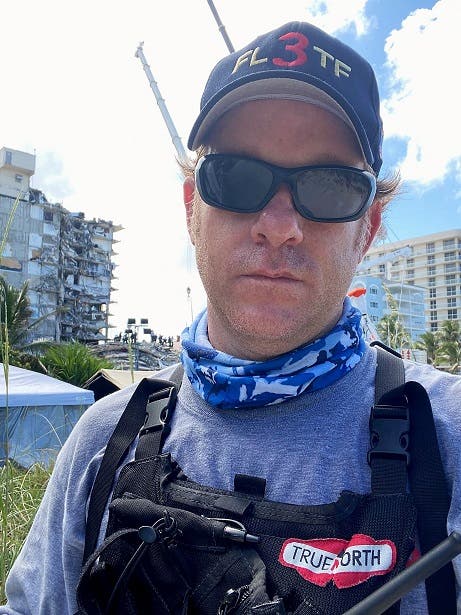
Tampa Fire Rescue Lt. Robbie Northrop is one of 72 member of Florida Task Force 3.
In the case of Surfside, 55 apartments were destroyed when the 12-story Champlain Towers South condominium building partially collapsed, creating a maze of twisted steel, huge chunks of concrete and tons of loose debris that rescue workers had to traverse.
If they moved too fast, there was a risk of further collapse, endangering the rescuers and any survivors who might be buried beneath the rubble.
"We make calculated risks on a regular basis," Northrop said. "We have a creed: Risk a lot to save a lot, risk a little to save a little, and risk nothing to save nothing."
The Tampa Bay task force was already on alert for a call from FEMA when they were summoned to Surfside two days after the June 24 disaster.
After receiving a call from FEMA, a task force has a three- to five-hour window to mobilize, load up supplies, gear and equipment and head to the disaster site.
"We each have a go-bag ready and with us all the time, so we can head out at a moment's notice," said Northrop.
The Tampa Bay task force's 18-wheelers were already loaded with the specialized equipment the task force would need to search for survivors in the debris including vibration detectors, highly sensitive microphones, telescopic cameras that can be inserted into gaps in the rubble to see if people are buried beneath, boring tools, jack hammers and concrete saws.
The task force also packed up six tent-style dormitories, a trailer with bathrooms and showers and generators.
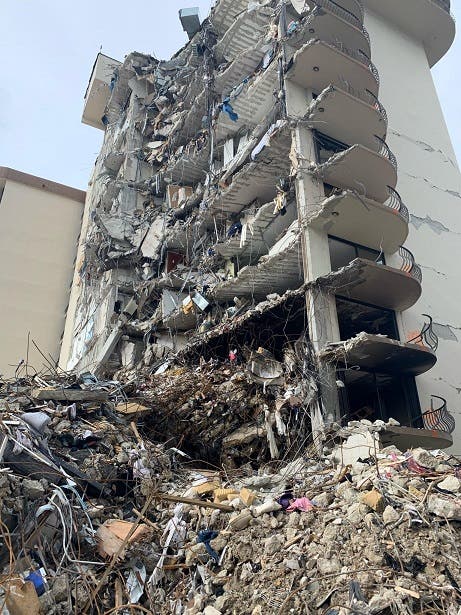
"I don't think any of us expected the magnitude of the task facing us, the tons and tons of concrete," Lt. Robbie Northrop said.
"We literally set up a city at the locations we're sent to," Northrop said.
Accompanied by four certified search-and-rescue dogs, the task force rolled out before dawn on Saturday, June 26, arriving in Surfside about four hours later.
Despite his decade of experience as a member of the task force, Northrop said he wasn't quite prepared for the scene that awaited him when the task force arrived in Surfside.
"It was definitely not what we expected," he said. "I don't think any of us expected the magnitude of the task facing us, the tons and tons of concrete. You'd think it'd be easier to search because it's just one spot. But it was a lot more difficult because of the size of the piles."
He remembers thinking, "How could anyone survive this?," a thought that proved to be prophetic.
To date, 94 people have been confirmed dead and 22 more are missing. There have been no survivors.
After receiving a briefing from disaster coordinators, half of the task force went to work right away at the site, battling the heat and humidity as they gingerly made their way across the massive piles of debris.
In the meantime, the other half of the task force set up their home away from home and waited for their 12-hour shift to begin.
"We used floor plans of the building to calculate where people might be found," he said. "Since the collapse occurred at 1:30 a.m., we focused on areas where bedrooms were located first."
The task force members methodically removed buckets full of debris from the piles and used jack hammers and concrete saws to break up larger pieces of concrete. Occasionally a piece of heavy construction equipment was brought in to remove a massive chunk of concrete, but rescuers had to use excavators and backhoes sparingly to avoid causing a secondary collapse.
"It was a matter of turning big rocks into little ones that we could move off the pile," Northrop said.
Periodically, all equipment would go silent and the dogs would be brought to the scene to listen for the cries or moans of survivors or sniff for bodies buried in rubble.
Northrop said the job was physically and emotionally taxing.
"Of course, we’re always disappointed when we can’t affect a live rescue," he said. "When we arrived, it was pretty clear that we wouldn't find many, if anyone, alive. But you can't afford to lose hope."
Though rare, there have been instances in which people survived for days buried beneath rubble, he said.
Following the 2010 earthquake in Haiti, 16-year-old Darlene Etienne was pulled out of the debris 15 days later.
Each time a body was recovered at the Surfside site, work would come to a standstill and rescue workers would stand at attention to acknowledge the solemn moment.
The father of three children, the oldest of whom is 15, Northrop said it was especially tragic when they found the body of 7-year-old Stella Cattarossi, the daughter of a Miami firefighter.
"We're all family, so when another firefighter loses a child, it's like we all lose a child," he said. "I'm just blessed beyond measure to have been a part of it and to allow some people to have closure."
Upon arriving home, Northrop said the first thing he did was embrace his children.
"I was very, very thankful to be home," he said. "That experience makes you want to hug your children closer. It really puts things into perspective."
Even so, Northrop said he and his go-bag will be ready for his next deployment.
"Somebody has to do it. Somebody has to step forward, and being selected as a member of the task force is one of the greatest honors of my career."
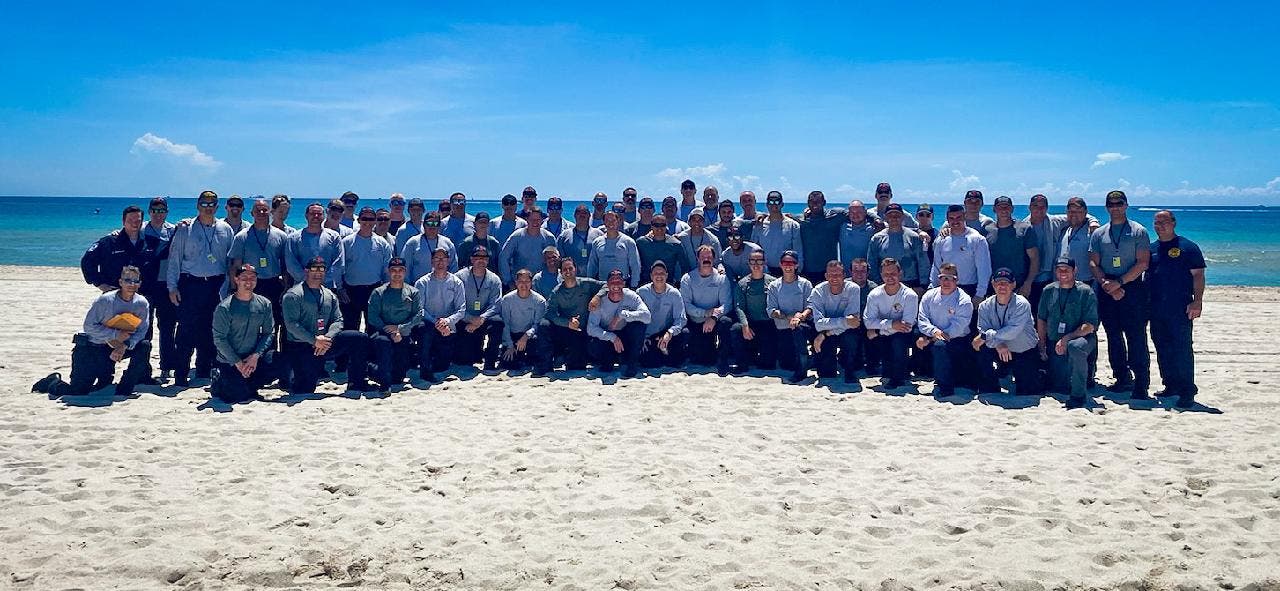
"There isn't a camera lens wide enough to capture the heart of this group," said Florida Task Force 3 member Michael Browning, who posted this photo of the entire team. "Blood, sweat and genuine tears were shed in Miami during our week there.
See related stories:
Get more local news delivered straight to your inbox. Sign up for free Patch newsletters and alerts.