Community Corner
Turtles Can Fly, Too: Rare Sea Turtle Catches Flight To Chicago
After suffering permanent injuries from a boat strike in the Gulf of Mexico, a rare Kemp's ridley sea turtle has a new home near Chicago.


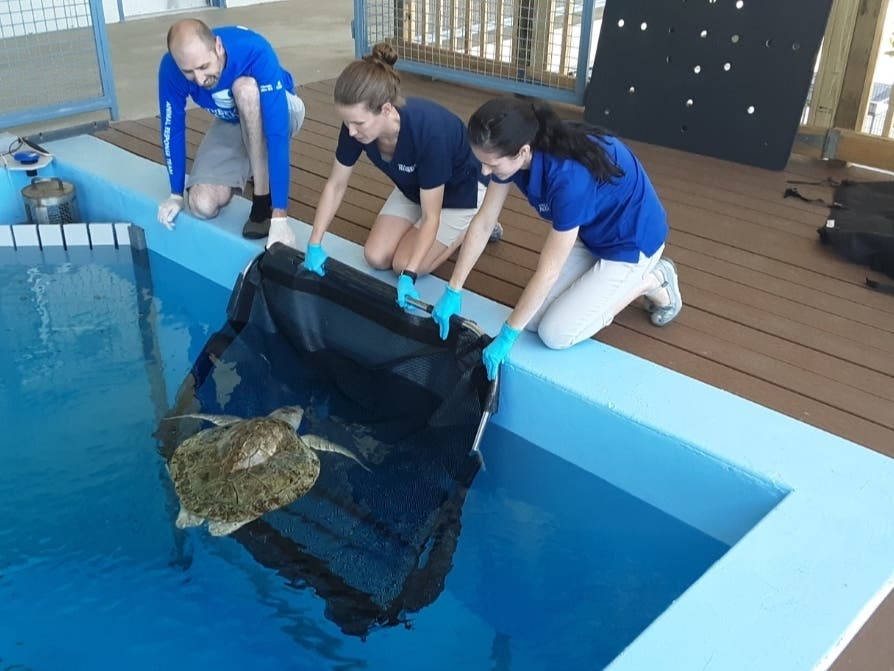
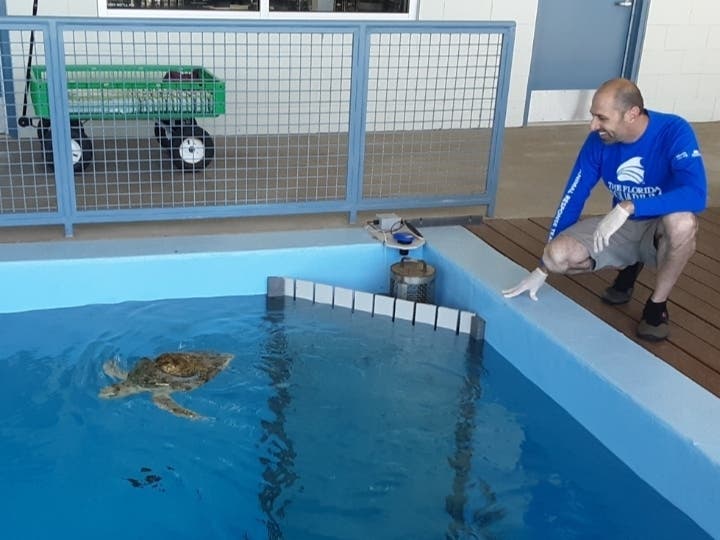

TAMPA, FL — How does a rare sea turtle get from The Florida Aquarium in Tampa to Chicago Zoological Society’s Brookfield Zoo in suburban Chicago? It flies, of course
Thanks to Turtles Fly Too — a national nonprofit organization that engages general aviation pilots who donate their expertise, aircraft, fuel and labor to support endangered-species rescue efforts — Pistachio is adjusting to her new permanent home near Chicago.
Pistachio, an endangered female Kemp’s ridley sea turtle, was brought to The Florida Aquarium in 2012 after being struck by a boat off the coast of Cedar Key. After years of care by The Florida Aquarium’s animal care and health experts, Pistachio is now swimming in her new home at the Brookfield Zoo, thanks to Turtles Fly Too volunteer pilot Brenda Tibbs, who arranged to fly Pistachio from Tampa International Airport to Midway Airport.
Find out what's happening in Tampafor free with the latest updates from Patch.
“The mission of The Florida Aquarium is to save wildlife, especially the most vulnerable species who, without the aid of conservation organizations like ours, might no longer exist in the natural world,” said Roger Germann, president and CEO of The Florida Aquarium. “Extinction is forever, which is why we remained fiercely committed to providing the best care for Pistachio in order to give her a second chance at life.
“Knowing Pistachio will spend the next chapter of her life thriving at the Brookfield Zoo is not only rewarding for all of us at The Florida Aquarium, but it’s personally meaningful to me because Brookfield Zoo is where I grew up enjoying and learning about wildlife," Germann said.
Find out what's happening in Tampafor free with the latest updates from Patch.
“The Chicago Zoological Society is very proud to partner with The Florida Aquarium, Turtles Fly Too and the state of Florida to provide a long-term home for Pistachio,” said Andy Snider, curator of herpetology and aquatics for the society, which manages Brookfield Zoo in the village of Brookfield. “She is a permanent reminder of how important safe boating practices and other water-related activities are when in and around areas where sea turtles and other wildlife are found.”
Upon arriving at Brookfield Zoo, Chicago Zoological Society veterinary staff conducted a complete wellness exam, including a CT scan, on Pistachio at the zoo’s animal hospital. Animal care staff then brought her new home, The Living Coast 36,000-gallon habitat.
Due to the pandemic, all indoor buildings at Brookfield Zoo are currently closed. Although guests are not able to see Pistachio in person, once she gets acclimated to her new home, a member of the animal care staff will introduce Pistachio during a special “Bringing the Zoo to You” Facebook Live chat in late September.
Pistachio was rescued by the Florida Fish and Wildlife Conservation Commission and was transported to The Florida Aquarium’s sea turtle rescue and rehabilitation program. She arrived with wounds to her skull and the front of her carapace (top shell), and as a result, she is partially blind in her left eye, has some partial rear flipper paralysis, and has experienced deformities to her shell; it grows differently now than it should. Her injuries have also made eating more difficult.
“With the support of the skilled animal care staff at The Florida Aquarium, this endangered turtle was able to recover from what could have been a deadly interaction with a boat,” said FWC sea turtle biologist Meghan Koperski. “The scars on her head and carapace highlight the importance of practicing safe and wildlife-wise boating. While this turtle’s injuries were too severe to allow for return to the wild, Brookfield Zoo’s commitment to provide a home for her will allow her to serve an important role as an ambassador for sea turtle conservation.”
While the ultimate goal for the FWC and The Florida Aquarium is to return every rescued sea turtle to the ocean, Pistachio was deemed non-releasable due to the severity of her injuries. The Florida Aquarium animal care team, in coordination with FWC, conducted several deep-water trials with Pistachio at its $4.1 million Sea Turtle Rehabilitation Center and confirmed her inability to survive on her own.
“We take great pride in being able to assist in the aviation transport of endangered animals,” said Leslie Weinstein, president of Turtles Fly Too. “We appreciate our 'turtle fliers' like Brenda Tibbs who donate their expertise, aircraft, fuel and labor to contribute to taking these animals to their new home.”
The Kemp’s ridley sea turtle is found primarily in coastal areas throughout the Gulf of Mexico and along the Atlantic coast of the United States. It has a greenish-gray carapace, and the underside is pale yellow. It is among the smallest sea turtles, reaching only about 2 feet in shell length and weighing up to 100 pounds.
Pistachio still has some growing to do — she currently measures about 1.5 feet in length and weighs just over 35 pounds.
Kemp’s ridley sea turtles are listed as critically endangered on the IUCN’s Red List of Threatened Species. Including injuries and deaths from vessel strikes, additional threats to the species are ocean pollution, entanglement in fishing gear, climate change and oil spills.
Established in 1964, the International Union for Conservation of Nature’s Red List of Threatened Species is the world’s most comprehensive information source on the global conservation status of animal, fungi and plant species.
Video courtesy The Florida Aquarium
Get more local news delivered straight to your inbox. Sign up for free Patch newsletters and alerts.