Schools
USF Physicists Finalists For World's Top Supercomputing Prize
The team used the fastest supercomputer in the U.S. to explore how carbon atoms behave at extremely high pressures and temperatures.


TAMPA, FL — A team of computational physicists and computer scientists led by researchers from the University of South Florida has reached a new milestone in supercomputing and was selected as a finalist for the field’s most prestigious award.
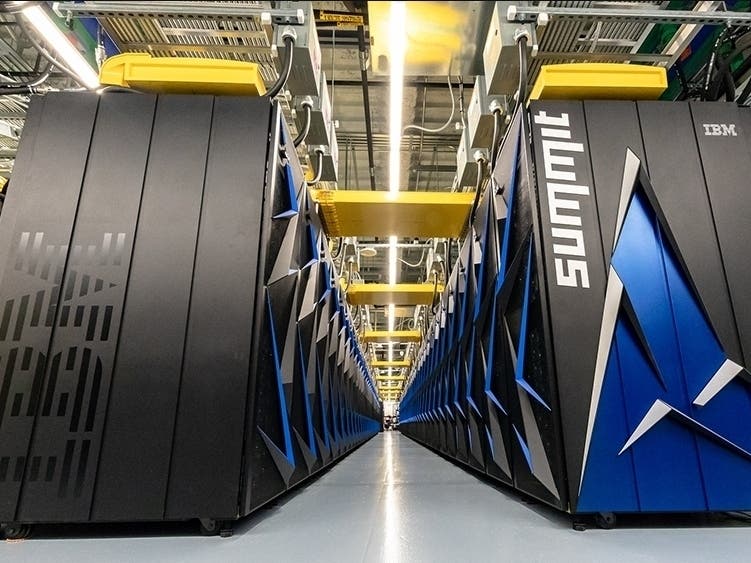
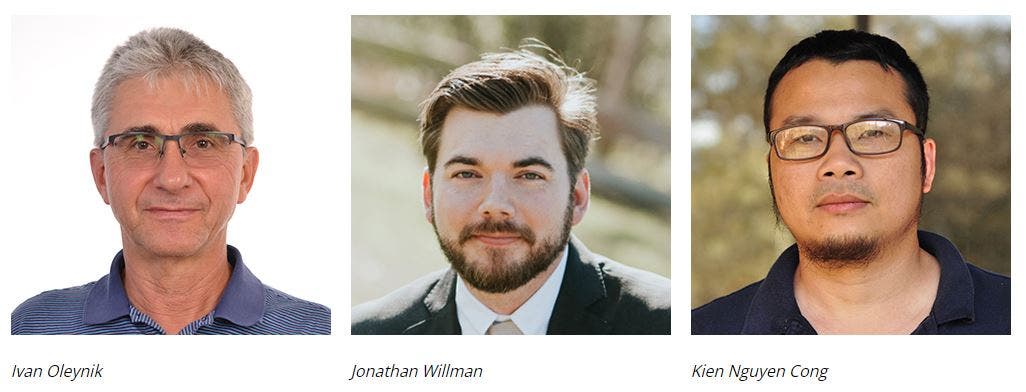
The team, led by Ivan Oleynik, professor in USF’s Department of Physics, along with Kien Nguyen Cong and Jonathan Willman, both of whom recently completed doctoral degrees at USF, used the 200-petaflop Summit supercomputer at the Oak Ridge National Laboratory, the fastest supercomputer in the U.S., to explore how carbon atoms behave at extremely high pressures and temperatures.
Find out what's happening in Tampafor free with the latest updates from Patch.
“This is one of the most significant fundamental problems that exists in material science today,” Oleynik said. “Furthering our understanding of carbon behavior inside of recently discovered exoplanets or upon enormous compression during inertial confinement fusion implosions is paramount to advancing our knowledge of the structure of exoplanets or unlocking limitless fusion energy sources. Making impact through such grand simulations is something we could have never dreamed of.”
For the first time, researchers were able to conduct cutting-edge molecular dynamics simulations of several billion carbon atoms with extreme quantum accuracy. To accomplish this, USF researchers worked with partners from Sandia National Laboratories, the Royal Institute of Technology, the National Energy Research Scientific Computing Center and NVIDIA Corporation to develop novel machine learning interatomic potentials describing interactions between carbon atoms with enabled computational algorithms.
Find out what's happening in Tampafor free with the latest updates from Patch.
By combining this novel methodology with access to Summit, the nation’s most powerful supercomputer, researchers were able to run a 24-hour simulation that uncovered a long sought-after synthesis of high-pressure post-diamond crystalline phase of carbon under extreme conditions. This transformative discovery was made possible not only through access to Summit, but through the use of the team’s combined expertise in innovative atomic-scale machine learning simulation methodology and its algorithmic implementation that helped unlock the predictive power of computer simulations on one of the most powerful supercomputers in the world.
“This was an enormous simulation that has revealed previously unknown behavior of carbon at the atomic scale in billion atom simulations at experimental time and length scales,” Oleynik said. “Not only have we made this discovery, but in the process, broke the previously held world record of quantum accurate molecular dynamics by running our simulation 23 times faster. This is an immense leap forward in computational materials science.”
The team is now working to publish its science findings from this simulation while awaiting the Nov. 18 announcement of the Gordon Bell Prize winner.
To learn more about the team’s work, read their research article.
Get more local news delivered straight to your inbox. Sign up for free Patch newsletters and alerts.