Health & Fitness
Floridians Now Facing Flu And Host Of Other Viral Illnesses
As of this week, the Florida Department of Health said influenza and "influenza-like illness" remains at low levels in most of Florida.


FLORIDA — As Florida reports its first case of the omicron variant of the coronavirus this week, health officials throughout the state are also gearing up for flu season.
As of this week, the Florida Department of Health said influenza and "influenza-like illness" remains at low levels across most of the state, but there's no telling what conditions will be a week from now.
"Influenza seasons vary in timing, severity and duration," said Cassandra Pasley, chief of staff for the Florida Department of Health. "It is not possible to predict what the 2021–22 influenza season will be like in Florida."
Find out what's happening in Tampafor free with the latest updates from Patch.
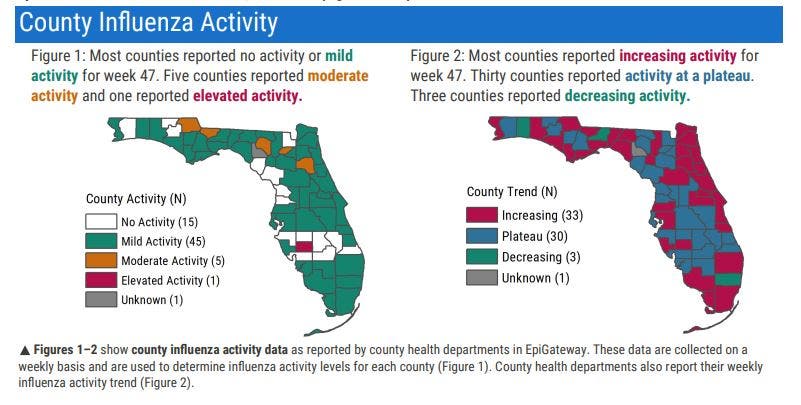
While most counties report low levels of influenza, five counties have reported moderate activity and one county (Desoto County) reported elevated activity.
She said the best way to protect yourself from influenza and its potentially severe complications is to get a flu vaccination.
Find out what's happening in Tampafor free with the latest updates from Patch.
"Now is the perfect time to get vaccinated," Pasley said, noting that "the flu vaccine may be given at the same time as the COVID-19 vaccine.
Click here for information on places to get a flu shot.
Most of the time, flu activity peaks between December and February, although significant activity can last as late as May.
During the last four weeks, the percent of influenza-positive laboratory results remained low but was slowly rising.
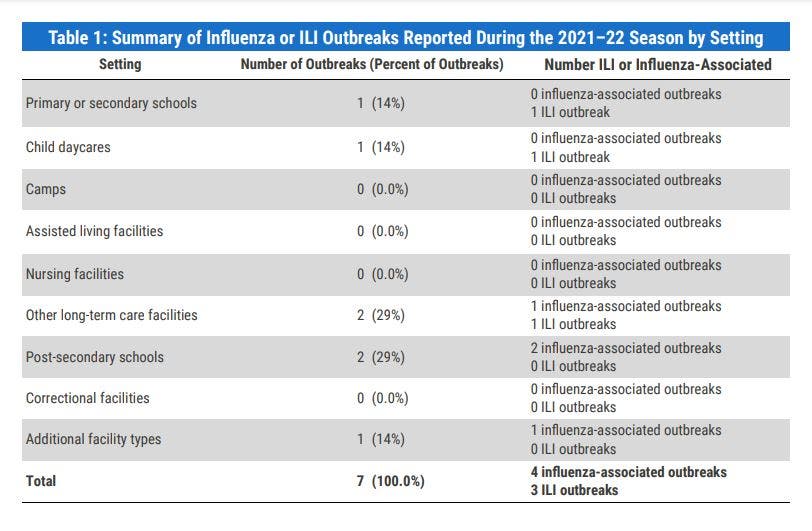
The percent of emergency department and urgent care center visits with discharge diagnoses that indicate influenza infection remained low in recent weeks but are starting to increase for the first time since March 2020, the DOH reported.
"It is still too early to say what strain will predominate during the 2021–22 influenza season," Pasley said. "There was no predominant strain detected in Florida for the 2020–21 influenza season."
This year, there have been more cases of influenza A (H3N2) than any other strains. Strains include influenza A (H1N1) virus, influenza A (H3N2) virus and two influenza B viruses.
Influenza (flu) is a contagious respiratory illness caused by flu viruses. It can cause mild to severe illness, and at times can lead to death. The best way to prevent the flu is to get a flu vaccine each fall. Children age 6 to 23 months of age are considered at high risk for flu complications and should be immunized.
The CDC recommends the use of injectable influenza vaccines.
The "flu shot"—an inactivated vaccine (containing killed virus) is given with a needle, usually in the arm. The flu shot is approved for use in people older than 6 months, including healthy people and people with chronic medical conditions.
The regular seasonal flu shot is "intramuscular" which means it is injected into muscle (typically in the upper arm). It has been used for decades and is approved for use in people 6 months of age and older, including healthy people, people with chronic medical conditions and pregnant women. Regular flu shots make up the bulk of the vaccine supply produced for the United States.
The high-dose vaccine is for people 65 and older which also is intramuscular. This vaccine was first made available during the 2010–11 season.
All flu shots in the U.S. are “quadrivalent” vaccines, which means they protect against the four different influenza viruses.
About two weeks after vaccination, antibodies that provide protection against influenza virus infection develop in the body.
The flu vaccine is the best way to prevent infection, but everyone must be re-vaccinated each year because the flu viruses change each year.
Symptoms of the flu include:
- Fever (not everyone with flu will have a fever) or feeling feverish/chills
- Chills
- Cough
- Sore throat
- Runny or stuffy nose
- Headache
- Muscle or body aches
- Tiredness
- Vomiting and/or diarrhea (this is more common in children than adults)
For those diagnosed with the flu, the CDC recommends beginning antiviral (monoclonal antibody) treatment as soon as possible for suspected influenza who are at higher risk for complications, including children under 2 years old, adults over 65 years old, pregnant women and people with underlying medical conditions.
Like with COVID-19, treatment should be administered within 48 hours of the onset of illness.
In addition to influenza and the coronavirus, the DOH monitors for other respiratory illnesses including:
- Influenza unspecified
- Respiratory syncytial virus
- Rhinovirus
- Parainfluenza 1-3
- Adenovirus
- Human metapneumovirus
Currently, rhinovirus is the predominant respiratory illness in Florida. 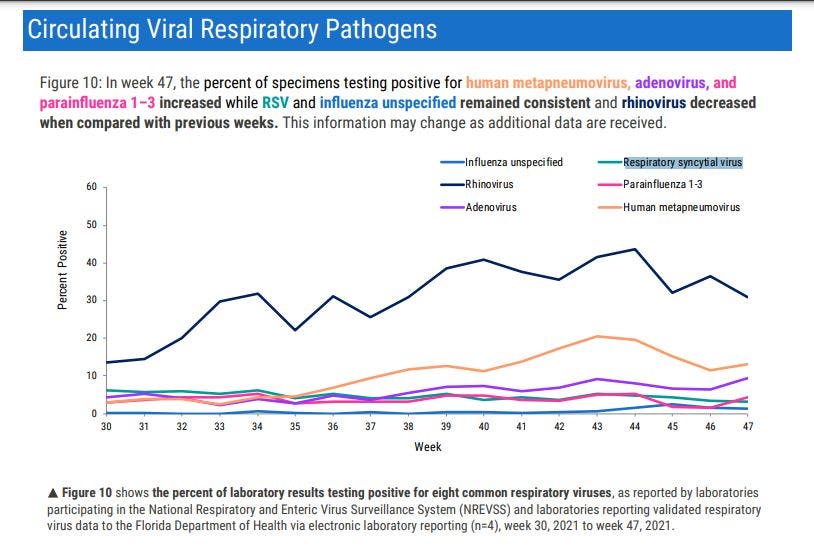
Get more local news delivered straight to your inbox. Sign up for free Patch newsletters and alerts.