Community Corner
Yoga 101: 5 Props to Make Poses More Effective
A wall, blanket, strap, chair or yoga block can help you find more ease, alignment and strength in your postures.


I never make a promise that I can't keep, and I promised you a few columns ago that I would cover the basics of using props as part of a yoga practice, so let’s get started!
Let begin with how and why to use props. BKS Iyengar is pretty much the father of most of the Western props and tools that we use today. Iyengar experimented for many years on himself, manipulating his body with bricks from the street, ropes and empty barrels to find ways to make yoga accessible to every body.
We now have modern choices including fabric straps, bolstgers, blocks, pillows, stools and chairs. Here are my five favorite props to use.
Find out what's happening in Tampafor free with the latest updates from Patch.
No. 1: The Wall
The wall is a great resource because it offers help with stability in balancing poses and support with strengtheners like , or extended side angle, and it can mimic a floor in poses such as a supine modified tadasana.
Find out what's happening in Tampafor free with the latest updates from Patch.
One of our first postures in the yoga 101 series was , or the mountain pose. This posture can be practiced two ways using the wall.
The first way is to put your back against a wall, placing your heels at the edge where the floor meets the wall. Draw your shoulders back and down, letting the chest rise and the tailbone slightly reach for the floor, feeling the support of the wall.
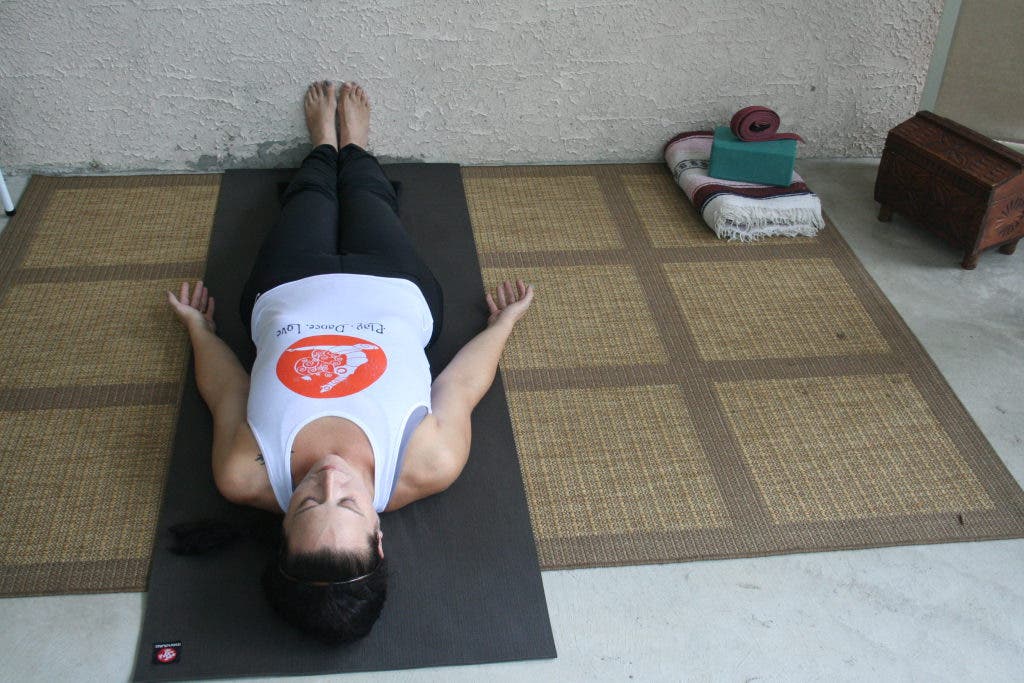
The second way you can do this posture is on the floor, completely supine. Lie back on the floor, lengthen your legs and place your feet flat on the wall with your heels on the floor. Engage as you would inthe mountain pose but with the complete support of the floor. (You can place a towel or small pillow under your head if there is arching or tension in your neck.)
, the goddess or horse pose, is another great one to try with the support of a wall.
Bend the knees out and away from you as you slide your back down the wall. Your knees should hover over your toes; adjust your legs and feet away from the wall to make sure your weight is still on your heels. Your heels should be turned slightly in and your toes slightly out. Use the support of the wall to help reach the tailbone down toward the floor.
Press your shoulders into the wall and raise your arms, bending your elbows in line with your shoulders.
No. 2: The Block
A block can be used for almost any posture, from sitting on it in , or easy posture, to helping you bring the floor up to you for extended side angle.
The block is a resource that will help bring the earth a little bit higher. In cases like easy posture, it helps those of use with less-open hips and knees. By sitting on it, the hips become higher, letting the knees drop below and feel less tight.
You can also use a block to help you feel postures that require you to touch the ground. In the extended side angle pose, you can try three heights – low, medium and high – to help you find the earth. Using a block can help you feel grounded in your bottom hand and create more length and openness.
We will include modifications using the block in future yoga 101 postures. The big box stores usually carry them, and most yoga studios have them for sale, as well.
No. 3: The Blanket
Using the blanket as a prop can become an art form of folds and tucks in itself, but here we will touch upon the two most common and important ways. We use the blanket to help protect and pad our limbs and joints, like when we place it under our knees. Or we use it to find comfort and support, like when we fold it and sit on top in easy posture, easing the knees and hips.
Folding the blanket lengthwise across your mat as we did in , or the low lunge, padding the knees is a common way protect the knee joints when in this pose or similar poses like the table, cat cow and low warrior II. Using a blanket is a must when practicing on concrete or tile floors, or if you have had surgery or feel any pain.
Blankets are also helpful when we need to free the hips, such as in easy posture or , the butterfly pose. Fold the blanket to whatever thickness you need, and sit on it to feel it out. You may even need two or three blankets to find comfort in the hips. If you are in easy posture, your knees should be lower than your hips.
Try the butterfly pose. You want the hips to relax as the knees spread apart. Using the blanket in these postures helps the body soften and open naturally without force.
No. 4: The Strap (or Towel)
We can use a yoga strap in reclined , the staff pose, or to help in finding the bind in a posture like extended side angle.
If you don’t have a yoga strap, you can use a hand or bath towel in the same way as a strap except when you are using the prop in a supportive way, such as in dolphin or back bending, two future yoga 101 postures. Always approach the strap or towel as an extension of your arm, hand and fingers.
In reclined dandasana, you can place the strap across the feet and pull back with your hands on each side as your feet press into the strap or towel. In extended side angle, we use the strap as an extension of our fingers, incorporating a bind around the thighs to help ourselves increase the intensity of the pose.
We will incorporate the strap or a towel in a lot of our future yoga 101 columns, so always have it on hand.
No. 5: The Chair
The chair can be used for most of the postures covered in the yoga 101 series. I often teach versions of these postures to my . I have my students use the chair for the support they need, exactly like we use the wall or the earth. Sitting down in the chair, one can feel rooting in the feet to find a version of tadasana. The spine lengthens, the shoulders roll down and the crown of the head extends toward the sky. The goddess pose can be done in the chair, as well.
Finding a seated meditation and working on pranayama, or breathing, can easily be done in a chair by rooting the feet. In seated meditation, place your hands comfortably up or down in your lap.
Find your postures this week with a little help from these props, and begin to experiment with options to finding better comfort, ease and balance in the body, mind and soul.
Namaste!
Look for an upcoming column on restorative yoga classes, and how we can dive into even more uses for these props.