Arts & Entertainment
Yum Or Yuck? Chef Serves Up Gourmet Insect Dishes At BugsGiving
Nearly 150 people had no problem acquiring a taste for edible insects Friday when the Museum of Fine Arts hosted BugsGiving.


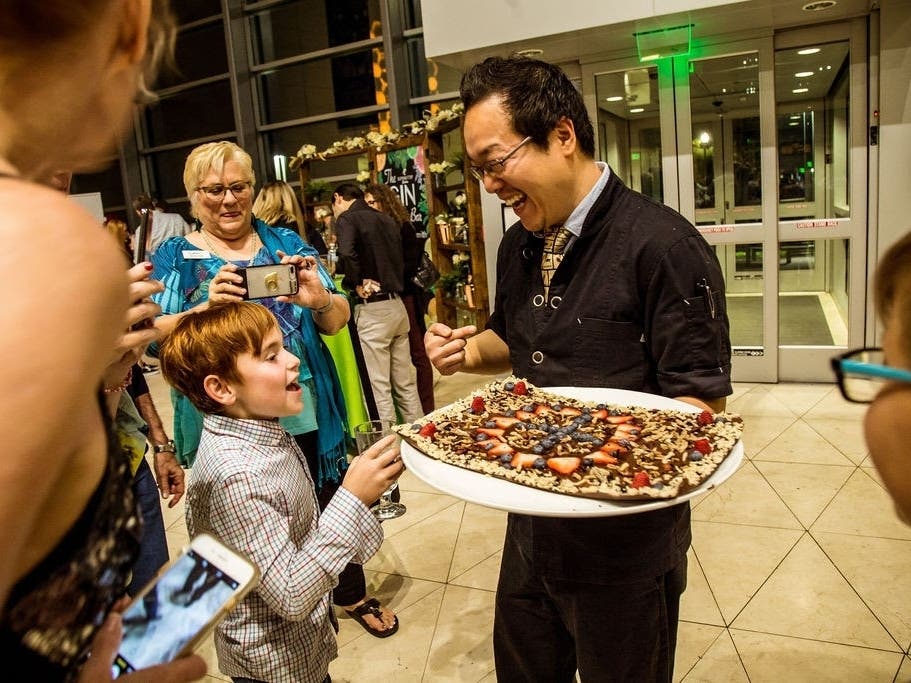


ST. PETERSBURG, FL — Nearly 150 people had no problem acquiring a taste for edible insects Friday when the Museum of Fine Arts in St. Petersburg hosted its sold-out BugsGiving event.
Chef Joseph Yoon, executive director of Brooklyn Bugs, created a menu of 10 dishes inspired by the MFA's current special exhibition, The Grasshopper and the Ant'and Other Stories, as told by Jennifer Angus, on view through Jan. 5.
Guests ranging from children to seniors not only devoured the "ento-cuisine" - insects cooked and baked into gourmet dishes - but also had the opportunity to tour the exhibit. Dishes included superworms with MFA St Pete honey (see related story) and Greek yogurt on apple slices; black ants and cucumber on shrimp cocktail; grasshoppers on potato medallions with creme fraiche; cricket chocolate brownies; crickets with gougeres, pecorino romano and herbs; Manchurian scorpion with gochujang sauce, cucumbers on wonton crisps; mealworm mac 'n cheese bites; termites with black beans, rice, aioli with cricket powder and Green Goddess dressing; and drinks like cricket-infused Sipsmith Gin with lime, soda and tonic.
Find out what's happening in St. Petefor free with the latest updates from Patch.
The artist, Jennifer Angus, made an appearance at the event as well. She was in town for her artist lecture that took place Saturday at the museum, 255 Beach Drive N.E., St. Petersburg.
The art installation, the largest of the contemporary Canadian artist's career, features nearly 5,000 exotic, dried insects reimagined as art pinned to the walls and displayed in other unique ways in the 7,000-square-foot Hough Wing.
Find out what's happening in St. Petefor free with the latest updates from Patch.
Where many see nuisance pests and recoil, Angus looks deeper and embraces their natural beauty — the rainbow colors of their giant wings and exoskeleton, the wispiness of an antenna, the jagged design of their legs. In her eyes, insects are not to be feared, but celebrated.
She hopes her latest project at the Museum of Fine Arts will rekindle a sense of discovery and respect for the importance and beauty of what she calls the “six-legged kingdom.”
Inspired by Aesop’s Fables and steeped in neo-Victorian ideas and design, Angus’
elaborate “wallpaper” patterns made of dried insects are pinned into
place (just as insects were traditionally collected and displayed in the 19th century).
The designs entice the visitor’s natural attraction to color and repetition, but upon a closer look, will challenge the viewer’s perception of insects and expectations of beauty.
An oil painting from the MFA Collection illustrating the Greek fable, The Grasshopper
and the Ant, serves as the starting point for the show. Quotes from various
Aesop’s Fables are printed on small cards that visitors can collect throughout
the galleries to guide their experience.
To complement Angus' exhibit, the “Cabinet of Curiosities” gallery includes bell jars with collections illustrating the Seven Deadly Sins; large cases with memento mori displays, alluding to the importance of insects in decomposition; and a large Victorian apothecary-type cabinet with 170 drawers containing surreal vignettes of insects performing human activities.
Another gallery features a whimsical, Victorian “animal dinner party” inspired by the tea
party in Alice in Wonderland.
Angus, a professor of textiles at the University of Wisconsin-Madison, combines her
medium with symbolic imagery such as skulls and clocks to speak to the global
disasters happening in the environment (i.e., colony collapse of bees) and how
humans play a part in the destruction.
“I seek to rehabilitate the image of insects and draw correlations between humans
and members of the six-legged kingdom. The fear we have of insects is generally
unwarranted,” said Angus. “Their role in the environment is vital to human
survival, whether it be in the pollination of flowers, which in turn produce the
fruits we so enjoy, or the decomposition of matter. Insects are both beautiful and
essential. I hope this exhibition will inspire conversations about what we value, the
stories we are part of, and the small actions we can take today to make change for
the greater good.”
The species Angus uses are not endangered. They are either farm-raised —
primarily in Madagascar, Malaysia, Thailand and Papua New Guinea — or
collected by the indigenous peoples who live in the areas from which they originate.
Angus recycles all insects, and many of them have been used repeatedly in her
shows for nearly 20 years. Her rule: she only uses insects with all six legs intact. If
they are missing parts or she can't repair them, she then creates “hybrid” creatures
for bell jars or other displays.
Angus has created art with insects since the late 1990s, presenting her work in solo
and group exhibitions mostly in the mid-West, Canada and New York. Then, in
2015, her unique and captivating installations catapulted her to mainstream fame
when her piece, In the Midnight Garden, was a part of WONDER, the inaugural
exhibition for the reopening of the Smithsonian Institution’s Renwick Gallery.
“You are rewarded by looking slowly and carefully at Jennifer’s work. It’s a thought-provoking and aesthetic experience. It’s experiential,” said MFA Executive Director
Kristen A. Shepherd. “This is not an exhibition about insects; it’s about all of us. It’s
about beauty and where we find it; about what we value in the world; and about
what we are prepared to do to change the stories happening all around us. With her
work, Jennifer hopes to make people think about insects a little differently. With so
much to see, visitors will want to experience this exhibition again and again, each
time discovering something new.”
Kids in grades first to fourth are invited to learn more about the benefit of insects during the Grateful for Grasshoppers Day Camp Monday, Nov. 25 from 9 a.m. to 4 p.m. The cost is $40 for museum members and $50 for nonmembers.
Get more local news delivered straight to your inbox. Sign up for free Patch newsletters and alerts.