Politics & Government
Burial Site Of Sponge Divers Added To National Historic Register
The historic burial site of many Tarpon Springs divers who perished while sponge diving is now on the National Register of Historic Places.



TARPON SPRINGS, FL -- The historic burial site of many Tarpon Springs divers who perished while sponge diving is now on the National Park Service's National Register of Historic Places.
Florida Secretary of State Laurel M. Lee announced that Cycadia Cemetery at 1021 E. Tarpon Ave. received the national recognition this month.
“Cycadia Cemetery is a culturally and historically significant site for Tarpon Springs’ Greek community,” said Lee. “Artistic detail on many of the graves is associated with important cultural practices such as sponge diving and music as well as religious beliefs.”
Find out what's happening in Tarpon Springsfor free with the latest updates from Patch.
The carvings on monuments and tombstones incorporate distinctive Greek American art elements earning the cemetery the National Register designation of Traditional Cultural Property, reflecting how the grave markers and funeral rituals that take place at Cycadia Cemetery continue to reflect Greek and Greek American traditional culture.
Tarpon Springs has been home to a large Greek American community since the early 20th century, and today has the highest percentage of Greek Americans of any city in the United States.
Find out what's happening in Tarpon Springsfor free with the latest updates from Patch.
Sponge diving crews came from the Dodecanese islands of Kalymnos, Halki and Symi and the Saronic Gulf islands of Aegina and Hydra after learning about Tarpon Springs through letters, newspaper articles and advertisements offering to pay travel expenses.
Sponge diving had already been a thriving industry in Tarpon Springs, and the city capitalized on the experience and expertise of the Greek sponge divers to further increase the success of the community.
The Greeks soon established Greektown with numerous residences, stores, churches, restaurants, coffee houses and recreational facilities that stretched from the Sponge Docks to the central section of the city. Greektown was designated as a Traditional Cultural Property historic district on the National Register of Historic Places in 2014, and Cycadia Cemetery, while not within the boundaries of the district, is associated with its culture and practices.
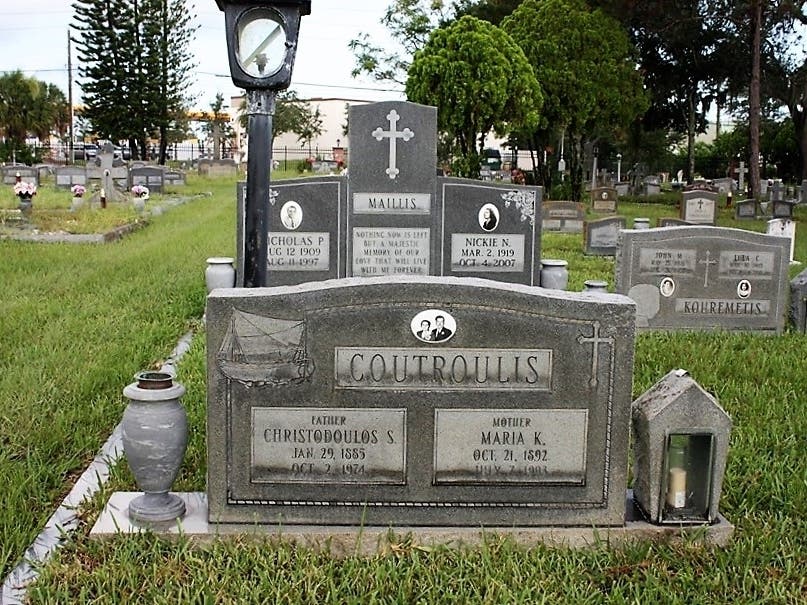
Lee said Cycadia Cemetery is significant for the number of sponge divers and boat captains interred there. The dangerous profession of sponge diving resulted in many deaths. The gravestones, mausoleums and large family plots in Cycadia Cemetery are among the most distinctive in the nation—and they differ from graves both in Greece and among non-Greek Tarponites, according to the National Register. Many headstones are carved with sponge boats, anchors and diving helmets, or include porcelain portraits of the deceased in their diving suits or at the Sponge Exchange.
To entertain the large Greek community, many nationally respected Greek and Greek American musicians and vocalists have lived in Tarpon Springs and performed at kafeneia (coffee shops), restaurants, clubs or for special events. Some of these significant musicians are buried in Cycadia Cemetery, including George Katsaros (1888-1997), a guitarist and one of the most widely respected Greek musicians of the 20th century, and Amalia Baka Vasilia (1897-1979), a singer who was one of the most famous Greek female vocalists of her time.
Another significant burial at Cycadia Cemetery is Mother Superior Thekla Makris (1910-1992), believed to be the first Greek Orthodox nun in North and South America.
Since the first major wave of Greeks arrived in Tarpon Springs in 1905 to work in the sponge industry, Cycadia Cemetery has been the major site for community burials, with graveside ceremonies and ongoing memorial observances.
The cemetery continues to be used for burials. Last year, thanks to a donation by longtime Tarpon Springs resident Harold Haftel, the city was able to acquire 2.55 acres of land at Jasmine Avenue and Keystone Road to expand the cemetery.
The Tarpon Springs cemetery is among 1,700 Florida sites on the National Register. All nominees are submitted to the National Park Service through the Florida Department of State's Division of Historic Resources.
Get more local news delivered straight to your inbox. Sign up for free Patch newsletters and alerts.