Community Corner
Diving Birds and Grunting Gators in Anderson Park
Anderson Park is as accessible as it is fascinating with some impressive wildlife to be seen just feet from the parking lot.


This week, my quest to find fresh air and wildlife took me to A.L. Anderson Park on U.S. 19 in Tarpon Springs. The inconspicuous entrance is quite easy to miss if you do not know it is there, but once inside the park you find it is well maintained and a lot of fun.
Named for a local fisherman and conservationist, A.L. Anderson Park is fairly small at just 135 acres, but there is so much squeezed into that space. Thanks to its location on the shores of Lake Tarpon, the area is alive with wildlife.
Passing the boat ramp area to the left, I parked my car in the lot at the far end of the park and followed the nature trail that skirts the edge of the lake. It was a comfortable and easy path to follow and is dotted with small piers that run out to the lake and offer pleasant spots for barbecues or for simply enjoying the views.
Find out what's happening in Tarpon Springsfor free with the latest updates from Patch.
On my last few excursions I have encountered large numbers of mulletpropelling themselves out of the water. This week, being away from salt water, I did not see any fish flying, but perhaps even more impressive, I did spot a bird swimming underwater.
The creature in question was an anhinga, a remarkable bird that seems to spend half its time getting wet and the other half trying to get dry again. I was at the end of one of the piers, looking out over the picturesque lake, when I noticed a small head surface about 10 feet ahead of me. At first, I thought it was a turtle, but the head continued to emerge from the water and soon a long slender neck was exposed.
Find out what's happening in Tarpon Springsfor free with the latest updates from Patch.
The anhinga came closer to shore and then swiftly hopped up onto a low-hanging branch and extended its wings. It remained like this, perfectly stationary, and I realized it was dying itself off in the afternoon sun.
I left this remarkable bird to get dry and continued along until I reached a wooden boardwalk. This afforded me a more unobstructed view of the lake, and it was while I was enjoying the scenery that I began to notice the air was filled with a curious grunting sound.
At first I thought it was the croaking of frogs, but my wife, a Florida native, informed me that it was in fact the sound of alligators. This immediately peaked my inquisitiveness, and I spent the rest of the walk searching for gators, albeit unsuccessfully.
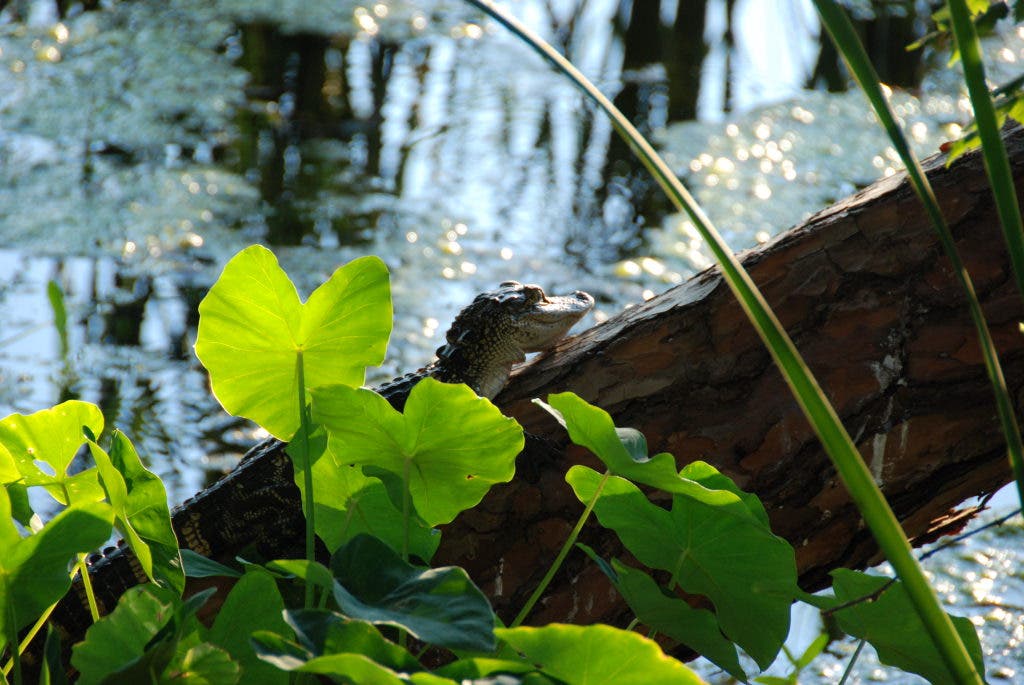
It was only once we had turned around and almost made it back to the car park that I came across not one, but two alligators. The first was almost completely submerged; only its eyes and snout were visible above the water. As I attempted to get closer to this gator, I almost stepped on another that was sunning itself on a tree trunk.
Thankfully he was only small and somewhat photogenic, so I managed to take a few pictures without losing any limbs.
I thoroughly enjoyed Anderson Park. While certainly not the biggest park and unquestionably not the longest hike I have been on since starting this series, Anderson Park seems to have crammed so much within its modest borders. Despite being right next to U.S. 19, the park is extremely peaceful and it is easy to forget you are right next to a very busy highway. It brings the feeling of being in the middle of nowhere right to your doorstep.