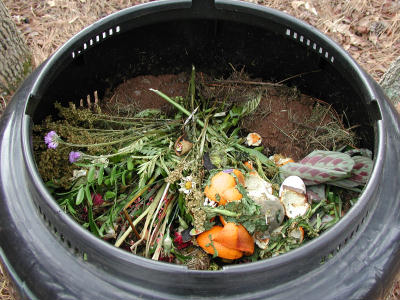
Composting your kitchen waste is a terrific and total use of food. To literally ‘waste it’ by throwing it in the trash or down the garbage disposal is to miss out on a prime resource for rich, organic fertilizer for the garden or even potted plants. If you have hens that you supplement with your kitchen scraps, you will still be utilizing their manure for compost eventually.
At the household level, the simplest compost can be in a pile outdoors. Leaves, grass clippings, sawdust, and ‘green’ food waste all breaks down over a period of months, to create humus. We have a place in our yard where we keep this kind of ‘brown’ pile, but we use it to add to our closed compost bin where we put our kitchen waste.
The reason we prefer to have our food waste contained is to prevent attracting unwanted vermin. The holes in the bottom of our barrel do attract the worms, fungi, microbes, and other helpful insects that break it down more quickly.
Find out what's happening in Tarpon Springsfor free with the latest updates from Patch.
Adding manure or cottonseed meal helps to create heat that decomposes organic matter, converting it into nutrient rich soil. Believe it or not, The Dancing Rabbit, an all vegan intentional community in Missouri, uses ‘humanure’ in their compost bins.
(The Dancing Rabbit residents simply don’t waste anything in their community, and because they live off-grid and are mindful of resources, they consider the use of water for flushing toilets to be wasteful. They’ve created composting toilets as an alternative to a septic system, and use humanure in their gardens after a year of breaking down.)
Find out what's happening in Tarpon Springsfor free with the latest updates from Patch.
So, here are the ultra-basics of composting. All kinds of plant materials have two necessary composting components the microbes feed on - carbon and nitrogen. ‘Brown’ materials, high in carbon, are leaves, saw dust, wood chips and such. ‘Green’ materials high in nitrogen and moisture are grass clippings, kitchen food scraps (even brown ones like coffee grounds and tea bags) and manure.
Everything should be somewhat small - 2-3” long in size. We even chop up banana peels, avocado skins, and citrus rinds so they will break down more easily.
It is ideal to layer your compost, like lasagne, so if you’ve added a lot of ‘green’ food scraps, it is great to add a ‘brown’ layer of leaves or sawdust, even dirt!
The University of Florida recommends partial shade for the location of the compost bin. We don’t spend a lot of energy ‘turning the compost’ because the warm weather breaks it down so rapidly. There are some ‘suspended’ home compost bins that have a crank for turning. If they are off the ground, you definitely need to add dirt in order to get the microbial action going.
Compost should be moist, but avoid letting it get saturated. A lid or cover for your compost is necessary during the rainy season. If it is too wet, it will start to have a subtle rotten egg smell. If that occurs, simply add leaves to the compost. We often leave the lid off during the day, just to let it ‘breathe’ and we make sure the food scraps are covered over so fruit flies are kept at bay.
The most scientific aspect is tracking the temperature of your compost. The ideal temperature is between 105-140 F degrees. Anything above 150 F degrees starts to kill the good microbes. If it is not hot enough, the matter doesn’t break down quickly. It has to be 136 F degrees for seeds to die. So, if you don’t want to grow any surprise ‘volunteers’, it’s good to add manure or cottonseed meal to heat it up. If you pull up seeding weeds, put them in your yard waste bin! It is best to keep seeds out of the compost bin.
For really excellent and detailed information, please visit Florida’s Online Composting Center here: http://sarasota.ifas.ufl.edu/compost-info/ Another excellent resource is Eliot Coleman’s The New Organic Grower. Just don’t let the idea of composting become too complicated or daunting because it is truly not challenging at all. It is just a new habit with the end goal of creating great potting or gardening humus for free!
To live sustainably, utilizing food waste for compost is essential. So, until we have a formal city program in place, this is the way to live ahead of the curve in Tarpon Springs!