Health & Fitness
Behold the Limpkin
Behavior of the Limpkin, one of our prominent and unusual tropical waterbirds, is described.
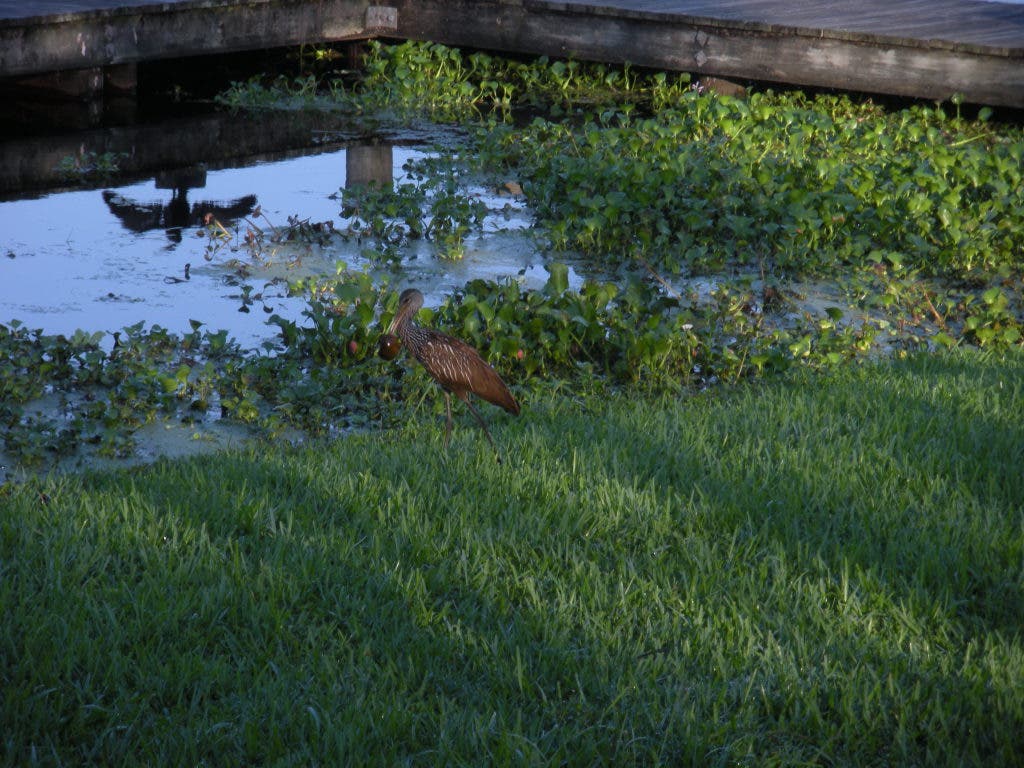


The Limpkin is one of our riverfront's most prominent birds. It's a large tropical long-necked bird with brown and white feathers, long, dark legs, and a thin long bill that comes to slight curve at the tip. This bill is the most important feature of the Limpkin because it allows the bird to feed on its favorite meal. This happens to be the large apple snail, which doesn't want to be eaten and protects its innards inside a hard shell, with the shell's opening sealed off by an operculum. Think of the operculum like a hatch cover. On one side is the outside world in all its threatening glory. On the other is the inside of the snail, with all of the organs, tissues, and other parts necessary to keep the snail alive. What happens inside the snail is not that different from what happens inside of us except that it is encased inside a hard shell. The Limpkin's challenge is to get into the soft stuff and feast on the snail's insides. This is where the Limpkin's special bill comes in. It is exactly suited for the job of unsealing the operculum from the shell. This it does by fitting in to the small joint between the two and prying the operculum open and off, not too different from how you use a short stiff knife to shuck an oyster. Others have compared the penetration of the beak to the action of tweezers. Once the hatch cover is off, in goes the beak to fish out the soft insides, which the Limpkin is happy to parade about with dangling from its mouth. They're not shy about eating in front of others, so as long as you don't try to take away its hard-won meal, the Limpkin will let you watch. As far as I can tell, every meal is a gourmet event for a Limpkin, as they seem to only eat snails.
I'm attaching photos showing the un-doctored, un-retouched real remains of a Limpkin meal. You'll see that the shell itself is not punctured or perforated. The thin disk-like object off to the side is the discarded operculum. Don't worry too much about the snails. One photo shows the abundance of snail eggs laid on trees and shrubs along the river's edge. Looks like there'll be plenty of them for the next Limpkins to eat, with some left over. I'm also attaching a poor quality photo of a Limpkin. All of these were taken at the RH Boardwalk. If you're there between 6:30 and 7:00 am you'll see many Limpkins enjoying their breakfast.
We are lucky here in TT to have Limpkins. Florida is at the limit of their northern range, and they live here year-round. Pioneers living in Florida in earlier times found them easy to capture and took a fondness for eating Limpkin. Habitat destruction also took its toll, and Limpkin numbers declined. Plenty of them in our neighborhood though, and I encourge you to seek them out. And if it turns out that you're more interested in snails, here's a website with everything you need to know and more: http://www.applesnail.net.