Business & Tech
Business Profile: The Story Behind the Eye-Catching Art at I-75 Exit
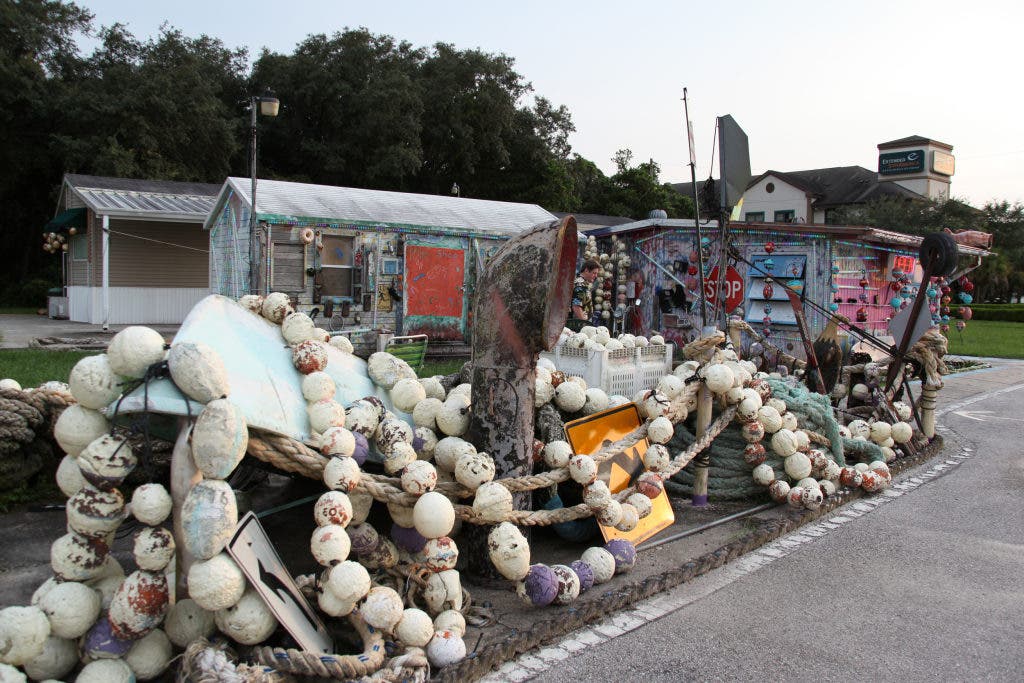
Folk artist Joe Brown, better known as "Hong Kong Willie," makes art with a message at his home/studio near I-75's Exit 266.


Sometimes, it’s the smallest experiences that have the biggest impact on a person’s life.
While attending an art class in 1958 at the age of 8, Tampa folk artist Joe Brown recalled being mesmerized by the lesson. It involved transforming a Gerber baby bottle into a piece of art.
“The Gerber bottle had no intrinsic value at all,” he said. “But when (the instructor) got through with me that day, she made me see how something so (valueless) can be valuable.”
Find out what's happening in Temple Terracefor free with the latest updates from Patch.
By the time class was over, Brown learned many other lessons, too, such as the importance of volunteerism, recycling, reuse and giving back to the community. He recalled being impressed by the teacher's volunteer work in Hiroshima, Japan, helping atomic bomb survivors.
"One of the last words she ever spoke to me about that was, ‘When I left, I left out of Hong Kong,’” he said. After turning that over in his young brain for awhile, he decided to use it in a nickname, adding the name “Willie” a year later.
Find out what's happening in Temple Terracefor free with the latest updates from Patch.
You've probably seen Hong Kong Willie's eye-catching home/gallery/studio at Fletcher Avenue and Interstate 75. But what is the story of the man behind all those buoys and discarded objects turned into art?
Brown practiced his creative skills through his younger years. But as an adult, he managed to amass a small fortune working in the materials management industry. By the '80s, he left the business world and decided to concentrate on his art. He spent some years in the Florida Keys honing his craft and building his reputation as a folk artist. He also bought some land in Tampa near Morris Bridge Road and Fletcher Avenue where he and his family still call home.
Brown purchased the land just after the entrances and exits to I-75 were built. He said he was once offered more than $1 million for the land by a restaurant. He turned it down, he said, preferring instead to make part of the property into a studio and gallery for the creations he and his family put together.
And all of it is made of what most people would consider “trash.” Pieces of driftwood, burlap bags, doll heads, rope—anything that comes Brown’s way becomes part of his vocabulary of expression, and, in turn, becomes something else, which makes a tour of his property somewhat of a visual adventure. What at first seems like a random menagerie of glass, driftwood and pottery suddenly comes together in one's brain to form something completely different. One moment nothing, the next a powerful statement about 9/11.
One Man's Trash ...
Trash? There is no such thing, Brown seems to say through his art.
He keeps a blog about his art at hongkongwillie.blogspot.com. He also sells his creations through the Web site Etsy.com.
In his shop, he has fashioned many smaller items out of driftwood, burlap bags and other materials into signs, purses, totes, bird feeder hangars and yard sculptures.
He sells a lot to the regular influx of parents and students every year who are are at first intrigued by the “buoy tree” and the odd-looking building they see as they take Exit 266 off I-75.
Brown Sells More Than Art
Of course, the real locals know Brown’s place for the quality of his worms.
If there’s one thing that Brown knows does well in the ground, it’s the Florida redworm, something he enthusiastically promotes, selling the indigenous species to customers for use in their compost piles. Some of his customers say his worms are just as good at the end of a fishing hook, though.
“To be honest, what made me come here is that they had scriptures on the top of his bait cans,” said customer John Brin. “Plus, they have good service. They’re nice and they’re kind, and they treat you like family.”
Though Brin knows Brown sells them mostly for composting, he said they are great for catching blue gill, sand perch and other local favorites. He also added that he likes getting his worms from Brown “because his bait stays alive longer than any other baits I’ve used.”
For prices and amounts, he has another blog dedicated just to worms.
Of course, many people also stop by to buy the smaller pieces of art that he and his family create: purses made of burlap, welcome signs made of driftwood, planters and other items lining the walls of his store.
He’s also helped put his mark on the decor of local establishments too, such as , 8448 N. 56th st.
Owner Jimmy Ciaccio said that when it came time to redecorate the restaurant several years ago, there was only one person to call for the assignment, and that was his good friend Brown.
"I’ve known Joe all my life, and we always had a good chemistry together,” Ciaccio said. "He’s very creative and fun to be around, and that’s how it all came about.”
Ciaccio says he still gets compliments all the time for the restaurant’s atmosphere he created using the “trash” supplied by Brown. He describes the style as a day at the beach, like a visit to Old Key West.
“They’re so inspired, they want to decorate their own homes this way,” he said.
It’s that kind of testimony that makes Brown feel good, knowing that others, too, are inspired to create instead of throw away when they see his work. He simply lets his work speak for itself.
“Somebody once told me to keep telling the story and they will keep coming," he said, "and they always do."