Community Corner
Burrowing Iguanas Cause A $1.8M Dam Problem In West Palm Beach
The large green lizards contributed to a $1.8 million emergency repair bill to a dam crucial to the West Palm Beach water delivery system.


WEST PALM BEACH, FL — Public utilities officials in West Palm Beach don’t dig this at all, and they’re putting at least some of the blame on invasive burrowing iguanas that have contributed to a $1.8 million in emergency repairs to a dam that controls the delivery of water into the city’s reservoirs.
The Florida Fish and Wildlife Conservation Commission also has put the exploding exotic species in its sights. Noting that the iguanas are not protected in Florida except by the state’s anti-cruelty law, the agency said the non-native species is causing “considerable damage to infrastructure, including seawalls and sidewalks.”
Wildlife officials even went so far as to encourage homeowners to “humanely kill green iguanas on their own property whenever possible.” Many of the lizards were killed off during an extended cold spell in 2010, but the population has rebounded.
Find out what's happening in West Palm Beachfor free with the latest updates from Patch.
Officials in West Palm Beach noticed last year the burrowing iguanas had dug enough in soft dirt that water was seeping around the edges of a 1950s-era low dam that controls the delivery of water from the Grassy Waters Preserve into the Lake Mangonia and Clear Lake city reservoirs, Poonam Kalkat, the city’s director of public utilities, told the Palm Beach Post.
“The sheet piling was getting pretty old and needed to be replaced, but the digging by the burrowing animals like iguanas made it more vulnerable,” Kalkat told the newspaper. “I can’t say how much the iguanas were the cause because it’s an older structure, but they definitely made the situation worse.”
Find out what's happening in West Palm Beachfor free with the latest updates from Patch.
The problem with the West Palm Beach dam gave public officials and south Florida residents one more reason to detest this particular species of lizard, which are notorious pool poopers and ornamental-plant munchers.
Their native range extends from Central America to the tropical parts of South America and some eastern Caribbean islands. The first Florida sightings were in the 1960s along Miami-Dade County’s southeastern coast for the large, typically green lizards — burrowing iguanas also can be brown or almost black, and some adults can take on an orange or pink coloration during certain times of the year.
Now, they’re found along the Atlantic Coast in Broward, Martin, Miami-Dade, Monroe and Palm Beach counties and along the Gulf Coast in Collier and Lee counties. Florida wildlife officials have also received reports from as far north as Alachua, Highlands, Hillsborough, Indian River and St. Lucie counties.
The iguanas found in northern Florida likely escaped or were pets released by people who no longer wanted them, according to the Fish and Wildlife Conservation Commission, which said they are unlikely to become established, as they’re not cold-hardy.
But the extensive network of man-made canals in South Florida is the equivalent of an iguana freeway, allowing them to colonize new areas
“In cleared habitats such as canal banks and vacant lots, green iguanas reside in burrows, culverts, drainage pipes and rock or debris piles,” the agency said on its website. “South Florida’s extensive man-made canals serve as ideal dispersal corridors to further allow iguanas to colonize new areas.”
The significance of the problem is underscored by the state Fish and Wildlife Conservation Commission's position of encouraging homeowners to kill them — a move that spawned several online petitions opposing iguana killing in the state. Under state law, it's legal to shoot iguanas in the head with an air pellet gun or strike them in the head with a single, fatal blow. It was once legal to freeze them, the South Florida Sun-Sentinel reported, but that practice was outlawed after researchers discovered iguanas can feel pain.
One of the petitions, “Stop Cruel, Government-Sanctioned Massacre of Florida’s Iguanas” had garnered 24,400 signatures by midday Tuesday.
More than 13,000 people have signed a Change.org petition to Gov. Ron DeSantis to “stop Floridians from inhumanely killing Iguanas” started by the Animal Hope and Wellness Foundation.
In July, after it greenlighted iguana killing, the state wildlife agency said its message had been misconstrued that “we are asking the public to just go out there and shoot them up.”
“This is not what we are about; this is not the ‘wild west.’ If you are not capable of safely removing iguanas from your property, please seek assistance from professionals who do this for a living,” Florida Wildlife Commissioner Rodney Barreto wrote in a statement.
How to manage exploding iguana populations is no small concern for officials such as Kalkat, West Palm Beach’s public utilities director. Isolated problems like the one with the dam can be repaired — but the dilemma, she told the Palm Beach Post, is how to safeguard hundreds and hundreds of miles of canals.
“Some people have suggested spraying water on them, but they like the water,” she told the newspaper. Another suggestion was to hang shiny CD-ROM discs near sea walls or on trees or plants that homeowners want to protect — the idea being that light reflections will deter the lizards — but Kalkat said she’s “seen iguanas and their whole families sitting next to where the CDs are.”
The species is distinguishable by a row of spikes down the center of the neck, back and upper portion of the dark, ringed tale. Males can grow up to 5 feet long and 17 pounds. When mature, they develop heavy jowls and a throat fan, also called a dewlap, that makes them look tougher to predators and rivals for a female iguana’s attention — there’s some evidence females prefer males with larger dewlaps.
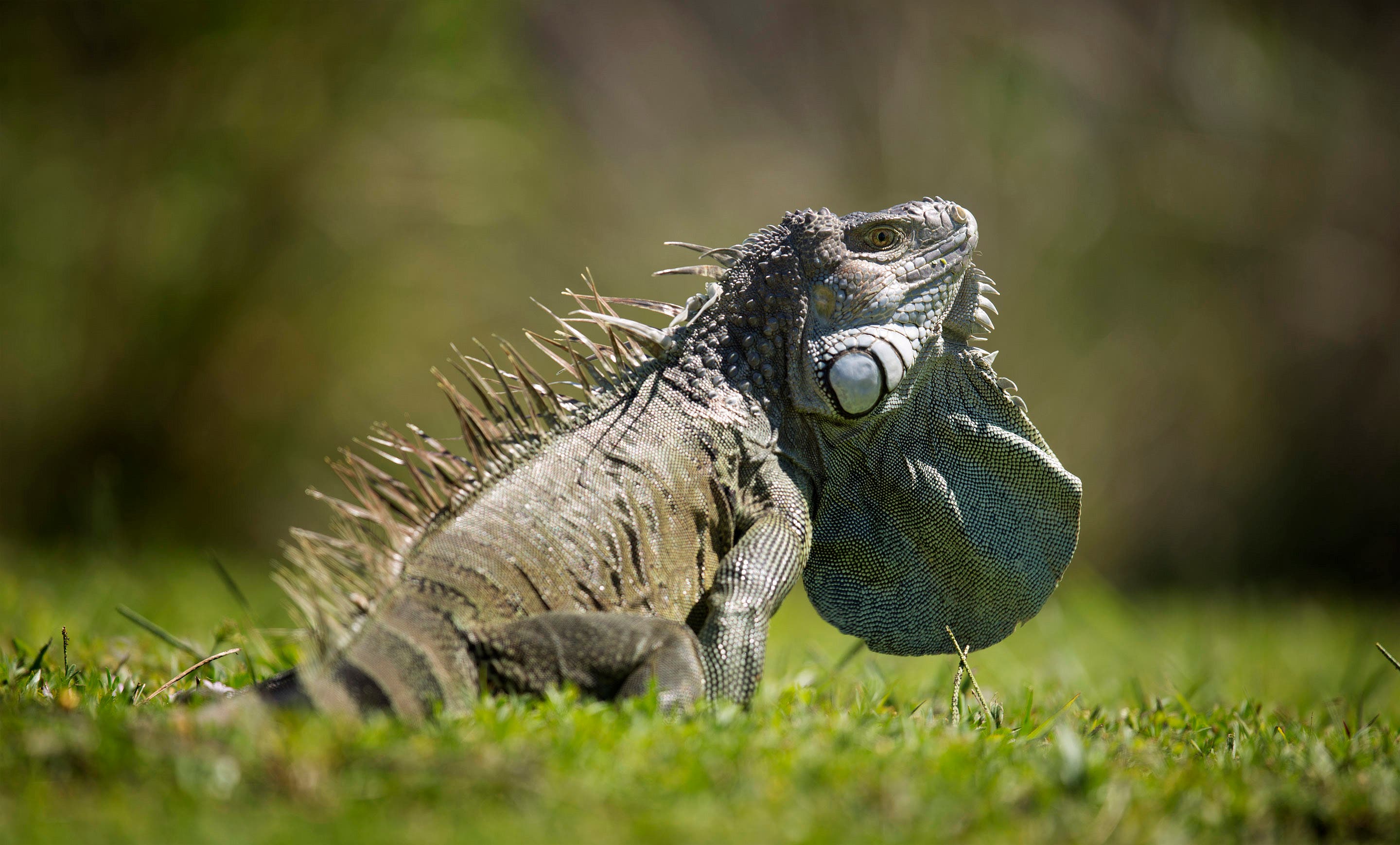
Dewlaps aren’t nearly as large among female iguanas, which generally are smaller overall. They can grow to about 5 feet long, too, but generally don’t exceed 7 pounds. In February and March, mature females dig 4 to 6 feet in the ground to construct elaborate egg chambers — a network of nearly 80 feet of interconnected tunnels with multiple entrances where they lay clutches of anywhere from about a dozen to six dozen eggs.
That could cause a catastrophe, said William Kern, an associate professor in the entomology and nematology department at the University of Florida’s Fort Lauderdale Research and Education Center, in an interview with the Palm Beach Post.
Kern, whose work centers on urban control and management of invasive species, said the underground construction in canal banks may cause erosion and, eventually, the collapse of entire sections of canal.
Now that iguanas are established, “it’s going to be an ongoing situation,” he said.
Digging away at aging infrastructure isn’t the only threat iguanas pose. Officials at Bill Baggs Cape Florida State Park are keeping a close eye on them after researchers found the remains of endangered tree snails in some dead iguanas’ stomachs. At Bahia Honda State Park, they have been munching away on nickerbean, which is a host plant of the endangered Miami blue butterfly.
And, like other reptiles, green iguanas can transmit the salmonella bacteria to humans when in feces-contaminated bodies of water.
Get more local news delivered straight to your inbox. Sign up for free Patch newsletters and alerts.