Community Corner
Lights Out: It's Turtle Nesting Season Along Florida Beaches
Innocent mistakes by beach goers can results in the deaths of newly hatched sea turtles. Only one in 1,000 sea turtles survive to adulthood.


FLORIDA — Lighting up the back porch of your beach house; forgetting to fill in the hole in the sand you dug to bury your feet; or leaving behind a sand castle you erected are all innocent actions that could jeopardize Florida's endangered sea turtles.
This weekend marks the beginning of sea turtle nesting season along Florida beaches when beach goers are encouraged to be extra cautious not to step on or disturb sea turtle nests filled with eggs that may be hidden on the beaches and to be extra mindful of recently hatched baby turtles making their seminal moonlight journey to the sea.
Around 90 percent of all sea turtle nesting in the United States occurs on Florida beaches
Find out what's happening in West Palm Beachfor free with the latest updates from Patch.
Alongside marine biologists and researchers, volunteer conservationists (or turtle patrols) will be out and about on Florida's beaches starting this weekend and continuing through Oct. 31, searching for and marking sea turtle nests and then monitoring the progress of hatchlings.

Young hatchlings make their way to the sea.
It's a big job protecting these endangered sea turtles. There are 402 miles of beaches on the east coast and another 435 miles along the gulf coast.
Find out what's happening in West Palm Beachfor free with the latest updates from Patch.
The patrols arrive at the beaches at sunrise seven days a week, first searching along the high tide line for evidence of sea turtle nesting, identified by trails in the sand made by crawling females.
Once tracks are located, the patrols determine whether there is a nest present or if the track is a "non-nesting emergence," also known as a false crawl.
Sea turtles use their flippers to dig holes in the sand, then lay 100 to 150 eggs.
The turtle patrols mark the nests and tape them off to prevent people from disturbing them. Disturbing a turtle nest is illegal.
The majority of the nests belong to loggerhead turtles, however, Florida also has its share of green sea turtle and leatherback turtle nests, all protected under state and federal law.
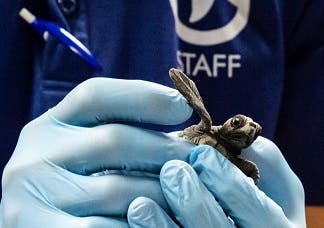
Aquarium personnel rescue a baby turtle heading the wrong way.
Nests belonging to Kemp's ridley turtle, the world's rarest sea turtle are uncommon though nests were discovered in both 2019 and 2020 in Pinellas County.
The eggs in each nest will typically incubate for 50 to 60 days before the hatchlings emerge and make their way to the ocean, leaving tiny tracks in the sand.
After a nest has hatched, turtle watchers wait at least 72 hours, then excavate the nest and do an inventory of its contents to record the number of hatched eggs.
That data is given to the Florida Fish and Wildlife Conservation Commission, which not only keeps track of successful hatchlings but also collects information on false crawls.
Turtle watchers also keep data on hatchlings that don't make it to the ocean after mistaking house lights or streetlights for moonlight or becoming disoriented when they encounter sand piles, holes in the sand and trash on the beach. Turtle patrols also note if nests have been ravaged by predators or vandalized by humans.
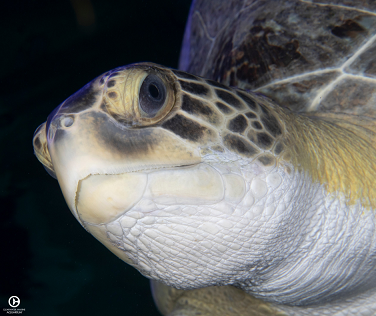
Loggerhead sea turtles are the most common sea turtles found in Florida.
According to the Florida Fish and Wildlife Conservation Commission, during the 2019 season, surveyors found more than 106,000 loggerhead nests, 53,015 green turtle nests and 1,105 leatherback nests.
In 2020, the FWC recorded 105,185 loggerhead nests, 26,656 green turtle nests and 1,652 leatherback nests.
On the east coast, Palm Beach County had the greatest number of nests: 29,465 loggerhead, 6,446 green turtle and 565 leatherback.
Brevard County had the second-largest number of nests: 26,991 loggerhead, 12,203 green turtle and 98 leatherback.
On the west coast, Sarasota County led in the number of sea turtle nests with 7,041 loggerhead and 206 green turtle nests.
Charlotte County came in second with 3,361 loggerhead nests and 82 green turtle nests.
Only one in 1,000 sea turtles survive to adulthood, according to the Clearwater Marine Aquarium.
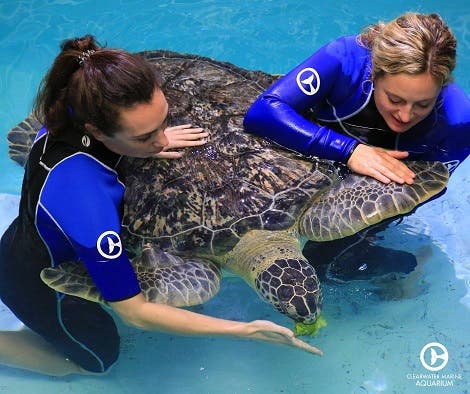
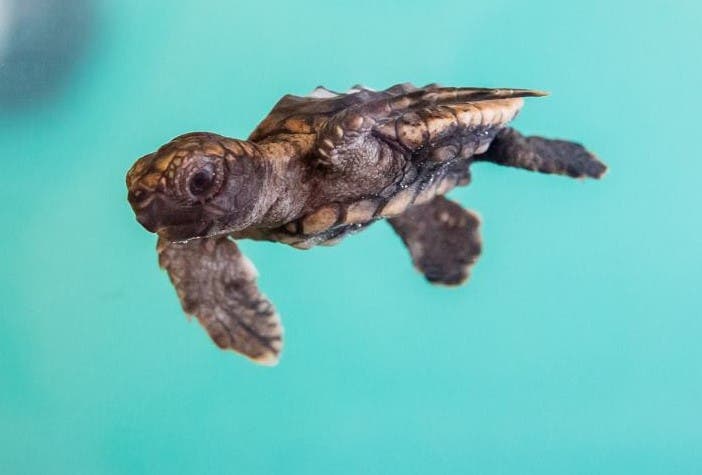
Cocoa is a green sea turtle that was rescued and rehabilitated at the Clearwater Marine Aquarium after being injured by a boat propeller.
How You Can Help
- Use sea turtle-friendly lighting. If you must use lights near nesting beaches, use amber or red light bulbs. Cover or shield light fixtures and keep them directed down and low to the ground whenever possible. Do not use lights from cell phones or cameras near nesting beaches. Even these lights can disorient sea turtles. Many counties have ordinances prohibiting lighting that reaches the beach.
- Do not pick up hatchlings heading toward the water, shine lights or use photo equipment with a flash.
- Remove obstacles such as sand castles or sandpits that may make it too difficult for hatchlings to make their way to the shoreline.
- Keep the beach clean. Eliminate trash items that may entangle baby hatchlings and adult turtles.
- Do not approach or harass adult turtles as they make their way back to sea.
- If residents spot turtle tracks or a possible nest, and it does not appear to be protected by stakes or ribbon, call 1-888-404-3922.
![]()
Clearwater Marine Aquarium To report the disturbance of a sea turtle nest or report turtles or hatchlings lost, stranded or wandering in the street, call the Florida Fish and Wildlife Conservation Commission Division of Law Enforcement at 1-888-404-3922 or *FWC from a cell phone.
Hatchlings emerge and make their way to the ocean, leaving tiny tracks in the sand.
See related stories:
Get more local news delivered straight to your inbox. Sign up for free Patch newsletters and alerts.