Neighbor News
AT&T leaders recognize Metropolitan Ministries' teen robotics team
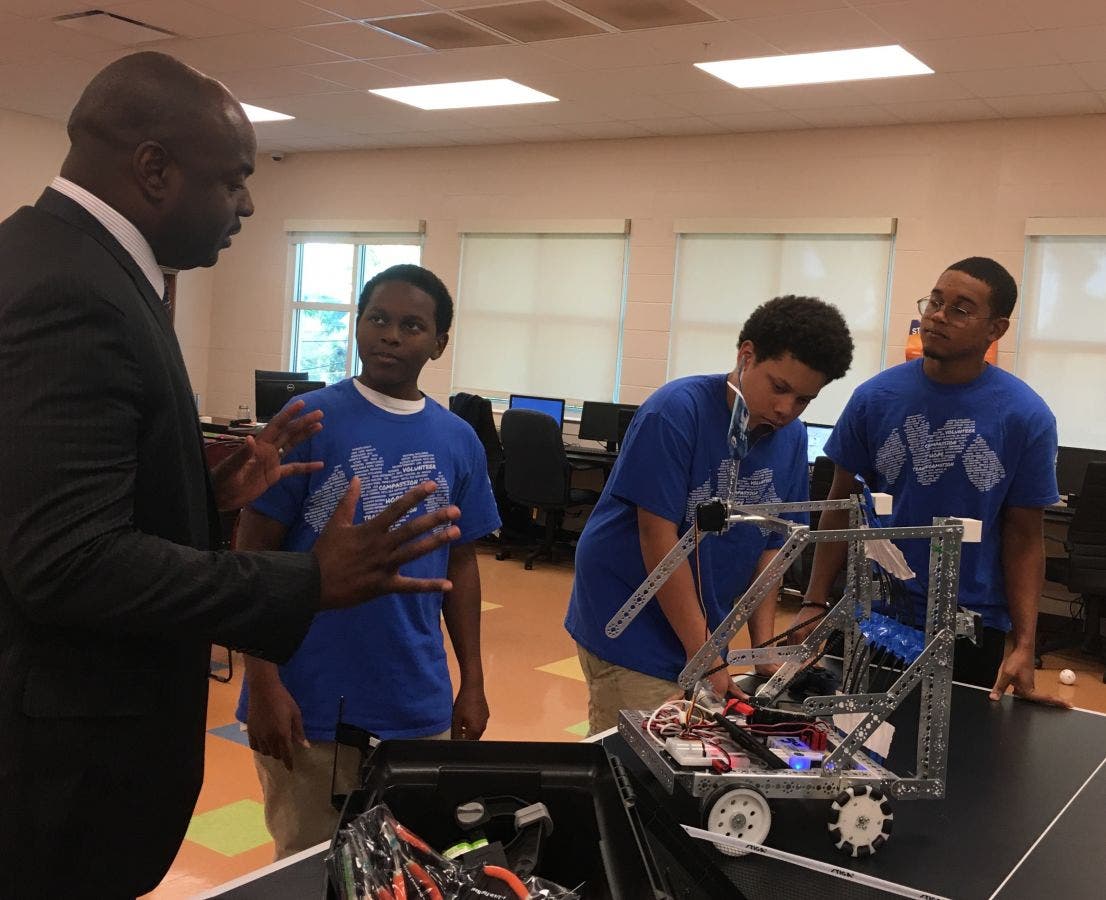
Teens from Metropolitan Ministries' robotics team, Coding Hope, demonstrated their robot for leaders from AT&T on March 21.

At Metropolitan Ministries, the community comes together bringing talent, time and treasure to ‘be hope’ to homeless children. The teen program at Metropolitan Ministries has expanded immensely over the last year and a half, and recently, AT&T added more to ensure the resident teens are remaining engaged through Science, Technology, Education, Arts and Math (S.T.E.A.M.) educational programming.
“The S.T.E.A.M. program will alleviate the impact of homelessness on educational outcomes by providing out of school time programming that reinforces classroom learning, and gives our youth the extra opportunities, experiences, and support they need to succeed,” said Christine Long, Metropolitan Ministries’ Chief Programs Officer.
In a partnership with FIRST Robotics, a local organization that teaches S.T.E.A.M. education through robot challenges, a robotics team for the teens residing at Metropolitan Ministries was formed. During the robotics season, the team “Coding Hope” placed as 86 out of 175 teams in the entire state of Florida. The team — the first from a homeless transitional housing facility in Florida — also received mentoring from students at Jesuit High School and Middleton High School.
Find out what's happening in Westchasefor free with the latest updates from Patch.
Coding Hope members demonstrated their robot for leaders from AT&T on March 21.
Some of the other S.T.E.A.M. activities that launched for more than 120 students at Metropolitan Ministries included 3D printing class, Science Monday classes and weekly labs. Several students also qualified to display their science projects at the county S.T.E.A.M. Fair this past January.
Find out what's happening in Westchasefor free with the latest updates from Patch.
There is an 80% percent increase in the demand for S.T.E.A.M. proficiency in the workplace, according to the National Network of Statewide Afterschool Networks. And according to the U.S. Congress Joint Economic Committee, there will be a 17 percent increase in S.T.E.A.M. careers from 2010 to 2020, resulting in one million new jobs in the field.
Unfortunately, not enough students are pursuing degrees or careers in the S.T.E.A.M. fields to meet this demand, especially not low-income or minority youth. This is likely attributed to the fact that lower income students are less likely to have access to the same quality of education and outside enrichment activities, which means they struggle to master subjects as well as their counterparts.
Children from homeless families may face an even larger challenge, as they are twice as likely to repeat a grade compared to their non-homeless peers (National Traumatic Stress Network). ACT’s recent report Understanding the Underserved Learner reveals that underserved students are just as interested as other students in S.T.E.A.M. subjects and careers, but they are far less likely to be prepared to succeed in them.