Neighbor News
Six Back-to-School Tips from Georgia’s Clean Air Force
Georgia's Clean Air Force has 6 common sense tips to help Atlanta commuters save time and money while contributing to cleaner air in Georgia
Six Back-to-School Tips from Georgia’s Clean Air Force
Save Time and Money Commuting During Back-to-School Season
ATLANTA – In Georgia, the month of August signals that school is back in session. This can mean only one thing: commuting times will be on the rise as more vehicles are on the road.
Find out what's happening in Buckheadfor free with the latest updates from Patch.
Georgia’s Clean Air Force, a partnership with the Georgia Environmental Protection Division (EPD), has six common sense tips to help Atlanta commuters save time and money, while contributing to cleaner air in the Atlanta metro region.
“Any time you put more cars on the road at high traffic periods like morning and late afternoon, there is going to be added congestion,” said Pamela T. Earl, Program Manager, Mobile & Area Sources, EPD. “However, there are ways to practice common sense driving habits that will help make your commute less stressful, while also helping to lessen the negative impact of harmful vehicle emissions.”
Find out what's happening in Buckheadfor free with the latest updates from Patch.
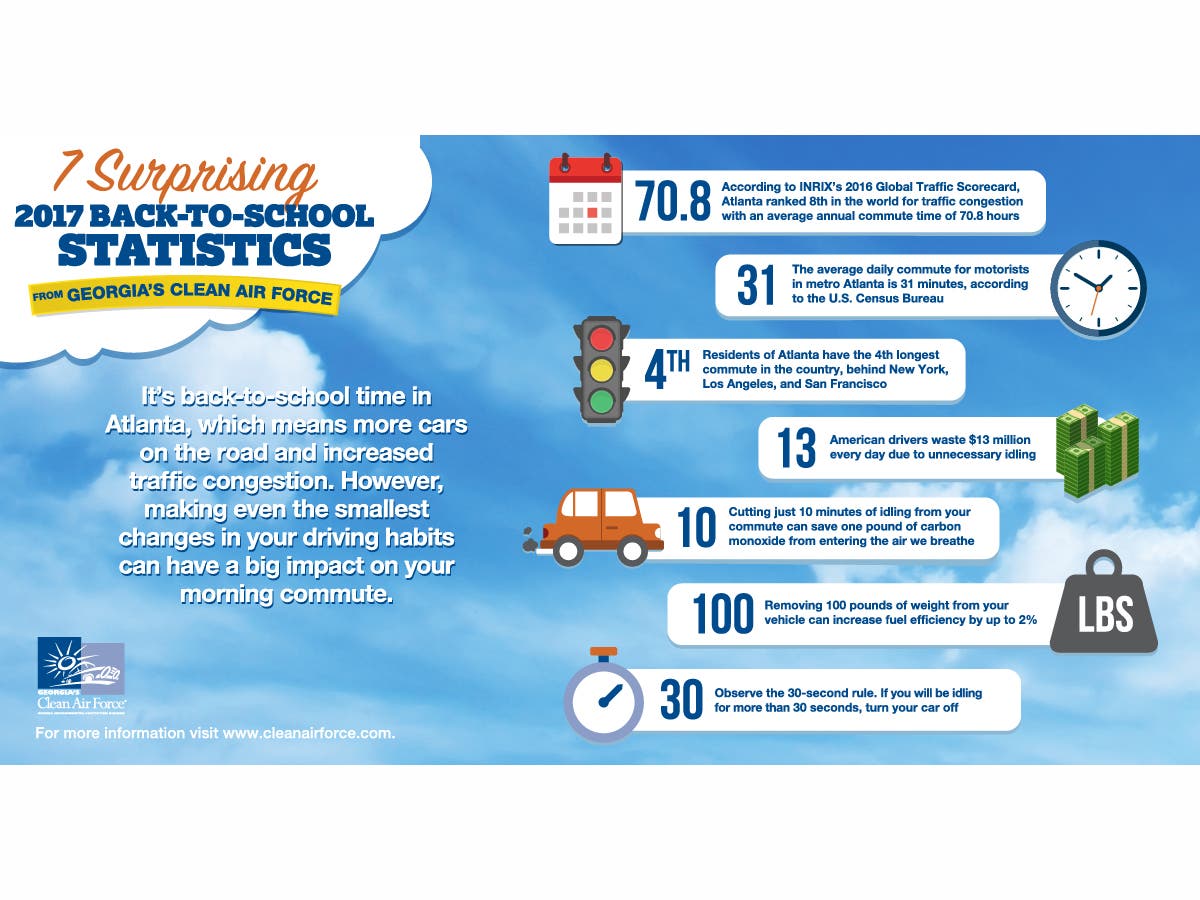
Download a helpful infographic on back-to-school commuting statistics at www.cleanairforce.com/documents/infographic-backtoschool2017.pdf
- It’s Cool to Pool. Use social media networks like Facebook to set up a back-to-school carpool with your neighbors. If you find just four other parents in your neighborhood, you can cut down your school commute to once a week, and spend less money on gas. Carpooling to work on the days that you don’t lead the kids’ carpool can help save even more time and money.
- The 30-Second Rule. It might seem convenient to keep your vehicle running while waiting to pick your child up from school, but in reality, it wastes gas and money, in addition to being harmful to the environment. For every 10 minutes of idling cut from your commute, you can save one pound of harmful carbon dioxide from entering the atmosphere. The rule of thumb is to turn off your engine if you’ll be idling for more than 30 seconds.
- Reroute Your Commute. Traffic in metro Atlanta becomes more congested as the school year begins in early August. While there’s no getting around that, staggering your commute might help you save time for school pickup runs. Ask your boss if you can arrive for work later in the morning, when school related traffic is minimal. If your employer allows telecommuting, you can opt to skip the trip to work entirely.
- Un-junk Your Trunk. The heavier the vehicle, the more fuel it consumes. Studies show that removing just 100 pounds of extra weight from your vehicle can increase fuel economy by up to two percent. Don’t carry bulky items like sports equipment unless you need to, and remove the roof rack unless you use it regularly.
- Follow the App. There are many smart phone apps that can help motorists bypass high traffic areas. Apple and Android have a number of free apps that were designed to find the most efficient and fastest way to get to your destination. The Georgia Department of Transportation (GDOT) has a data-sharing partnership with Waze, the real-time crowdsourcing app, that provides construction and road-closure data to the app. This helps reroute drivers to less congested routes.
- Maximize Performance. Late summer is a good time to have your car inspected by your local mechanic. He or she can check for malfunctioning oxygen sensors, underinflated tires, clogged filters, and other factors that can reduce fuel economy and increase harmful emissions.
For additional information, visit Georgia’s Clean Air Force at www.cleanairforce.com.
About Georgia’s Clean Air Force
Georgia's Clean Air Force (GCAF), in partnership with the Environmental Protection Division (EPD), is responsible for the management of the Enhanced Vehicle Emission Inspection and Maintenance (I/M) Program throughout Atlanta's 13 metro counties. Since 1996, Georgia's Inspection and Maintenance Program has prevented more than 1.6 million tons of harmful ozone-forming pollutants from entering the air we breathe, the equivalent of removing 13,400 vehicles from the road, or planting more than 400 million trees. It is also estimated that Georgia residents have saved $311 million in utility bills since 1996 due to cleaner air. The program has also identified and repaired more than 3.2 million heavy-polluting vehicles. For more information, please visit www.cleanairforce.com.