Schools
Solar Eclipse: Cartersville, Bartow County To Extend School Day (UPDATED)
While the Atlanta area is not in the path of totality, we are expected to experience at least a partial solar eclipse on Aug. 21.


CARTERSVILLE, GA -- We are drawing closer to the near total eclipse that will be seen (weather pending, of course), in the sky across north Georgia, and the Cartersville City and Bartow County school systems want to ensure its students will have a safe way to experience this historic moment.
To ensure a safe dismissal and safe viewing, Cartersville City schools on Friday said it will extend the school day on Aug. 21 by 45 minutes.
The release times on that day are as follows:
Find out what's happening in Cartersvillefor free with the latest updates from Patch.
- Kids & Company Pre-K: 3 p.m.
- Cartersville Primary School: 3:15 p.m.
- Cartersville Elementary School: 3:45 p.m.
- Cartersville Middle School: 4 p.m.
- Cartersville High School: 4:07 p.m.
Bartow County Schools also said it will delay dismissal of elementary school students by 30 minutes.
Middle and high school car riders and high school drivers will be dismissed on a normal schedule for that day, but bus routes will be delayed for middle and high, the system added.
Find out what's happening in Cartersvillefor free with the latest updates from Patch.
Elementary dismissal time will be 3:05 p.m. and middle and high school bus routes will begin at 4:05 p.m.
The decision by Cartersville and Bartow County follows Cobb, Gwinnett, Forsyth and Fulton county schools all deciding to delay dismissing its students on that day. For its part, the Cherokee County School District said it does not have plans to delay its dismissal of students.
The Aug. 21 phenomenon will, no doubt, have thousands flocking to areas in extreme northeast Georgia and Tennessee to witness the eclipse in action. Georgia State Parks officials said campsites and cabins have been sold out for months, and only a few slots at state parks have accommodations available.
The last coast-to-coast solar eclipse in the U.S. occurred in 1918, according to NASA. If you are in the path of totality, you will be able to witness a total solar eclipse, which involves the moon completely covering the sun. The path of totality will stretch from Salem, Oregon, to Charleston, South Carolina.
"Observers outside this path will still see a partial solar eclipse where the moon covers part of the sun's disk," NASA states on its website.
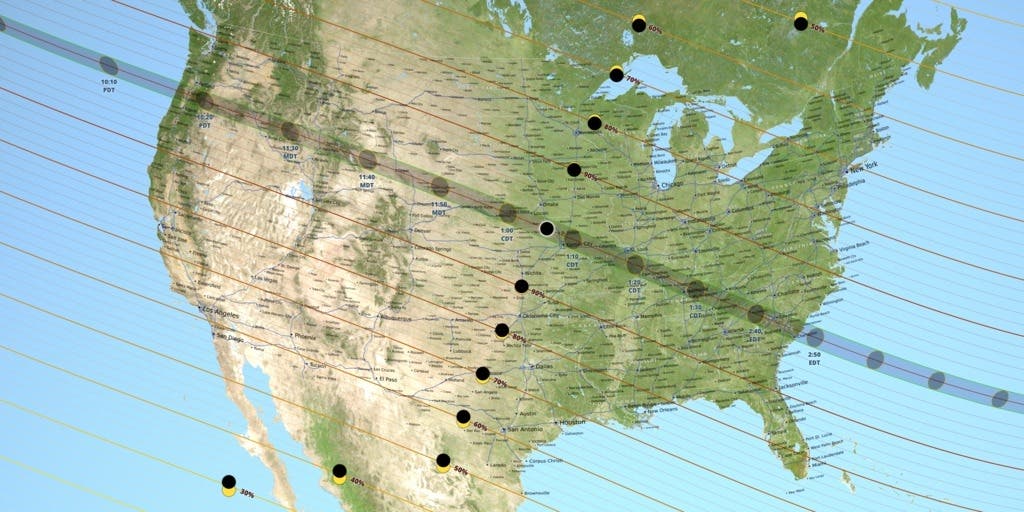
Here are some community solar eclipse resources you can peruse at your leisure to learn more about this historic day.
- An interactive eclipse map that allows to select your location and see the calculated eclipse times and duration of annularity for that location.
- The American Astronomical Society has created How to Safely Watch a Solar Eclipse and has posted eclipse glasses and social viewer information.
- NASA will post a 4-hour, 30-minute live webcast of the total solar eclipse.
- For more information and resources visit the NASA site on the eclipse.
Image via Jeff J Mitchell/Getty Images News/Getty Images
Get more local news delivered straight to your inbox. Sign up for free Patch newsletters and alerts.