Arts & Entertainment
Tellus Records Earthquakes Around the Globe
The local museum offers a unique look at the science behind earthquakes.
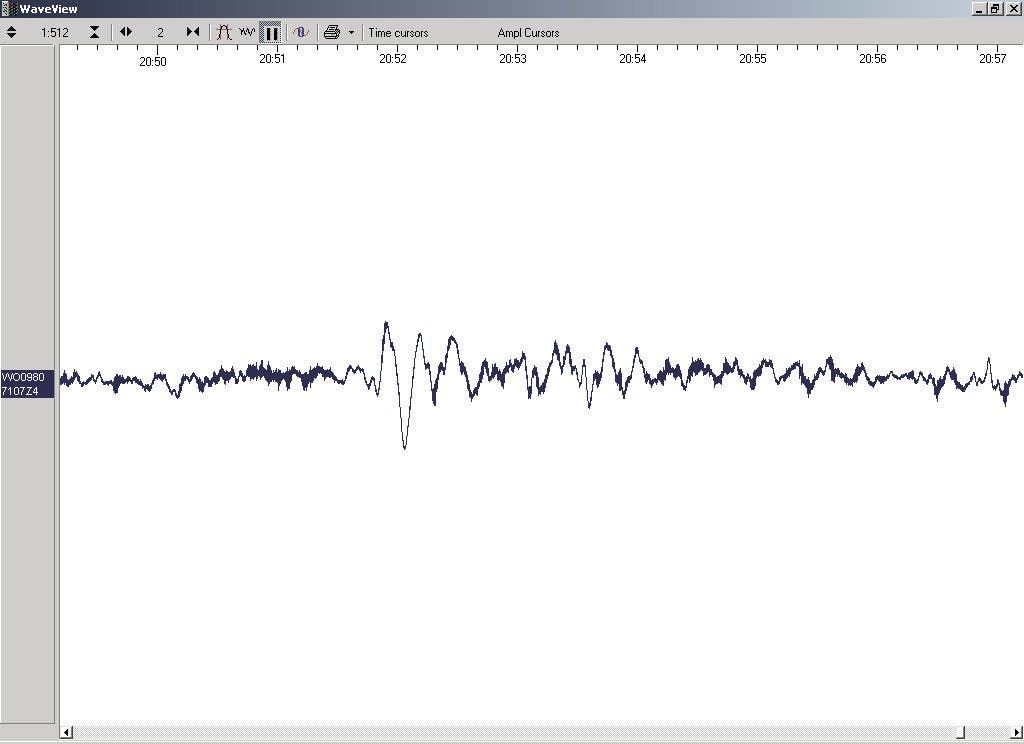
Ever feel a rumbling below your feet while walking around Cartersville?
Me either, but apparently it’s there, according to the Tellus Science Museum. They’ve adopted a seismograph courtesy of Georgia Tech, and are now one of many locations using seismograph technology to track earthquakes not just here in Georgia, but all over the world.
What need is there for earthquake monitoring in Cartersville, a place not generally known for serious earthquake activity?
Find out what's happening in Cartersvillefor free with the latest updates from Patch.
Plenty, according to Julian Gray, curator of the museum.
“Everything associated with this technology is purely research driven," she said. "It’s interesting scientifically to be able to pull up records of earthquakes in our area and around the world and take a look at them. We’re learning a lot about the plate structure of north Georgia. All the while, the data from our machine is sent directly to Georgia Tech where they are taking a lot of time to study the seismicity of the Appalachians.”
Find out what's happening in Cartersvillefor free with the latest updates from Patch.
Seismograph technology has come a long way over the years.
There are a couple of components to the now completely electronic system. The part of the seismograph that does the actual seismic measuring of waves is a geophone outfitted with electromagnetic coils that detect motion in the ground. All of this information is sent to a computer where a GPS indicator gives a reading down to a fraction of a second when the signal arrived. This helps to identify earthquake magnitudes with rapid accuracy.
Although earthquakes cannot be predicted, scientists are able to form opinions on possible earthquake activity based on current data trends and relevant history. Luckily for Cartersville residents, earthquake history is relatively quiet throughout the southeast.
Most of the activity Cartersville experiences is rated at a Level 3 magnitude or less, which is mostly undetectable without the help of a seismograph.
Whenever these earthquakes do occur, Tellus’ instrument picks it up and sends the information to Georgia Tech for study. As a result, the network has been able to find fractures and fault lines in the region and begin monitoring them, but most of the earthquakes Cartersville experiences are safe and educational.
Recently, Tellus detected a 7.2 magnitude earthquake that hit Pakistan in an area where India and Asia are colliding, their plates pushing against each other. There were no reports of damage or injuries associated with that particular earthquake, however, in more densely populated areas, that is not always the case. Tellus has picked up readings for similarly powerful earthquakes all over the world, as far away as China and areas of the western Pacific Ocean.
“While we’re a museum, we’re doing active research. The benefit this research brings to the people of Cartersville and Bartow County is that visitors to the Tellus Museum can see the information not only through our website, but through live and interactive exhibits inspired by the seismograph technology,” said Joe Shulman, director of Marketing.
The seismograph itself is located in the museum observatory and can be seen during special tours. Permanent exhibits include a monitor that shows earthquakes in real time as they occur around the world. There is also an exhibit that shows the earthquakes that have occurred within the past 24 hours, which is said to be eye-opening, as well as an interactive “earthquake maker.”
For more information on this and other exhibits at the Tellus, visit the website or call 770-606-5700.