Community Corner
Wheels and Heels: Speed Bumps - A Waste of Taxpayer Money?
Not according to DeKalb County, which assesses residents $25 per household, per year, to maintain the bumps
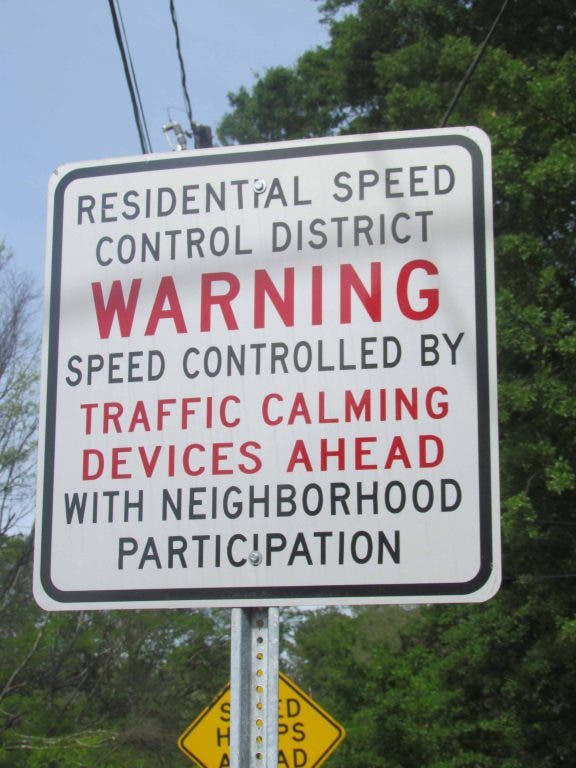


When driving down a street with a speed bump, most drivers slow down to avoid the bone-shaking jolt that would occur from hitting the hump.
That’s the theory, anyway. Those artificial mounds decorated with reflective white triangles are supposed to make you slow down.
Richard Williamson, who lives near Avondale Estates, thinks speed bumps are a waste of taxpayer money that do nothing more than impede traffic and waste gas.
Find out what's happening in Decatur-Avondale Estatesfor free with the latest updates from Patch.
A few blocks away, Erica Sammons disagrees. Sammons, who lives on Wells Street, thinks differently. She and her neighbors got together and petitioned DeKalb County to install speed humps on their dog-legged street.
“We’re a cut-though street to the Farmer’s Market,” explained Sammons, who noted that there were many small children living on the street. Despite the short distance of the street, some lead-footed motorists would gun through the neighborhood, Sammons said. “We thought speed humps would help.”
Find out what's happening in Decatur-Avondale Estatesfor free with the latest updates from Patch.
The speed bumps or humps fall under DeKalb County’s traffic calming program. To be eligible for the program, a street must be classified as local residential on the DeKalb County thoroughfare plan and have a posted speed limit of 30 miles per hour or less. A minimum of 65 percent approval from the property owners is required to install traffic calming devices.
Now, there are five speed bumps on the small street. Sammons said, “we’ve still got people who blow through here.”
Though, the speeders do “seem annoyed” at the speed humps, she added.
But Williamson says those speed humps are a waste of money. The cost of the humps varies, depending on the width and length, but average about $2,800 apiece, including labor and materials, according to DeKalb County Chief Communications Officer Burke Brennan. The county assesses residents $25 per household, per year, to maintain the bumps.
The county has budgeted $1.7 million for the speed hump fund in 2011, which is a 3 percent decrease from 2010. Projects call for installing 100 humps in the next year.
The county estimated it will collect $250,397 in 2011 from the $25 per property assessments, which, coupled with $3,000 interest and almost $1.5 million in the previous fund balance, means they project about $1.7 million in revenues for the speed bumps.
So the county's actual expenditure for the humps will be $232,905, which is a big increase from the 2006 budget, when the county spent $18,983 on the devices.
Williamson's thinking is that the five bumps on Wells Street would have cost the county at least $14,000, and since there are just 12 homes on the street, it will take more than 46 years for the county to recoup the cost, according to his estimates.
“We’re in the midst of a county financial crisis, and they’re allocating $1.7 million for speed bumps in the budget,” Williamson said.
“Speed bumps deter traffic, cause congestion, cause people to use more gas at intersections, pollute the air more, and cause us to use more gasoline,” charges Williamson. “We’re overseas fighting three wars over oil, and our energy consumption as a society doesn’t seem to be lagging.”
Williamson’s not alone in his abhorrence for speed bumps. The National Motorists Association describes itself as a group of people who “want to drive what we want to drive, go where we want to go and in the process not be unwitting cannon fodder for self-serving government programs, over-bearing police departments or greedy courts.”
“The longer wheel-base, stiff suspension, high vehicle weight, as well as the sensitive equipment and injured victims transported by these vehicles, requires drivers to slow almost to a stop to negotiate the devices safely,” wrote the NMA's Kathleen Calonge in an article on the website. Slowing the response of emergency vehicles can result in death or serious harm, she said.
“Calming devices impose permanent, 24-hour delays to emergency response, unlike traffic congestion which occurs periodically. A study conducted by the fire department of Austin, Texas, 1997, showed an increase in the travel time of ambulances of up to 100 percent transporting victims,” Calonge wrote.
Traveling over the bumps can cause lasting pain and injury to people with disabilities, says the NMA, citing a website attributed to Road Access for Disabled Americans.
Federal transportation officials have “avoided the examination of the problems associated with intentionally imposing vertical and horizontal deflection on vehicles and vehicle passengers, in order to encourage the proliferation of devices on city streets,” according to Calonge.
Sometimes, the humps increase accidents, the NMA charges. A street with a school in Portland, Maine registered 35 percent increase in accidents after experimental speed humps were placed there. A Boulder, Colo., traffic circle saw accident rates double, the NMA said. But the traffic circle and Portland speed humps remain, the NMA said.
Although the devices are built under the thinking that they’ll reduce accidents, Calonge cites a 1999 study commissioned by the Institute of Transportation Engineers and the Federal Highway Administration that concluded that traffic calming is restricting to “low-volume residential streets” where collisions are infrequent, which “limits our confidence in drawing inferences about safety impacts of traffic calming."
Williamson, who also lives on a busy street, isn’t in favor of ignoring speeders.“People shouldn’t be going fast through neighborhoods,” he said.
But other options exist for slowing down motorists who ignore speed limit signs, including asking for police radar enforcement and putting up automated signs that remind vehicles of how fast they’re traveling.
County transportation officials should design alternatives for traffic flow to help ease traffic congestion, not impede those alternatives with speed humps.
“We should be thinking about how to make the cars flow instead of making them pile up,” Williamson said.
…………
Here’s the procedure residents must follow to get traffic calming devices on their streets.
First, call (770) 492-5219 to receive an initial interest petition for the street. This petition is a screening to determine if at least 20 percent of the residents are interested in learning more about traffic calming. Once the initial interest petition passes, a traffic volume and speed study will be evaluated for all affected areas within the study area. If the study indicates that a speeding or cut though problem exists, then a stakeholders group will be formed with DeKalb County staff to develop a traffic calming plan for the area. To ensure citizen input, the development of the plan can take up to one year. The plan will then be presented to the Board of Commissioner’s (BOC) for approval. Once approved by the BOC, a petition for the installation and establishment of a special tax district will be circulated. A minimum of 65 percent approval from the property owners is required to install traffic calming devices. For more information, see the DeKalb County Public Works web page.