Health & Fitness
Faces of Carapace: Sara Drum, from the heart
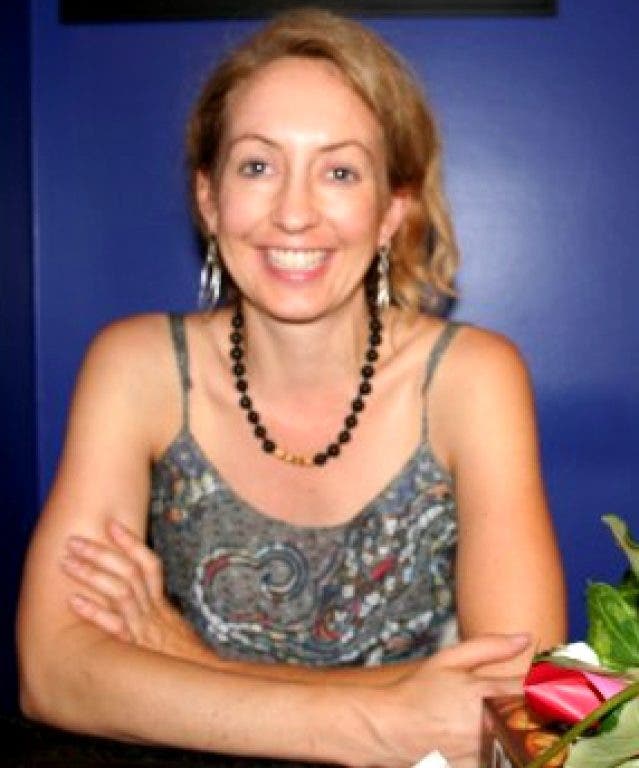
Carapace raconteur / animal rescuer Sara Drum talks about dogs, nudity, and running away from the police.
[This is the second in a series of profiles from Carapace, a free event of true personal stories told without notes at Manuel’s Tavern, 602 N. Highland Ave., on the fourth Tuesday of every month at 7:30 p.m.]
“Who wants to be nice?” Sara Drum says, and bursts into a peal of melodious laughter. “I’m too tired to be nice, if it isn’t true.”
Drum has just finished helping a party of three polish off a platter of Ethiopian specialties – vegetarian, of course – at Queen of Sheba restaurant on Briarcliff, along with a bottle of Kendall Jackson cabernet.
Find out what's happening in East Atlantafor free with the latest updates from Patch.
A frequent raconteur at Carapace, Drum is known for her animal-rescue work, and operates Safe Harbor, a no-kill shelter. But not everyone knows Houston-born Drum is a cardiac nurse, and even fewer have heard about the “alternative religious group” in Michigan from which her parents fled when Drum was a teenager.
She’d rather talk about dogs and cats.
Find out what's happening in East Atlantafor free with the latest updates from Patch.
Middle of four children – all girls – Drum spent her later adolescence in North Carolina. “I went to college when I was 19 or 20, and did a miserable job, and was kicked out a couple of times,” she says. Among other jobs, she worked as a waiter in a country club, where the racist policies caused her to protest in the most effective way she could imagine at the time: streaking naked through the busy dining room, an episode she described in a story at Carapace.
She ended up in New York, working in another restaurant.
“I was searching,” she says. “I didn’t feel fulfilled. I was waiting for some grand epiphany, but I never thought of health care. I was thinking more of theater. Or taking a bunch of literature courses and learning to become a writer.”
She fled New York, not to pursue career options but to save her dog, Bear, “my snappy, snarly darling.” Bear had made the mistake of sinking her teeth into a semi-retired police officer in the elevator of Drum’s apartment building. New York had a “one-bite” law. On the day of the event, rather than linger to discuss the matter, Drum and Bear scrambled from the elevator. They ran.
For days, they managed to avoid the cop, who had made it his mission to track them down. Finally, Drum – draped in scarves as a disguise, Bear bundled like a baby – jumped in her car and went south under the cover of night. Their exodus is the subject of another Carapace story.
Then 9/11 happened. She and her co-workers in Atlanta stood around the radio, listening in shock – a day that Drum described in yet another of her Carapace tales. People stumbled through the surreal period afterward, “that brief era, when everyone was nicer, just real careful,” she says. “Everything was fragile. The world is fragile. I felt drawn to the need, and saw the vulnerability in people.”
She attended Georgia Perimeter College and next, helped by a scholarship from the Jack Kent Cooke Foundation, studied nursing at Emory University. Meanwhile, the compulsive biter Bear kept doing it. Young and otherwise healthy, she had a disability that made her unable to stop. “I looked people in the eye and told them a bald-faced lie: that she was a deaf, blind, 14-year-old dog,” Drum says. Nobody pressed charges. Bear eventually died of old age, having tasted many humans.
Today, Drum’s animal shelter houses about a dozen dogs.
“Animals are my favorite,” she says, but her days are filled with sick people. Witnessing their struggle, and serving their need, enriches her, too. “They’re letting you know everything about their lives,” Drum says. “They’re telling you their thoughts and fears. It’s an honor. I consider it a great privilege for someone to be sharing that part of themselves, when they are that sick, possibly close to death, to let me in and let me know what’s going on, how they’re feeling.”
Until nursing, “there was nothing I thought I could do to create a big impact,” she says. Of course, not every patient survives. “You don’t get used to it, but I’m so busy with the next patient, the next group of people … I get focused on that, and I focus on the people who were able to be helped. I remember that instead of the people who died, and didn’t want to die.”
When a vacancy arises at Safe Harbor, Drum spends her free time racing to other shelters, snatching up dogs, often the day before they are to be put to sleep. “That’s how I ended up with seven a couple of weeks ago,” she says. “I went for one, and ended up with a group of black puppies, and then a German shepherd and then a pit bull.”
And so she swings from animal rescue to the healing of humans and back again.
“I have more pleasure with animals,” Drum says. “That I could do all day long and not consider it work. The quietness of them gives me time to think and be and feel creative. It’s peaceful. It’s like a walk in the woods.”
From humans, she says, the rewards are more complex, such as watching a doomed transplant seeker go from a “flat, depressed affect,” to robust and healthy when an organ donor comes through.
“Heart patients are special,” Drum says. If the body’s main blood pump doesn’t function, then other organs begins to fail. Each part, sheltered in the helpless envelope of flesh, is subordinate to the primary one, and fed by it. “They can’t do anything without the heart.”
*
Listen to Sara Drum's Carapace story about streaking for justice at a North Carolina country club.