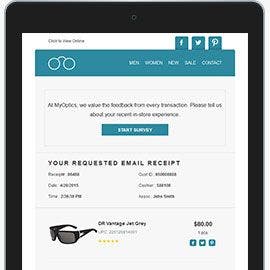
More and more retailers and banks offer customers the option of receiving receipts from purchases and ATM transactions via email or an e-receipt. While this is a convenient alternative to paper and easier to organize, shoppers need to be vigilant to protect their identity in the process.
Many retailers offer e-receipts not just for their customers’ convenience but also for their own. E-receipts save retailers money, and they make it easier for their customers to electronically file them away until they are needed for returns, warranties or taxes. Merchants can tie e-receipts to store affinity cards, but customers can also opt for paperless simply by providing your email address to the clerk at the time of purchase.
There are also online companies that offer to organize and store digital receipts. You must create an account and provide your credit or debit card information, which the company uses to track transactions. After purchases, the company retrieves receipt information directly from retailers and stores it online. But be careful! Obviously, this kind of service is ripe for scammers to mimic in order to steal your information.
Find out what's happening in East Atlantafor free with the latest updates from Patch.
The cost of a digital receipt is that we must hand over our email address, which opens the door to unwanted marketing materials arriving in our email inboxes, and also, because our information could be sold to third parties. Consumers may be resistant to electronic receipts due to fear of corporate data breaches, theft of personal information and hacking of digital files. There is a perception among most consumers that the less information that is put into a computer, the better. The reality is that even with a paper receipt, information is still stored in a computer.
Businesses that offer the choice of paper or email help develop their image as a good corporate citizen protecting the environment. However, that may not be the only motivating factor. According to a 2012 report from Epsilon International, 83% of retailers who offer emailed receipts did so because they have proven to be an effective marketing tool. Sellers say digital receipts also provide retailers with information about our shopping habits.
Find out what's happening in East Atlantafor free with the latest updates from Patch.
Some experts question whether the strategy will backfire on sellers because of the risk of unapproved use of information gleaned from our email addresses.
While paperless receipts may offer savings and convenience, be sure you are aware of what else you could be receiving in your inbox. Along with receipts, businesses may send “junk mail” filled with surveys, coupons and other promotional offers. They may also use your information to build profiles on demographics and buying habits.
For shoppers who are interested in opting for the paperless, e-receipt, BBB offers the following tips:
•Find out how the business plans to keep your information secure. Check to see if the business plans on selling your information to third-parties. If they do, be on the lookout for unsolicited emails requesting your personal information; they could be scams that download malware on your computer.
•Ask if you can opt-out of receiving promotional emails. Now that the business has your email address, it’s possible you’ll start to receive coupons, newsletters and other promotional emails from them…and even from others if they’ve sold or shared your data. You may want to set up a separate email address to use for paperless receipts so that you can easily monitor it for spam.
•Beware of scams! Having receipts emailed can also make you susceptible to phishing and other identity theft scams. Scammers pose as retailers or banks with realistic-looking emails that may claim there are problems with your purchase and request that you click a link to fix it. The link may take you to a fraudulent site that asks for your personal information, or it might download malware on your computer that will search your hard drive for account numbers and passwords.
•Make sure your anti-virus software is up-to-date. Whether or not you plan to increase your internet and email use, it’s always a good idea to make sure your system’s security plan is updated regularly. Spammers feed off of online shoppers who fail to update their security patches.
Final thoughts:
The Benefits
- Only one card needs to be taken along on shopping sprees; carrying large amounts of cash for purchases is impractical and poses theft risks.
- Charges made with debit or credit cards offer built-in protections like zero or limited liability.
- Significant amounts of paper are saved with the use of digital receipts.
- Small vendors can now accept small non-cash payments anywhere, without the fees previously associated with this convenience.
The Dangers
- Since payments are typically processed on mobile devices which are not connected to printers, digital receipts are often emailed to customers; but, if email addresses are incorrect or spam filters are overly-aggressive, records of transactions may be lost, making it difficult to return or exchange merchandise.
- Phishing emails with fake receipts can get mixed in with legitimate digital receipts and pose identity theft risks.
- Once companies have email addresses and other personal information, they may be sold to third parties or used to blast “promotional” offers.
For more information and to find companies you can trust, please visit bbb.org/atlanta.