Politics & Government
Federal Judge Rules In Favor Of City In East Atlanta Cell Tower Dispute
Judge find city's Office of Planning was correct in denying Metropolitan Place cell tower application


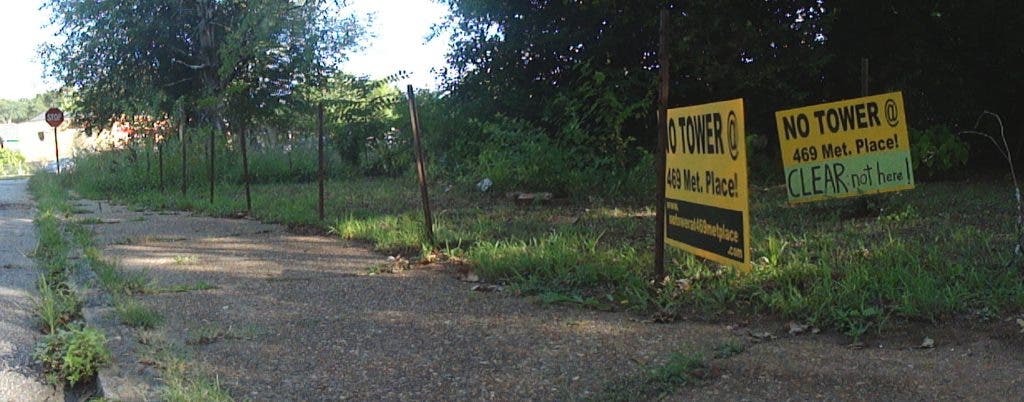

A federal judge ruled Friday that Atlanta's Office of Planning was not wrong to deny a local businessman a permit to erect a 150-foot cell phone tower on a residential side street in East Atlanta Village.
The 40-page ruling by U.S. District Court Judge Harold L. Murphy is the latest in a years-long and controversial proposal to erect the cell tower at 469 Metropolitan Place, a vacant lot just off Haas Avenue.
It's not clear what Alan David Sanders, owner of Atlanta-based Communication Structures of Georgia LLC, will do in light of losing the lawsuit he filed against the city last September.
Find out what's happening in East Atlantafor free with the latest updates from Patch.
Sanders, who could not be immediately reached Friday, owns the lot at 469 Metropolitan. The tower was originally planned for 's use, but Sanders later entered into a leasing agreement Clearwire Corp.
The property is zoned Neighborhood Commercial or "NC-2." But it is sandwiched between single-family homes on Metropolitan and a parking lot off Haas for SunTrust Banks and Holy Taco customers.
Find out what's happening in East Atlantafor free with the latest updates from Patch.
The city denied Sanders a permit to construct the tower there arguing it could be erected elsewhere in the Village or in Grant Park.
The project also faced fierce opposition from homeowners on Metropolitan and nearby side streets as well as the East Atlanta Community Association.
Neighborhood Planning Unit-W, the advisory group to Atlanta City Hall that makes recommendations on land use and planning in East Atlanta, Ormewood Park and several other Southeast Atlanta neighborhoods, also opposed the project.
In his responses to the city, Sander said alternative locations, which included the Brannen Towers senior citizens building on Glenwood Avenue, were not viable.
Those sites, which also included Grant Park, and spots on Memorial Drive, wouldn't work, because he couldn't reach an agreement with property owners, didn't meet Clearwire's needs or wouldn't give adequate cell phone coverage for East Atlanta and surrounding neighborhoods.
But city planning officials disagreed, saying he didn't prove the need for an additional tower and that Clearwire could be accommodated by existing structures. T-Mobile itself has a cell tower atop Brannen Towers, just a couple blocks away from the Metropolitan Place site.
Existing city rules require that cell antennae be placed on existing structures, when possible, instead of building new towers.
What's more, a consulting firm hired by the East Atlanta Community Association issued a report that said three alternative sites with existing towers would meet Clearwire's needs and placement of antennae there would provide sufficient coverage to the neighborhood.
The judge agreed.
"The Court finds that the Office of Planning's conclusion that Plaintiff CSG failed to reasonably demonstrate that existing towers and structures are not of sufficient height to meet Clear's engineering requirements is supported by substantial evidence," Murphy wrote in his ruling.
"The Office of Planning is empowered to analyze evidence and assess its credibility. Here, the Office of Planning possessed sufficient evidence to reasonably conclude that existing structures could meet Clear's height requirements. The Court consequently finds that Plaintiffs fail to satisfy their burden to demonstrate that substantial evidence did not support the Office of Planning's conclusion."
Edward Gilgor, who chairs NPU-W, said he was pleased with the outcome.
"NPU-W is gratified that the Federal District Court has upheld the City's denial of the application," he told East Atlanta Patch. "The Federal Telecommunications Act requires a party show that the municipality in question either 'unreasonably discriminate[d] against providers of functionally equivalent services… [or] made a zoning decision which prohibit or effectively prohibit the provision of wireless services.'
"Since the city had just granted T-mobile an SAP for a tower within the same zoning district, NPU-W did not understand how one could reasonably claim that the city's actions were in violation of the TCA," said. "Apparently the Federal Court was of the same opinion."
Get more local news delivered straight to your inbox. Sign up for free Patch newsletters and alerts.