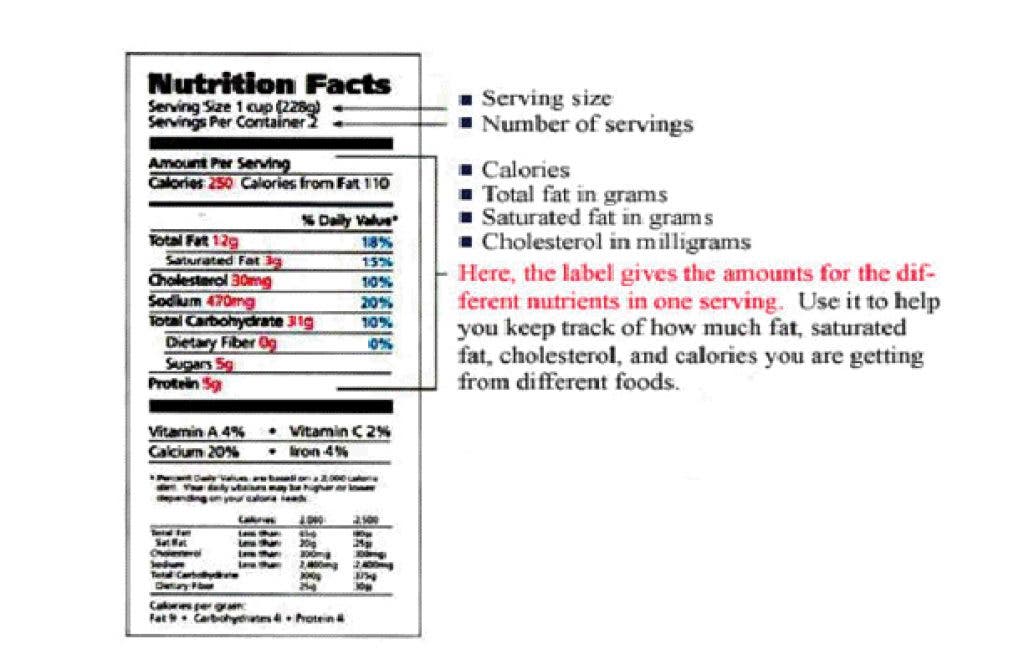
Yes, I know. The information on the boxes, cans and packages of food that we buy is supposed to help us make better informed choices.
But what does it mean? How do we put it in context?
Here's my guide to deconstructing nutrition labels:
Find out what's happening in East Atlantafor free with the latest updates from Patch.
- Look at the serving size. Often, the serving size is not realistic in most people’s minds. For instance, one serving on the label in the graphic is one cup. Look at your 1-cup measuring cup. Now look at the size of the bowl you normally eat from. How does the bowl compare with the measuring cup? Is this what you expected?
- Number of servings. Is it 1, 2, 3 or more? In the graphic, the food label shows 2 servings. This is another example of how the serving size could easily be smaller than you expect.
- Fat. The total fat in grams is listed. There are nine calories in one gram of fat. If you take the total fat in grams and multiply it by nine, the result is the total fat from calories. The American Heart Association recommends that you get no more than 30 percent of your daily calories from fat. The breakdown of types of fat is as follows:
- Less than 10% of your daily calories from saturated fat.
- No more than 10% of your daily calories from polyunsaturated fat.
- 10 percent to 15 percent of your daily calories from monounsaturated fat.
Eliminating or limiting your trans-fats is strongly suggested. Scientific reports link trans fat and saturated fat with raising blood LDL ("bad") cholesterol levels which increases your risk of coronary heart disease. You can get a sense of the good types of fats you should include in your diet by reading one of my earlier columns on the subject.
- Nutrients. Each specific amount is listed and the daily value percentage given is based on a 2,000-calorie-per-day diet. If your daily target calories are 1,500 then you only need 75 percent of the recommended daily value, and you should take this into consideration when choosing your foods and your portion sizes. A value of five percent or less is considered a low source of that nutrient while 20 percent or more is considered high.
- Carbohydrates. If a label shows net carbohydrates, it is referring to the carbohydrates, which significantly impact your blood sugar level. This is calculated by subtracting fiber from carbohydrates.
Here's a great resource for more information: http://www.choosemyplate.gov/guidelines/index.html