Politics & Government
Residents Call On Sandy Springs To Protect Trees
The city is considering changes designed to strengthen its tree ordinance.


In light of recent development on both the residential and commercial front, the city of Sandy Springs is eyeing ways to protect its trees from future devastation.
The City Council last week reviewed proposed amendments to its tree ordinance during a called meeting, a gathering that drew dozens of residents who have become alarmed at what they label as clear cutting of trees in residential areas.
Find out what's happening in Sandy Springsfor free with the latest updates from Patch.
The changes are designed to improve the city’s tree canopy conservation and replacement. Some of the proposed changes include:
- Establishes that only trees 18-inches in diameter or larger count toward canopy requirements;
- Sets requirement to use larger planted trees — 2 ½” diameter trunk minimum;
- Requires replanting and payment for tree removal below minimum canopy requirements;
- Defines a damaged tree as one where 25% or more of the critical root zone is compromised
- Provides two options pertaining to protecting street trees and stream buffers: requires planting along the street; and provides incentive for planting along street frontage and within stream buffers;
- Requires qualified professional’s determination for removal of landmark trees;
- Requires mitigation be based on actual measured canopy of landmark trees;
Several residents expressed dismay at residential developers who, according to them, clear-cut trees in their neighborhoods for the purpose of redevelopment.
Find out what's happening in Sandy Springsfor free with the latest updates from Patch.
Molly Welch told the council she saw four acres behind her house wiped out, noting the developer removed roughly 15 trees right up to her property line.
To prevent such actions in the future, Welch called on the council to require developers to leave at least a five to 10-foot buffer between the land subject to new housing and adjacent homes. If that were in place, she “would not be staring at the back of three houses.”
Additionally, Sherry Epstein of the Watershed Alliance of Sandy Springs added she’d like to see the clear-cutting in residential areas eliminated, as it “does nothing to protect environment or make it more attractive.”
She also said she’d like to see the city prohibit developers from planting trees in the stream buffer, noting they often are unaware they are not planting the proper trees to replace the ones removed.
Former City Council member Karen Meinzen McEnerny added she’d like to see the city strengthen the ordinance to protect existing trees and utilize the tree bank fund to focus on replacing trees that have been lost. She also said Sandy Springs should take the initiative to protect its existing trees and prohibit “the ability of a develop doing business in our neighborhood(s) to clear cut.”
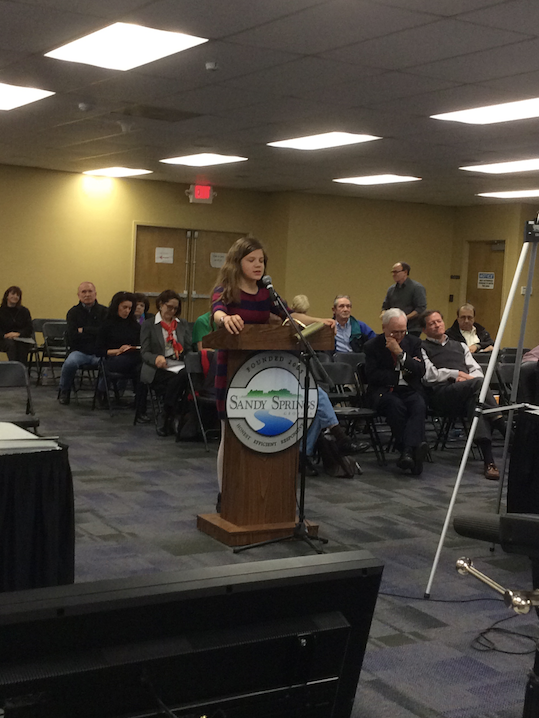
While she’s too young to vote, that didn’t stop Kate Kearney from voicing her opinion on the topic. Kate said she’s lived in Sandy Springs for most of her life and said she’s witnessed the changes that have come with growth and development, namely the slowly disappearing tree canopy.
Kate pleaded with the city to do what it can to halt clear-cutting, something she said is happening frequently and “it feels like no one is doing anything (about it).”
Photo: Kate Kearney speaks to the Sandy Springs City Council at its March 3 meeting. Photo credit: Andy Bauman
Get more local news delivered straight to your inbox. Sign up for free Patch newsletters and alerts.