Health & Fitness
The Newly appointed commissioners of the Georgia Charter Schools Commission
The commissioners of the Georgia Charter School Commission were appointed to represent all charter schools from Atlanta, but will all Georgians want this?


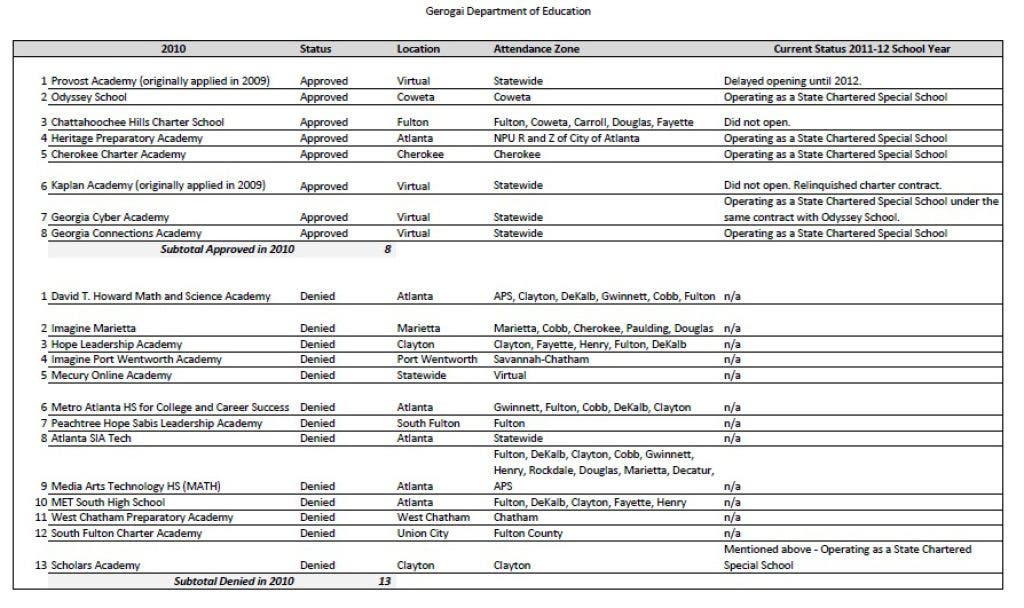


On January 17, 2013, the State Board of Education (SBOE) appointed seven new commissioners for the Georgia Charter Schools Commission (GCSC). In 2012, the Georgia General Assembly passed H.B. 797 (State Chartered Special Schools Act), so the GCSC could authorize charters if Amendment One H.R. 1162 was approved by Georgia voters on the ballot. In 2011, the Georgia Supreme Court found the GCSC unconstitutional over the misuse of “special schools,” applied to state-approved charter special schools.
Amendment One was voted 58% by Georgia voters. Some claim, the ballot language was misleading to solicit a Yes vote by misinformed voters. The ballot read as “Provides for improving student achievement and parental involvement through more public school options. Shall the Constitution of Georgia be amended to allow state and local approval of public charter schools upon the request of local communities?”
Find out what's happening in Virginia Highland-Druid Hillsfor free with the latest updates from Patch.
Who would vote no against improving education? Did voters know they were recreating this third state board to only serve charter schools? This was not in the ballot language; even though state and local boards already had the power to approve charters upon request.
This ballot created appointed commissioners, not elected; by the SBOE and recommendations of the Governor, Lt Governor, and House Speaker. The GCSC job is to approve or deny charter applications, by converting public schools; creating new start-ups or state-approved charter schools. This ballot forces representation from Atlanta appointees on all public school parents (which may not want charters) throughout Georgia; and removes absolute local board authority for choice on charters.
Find out what's happening in Virginia Highland-Druid Hillsfor free with the latest updates from Patch.
“Authority is granted to county and area boards of education to establish and maintain public schools within their limits” under Art. VIII, Sec. V, Par. I, of the 1983 GA Constitution. If GCSC represents charter parents, where is the representation for those against charters?
Governor Deal said, “I am pleased to see that the members of the Charter Schools Commission represent a broad cross section of backgrounds and expertise in business, education, non-profits, and government...I know they will take their duty of reviewing charter school petitions and approving high quality charter schools seriously.”
Out of Governor Deal's eight nominations, five were not chosen by the SBOE. The first was Billie Dendy, with experience in the federal Civil Service Commission; the federal Office of Economic Opportunity; and active in her Burnt Hickory Baptist Church. She’s involved in the Cobb County Republican Party; the Cobb County Republican Women's Club; and the Georgia Federation of Republican Women.
The second was James Andrew “Andy” Peryam, a U.S. Navy veteran; a teacher with Coweta County; principle and Vocational Director with the Central Education Center. He served on the boards of the Career Technical and Agriculture Education Resource Network; the Trade and Industrial Educators of Georgia; and the Georgia Non-public Postsecondary Commission.
Third was Dr. April Peters-Hawkins, an Assistant Professor at the University of Georgia with the Department of Lifelong Education, in school leadership research and educational reform for women and African-Americans. She was Dean of Students, at North Star Academy Charter School in Newark, N.J.; taught with the Teach for America Corps in Elizabeth Public Schools, N.J.; and principal in Baltimore, Maryland.
The fourth was Dr. Shawn Utley, the VP of Economic Development at Moultrie Technical College in Tifton, Georgia. Dr. Utley was a public school assistant principal, coach, principal, and teacher. Since 2005, an adjunct professor for the Valdosta State University; teaching Educational Leadership and Adult Career Education. Dr. Utley also serves as Chairman for the Tift County Board of Education; the Kiwanis Board of Directors; the Tift County Chamber of Commerce; and the YMCA Board of Directors.
The last nominee not chosen by the SBOE was Eric Rosen, a VP of SunTrust Community Capital Corporation. Since 1999, director on the New Markets Tax Credit (NMTC) and speaker. Also since July 2011, advisory board member for Georgia's Race to the Top Innovation Fund. Rosen was VP of Capital Development for the Atlanta Community ToolBank; and from January 2009-April 2011, the Treasurer and Secretary of the first GCSC.
From 2003-09, the SunTrust Community Development Enterprises (CDE) received $295M in NMTC allocations. The Community Renewal Tax Relief Act of 2000 created NMTCs to revitalize low-income areas, by giving investors incentive with a tax credit.
Invest Atlanta and Central Atlanta Progress created Imagine Downtown, Inc. (later renamed Atlanta Emerging Markets Inc.); a community development entity (CDE) that received a total of $80M in NMTC allocations, with below-market interest rate loans for a 7 year term and interest-only payments. These NMTC provide “financial assistance to private-sector companies (for-profits and non-profits) seeking low-cost financing for real estate development projects that create positive targeted community benefits;” like childcare, education, healthcare and other benefits for low-income residents.
To qualify for $5-40M in NMTC funding, the area must be in: a poverty rate of 30%; the average household income is below 60% of the area median income; and unemployment is 1.5 times the national average.
Some NMTCs fund charter schools, like JPMorgan Chase's $50M in grants to Community Development Financial Institutions to leverage funds for charters; with $175M in debt and $100M in NMTCs allocated for charter projects. The Spring 2011 Community Developments Investments report by the U.S. Department of the Treasury; showed JPMorgan Chase NMTCs with charters in Arlington, Philadelphia, and San Francisco. The U.S. Treasury awarded, the nonprofit Excellent Education Development with $50M in NMTCs for Los Angeles charters, like KIPP LA Prep.
Capital Peak Partners, LLC (Denver) closed a $11.5M NMTC loan for nonprofit KIPP STRIVE Primary school in Atlanta, with SunTrust as investor. KIPP Metro Atlanta operates six charters, and plans for eight by 2018.
In 2009, the OCC's Community Affairs Department showed 29 private nonprofits financing charter schools; with $1.1B in direct financal support (grants, guarantees and loans) and another $369M in NMTC allocations. From 1999-2009, $2.4B in tax-exempt debt was issued to charters; with Bank of America, Citigroup, Prudential, and other regional commercial lenders financing charters.
Since 2000, NMTCs “pairs traditional free-market forces with public resources.” A Public-Private Partnership with NMTC equity investors, like U.S. Bancorp Community Development Corporation (subsidiary of U.S. Bank and America's largest NMTC purchaser); had charters as their “significant beneficiary of the NMTC.” USBCDC portfolio has over 500 NMTC-financed projects of $8.7B in Qualified Equity Investments (QEI), with $323M supporting 20 charter schools (like North Star Academy in Newark, NJ and EMO Imagine Schools Inc.).
The charter schools partner with CDEs awarded with NMTC allocations; to receive capital at better terms and rates for investors, on their owed taxes. The investor “can use the tax credits as a method of partially offsetting some federal or state income tax liabilities,” much like tax credits for Student Scholarship Organizations. The NMTCs are taken over seven years for a total of 39% off investor's taxes; with 5% each year for the first three years and 6% each year for the last four years.
The reason for debts and NMTCs, is because charters suffer financial challenges. These independent public charter schools are not solely funded on state and local taxes, like government only public schools. Fitch Ratings give charters BBB low investment grade, and the whole industry BB non-investment grade; so charters cannot borrow at a low interest rate.
Charters use leveraged structures in NMTCs and other sources (capital campaigns, debts, grants, and private equity), for funding. The CMO, EMO or other management, collects those sources (debt, equity, fundraising, and grants) to create a Leverage Loan in an Investment Fund; which pools the Leverage Loan with the NMTC equity from investors to make a QEI, for the CDE. Then the CDE lends or makes equity investments for businesses, which operates the school or leases the property back to the CMO, EMO or management.
After this NMTC compliance period ends, the investors and the CDE leaves the NMTC. Allowing the charter's CMO, EMO or management to refinance any debt sources, through an asset management or intermediaries fee.
In 2012, Eric Rosen won the Joe Belew Award for Job Creation, using NMTCs for low-income communities. SunTrust helped create over 4,500 permanent jobs; over 2,500 pre-development or construction jobs; served 80K meals per month for low-income people; and served over 6,500 charter school spaces. SunTrust invested or loaned $243.9M in subsidized NMTCs to businesses and communities in: D.C., Florida, Georgia, Maryland, North Carolina, South Carolina, Tennessee, and Virginia.
The three appointed by the SBOE was Dr. Charles Knapp, the President Emeritus and President for the University of Georgia. He was chairman of the board for the East Lake Foundation, which helps redevelop Southeast Atlanta. He served on the boards of Aflac; the Georgia Early Education Alliance for Ready Students; and the National Commission on Teaching and America's Future. Dr. Knapp also served on the first GCSC.
The National Commission on Teaching and America's Future, wants all children to have access to quality teaching by partnering with local, state and national agencies. This organization researches quality teachers to “become more engaged in professionally rewarding careers...to more effectively educate our mobile and digitally-connected learners.”
The Georgia Early Education Alliance for Ready Students, helps “business, civic and government leaders maximize the economic return on the state's investments in early care and learning.” To ensure K-3rd graders success in reading, through their independent group United Way's Early Education Commission, chaired by Dennis Lockhart and Spelman College's president, Beverly Tatum.
SBOE's second appointee was Tony Lowden, the Executive Director of STONE Academy; an after-school program for at-risk children, in Macon-Bibb County. He serves as youth pastor for Lundy Chapel Missionary Baptist Church; with an M.Div from New Orleans Baptist Theological Seminary. Lowden also served on the board of directors for the Center for Racial Understanding; the Mayor's Office of Workforce Development Board; a member of Leadership Georgia's 2011 Class; and the Martin Luther King, Jr. Commission.
Lastly the SBOE appointed Jennifer Rippner, a consultant for the National Association of Charter School Authorizers (NACSA); pursuing her Ph.D. as Graduate Research Assistant, at the University of Georgia. She was Senior Policy and Legal Advisor with the EducationCounsel, LLC; an Education Policy Advisor for Governor Sonny Perdue; an Executive Director for the Governor's Office of Student Achievement; the Charter Schools Program for the Georgia Department of Education (GADOE); the Director of the Charter School Accountability Center at Florida State University; and director of a Micanopy, Florida charter school. Rippner also was the Chair of the first GCSC.
The NACSA is a nonprofit membership organization, to maintain high standards for charter school authorizing.
The EducationCounsel LLC, in affiliation with Nelson Mullins Riley & Scarborough LLP; provides legal advice for clients in education policies, strategies, advocacy, and reforms. These two organizations only support charter bureaucracy, not government operated public schools.
Lieutenant Governor Casey Cagle believes, “Strengthening and reforming the way we educate our children has long been a passion of mine, which is why I have consistently supported Charter Schools in Georgia.”
Out of Lt. Governor Cagle’s four nominations, two were not chosen. The first was Dr. Eva C. Galambos, the current Mayor of Sandy Springs, and retired economist in labor economics and urban finance. With a Ph.D. in economics from Georgia State University (GSU); a Master’s Degree in Labor and Industrial Relations from the University of Illinois; and a Bachelor in Business Administration from the University of Georgia.
The second not appointed by the SBOE was B.J. Van Gundy, a partner with e2 Assure LLC; a management consulting firm specializing in government departmental process improvement, also third-party oversight and revenue enhancement. Some of e2 Assure clients are: DeKalb Water and Sewer Billing Department; Planning and Development Department; Recorder's Court; ABCM Analyses (the Army's largest ammunition plant); Fulton County School District with SAP budget; Peachcare for Kids; and others.
In 2002, he was a board member for the Roswell Math and Science High Charter School. From May 2003-July 2010, served as Chairman of the Georgia Charter Schools Association.
The Georgia Charter School Association a nonprofit membership and professional organization, promotes and accountability from charter leaders, teachers, parents and others.
The “non-partisan” Brighter Georgia Education Coalition, lobbied for the 2012 Amendment One H.R. 1162 ballot. Their coalition consisted of local-national groups including: Georgia Charter Schools Association; Center for An Educated Georgia; American Federation for Children; Georgia Chamber of Commerce; Georgia Public Policy Foundation; Americans for Prosperity; 100 Dads; StudentsFirst; Black Alliance for Educational Options; and the Friedman Foundation for Educational Choice. Van Gundy's organization lobbied with others for the recreation of the GCSC and failed to be appointed, yet served on the first GCSC.
As part of the Brighter coalition was 100 Dads, which sued all 180 Georgia local school districts before the 2012 election. Rich Thompson, CEO of 100 Dads and other plaintiffs sued with Glenn Delk; Atlanta attorney and charter school advocate.
Delk accused 180 districts of “conspiracy” for not restricting public officials and employees using taxpayer dollars. A 1981 ruling said “expenditure by a political subdivision of public money to influence the citizens and voters of the entity contains within it the possibility of the corrupt use of influence to perpetuate a local administration’s power.”
This does not seem to apply for the Governor, Lt. Governor and the House Speaker, which support charters openly; influencing citizens with public money. Remember these public officials, also represent voters that voted against them, and taxpayers that oppose charters too. Where is their local representation in government, if not the local school districts?
Delk said public officials cannot campaign by “hiring a public relations firm...printing bumper stickers and yard signs,” which “still involve an official government resource.” Yet, government resources favored by public officials in both parties are used everyday in other programs; why should education be different? Is education suppose to be bipartisan?
Delk accused 180 districts as part of “the Education Empire” for engaging in a “coordinated campaign and conspiracy” to defeat Amendment One; where members get $11M from taxpayers. Yet supporters of Amendment One like Families for Better Public Schools (FBPS), used nonprofit members and for-profit shareholders money. Did any of them disagreed with their lobbying?
In October 2012, the FBPS raised over $522K, while Vote SMART against the ballot raised over $115K. By November, FBPS raised $2.8M, more than Vote SMART's $309K. For nonprofits to use a legal loophole advantage of confidentiality to have a greater voice and suppress another group's right, because they work for the government – suppresses individual's rights to petition.
Plaintiffs used audio recordings from a Georgia School Boards Association meeting, with a session called “Communicating About Ballot Initiatives.” This session showed how to defeat the ballot through lobbying booster clubs, chambers of commerce, parents, school employees and staff; using terms like “building a dual educational system” and “taxation without representation.” Did the FBPS also have sessions on lobbying too?
Delk said no “agent, employee, servant, attorney or independent entity,” could have anti-charter materials on public schools during business hours. What about pro-charter materials?
Supreme Court Judge Wendy Snoob asked Delk “So they can’t speak if they have a title?” Snoob threw out the case, refusing to block Fulton County's online Q&A against Amendment One, which Delk called “thinly veiled propaganda.”
Dr. John Barge, the superintendent of the GADOE (also Republican); consulted with Attorney General Sam Olens taking down their Amendment One webpage.
Governor Deal's and his spokesman Brian Robinson, removed their webpage supporting Amendment One stating “While it’s well within the governor’s rights to explain to Georgians where he stands on the issue, we are happy to play by the same rules as the superintendent’s office...The governor, however, will not stop working to give every Georgia family school choice so that no child is trapped hopelessly in a failing school.”
Both Deal and Robinson are state employees, funded by taxpayer dollars; yet the Governor has more rights than teachers and superintendents, to explain where they stand? Sounds like hypocrisy.
Why is it the Governor's right to explain their views politically and support one side, but Georgia schools cannot petition against nonprofits and for-profit companies bureaucracy, lobbying with more money and more political rights?
Why is it not wrong to use members-shareholders money, when some may not agree to for-nonprofits lobbying without their approval, to manipulate the government or the market for their bureaucracy? Van Gundy and the Brighter coalition lobbied for their bureaucracy; where is the other taxpayer's voice lobbying against charters?
Why are tax dollars paid by all citizens, different than member-shareholders dollars; if they cannot control their organizations from lobbying against things they oppose? At the 2011-12 Home Depot shareholder meetings, the American Family Association petitioned against executives supporting homosexual organizations. This did not change the executive’s behavior to be inclusive; to their diverse customers they serve.
Another Brighter coalition group allied with Van Gundy's group was the Friedman Foundation for Educational Choice. Founded by Milton Friedman “to promote universal school choice as the most effective and equitable way to improve the quality of K-12 education in America...(because) when schools are forced to compete to keep the children they educate, all parties win.” Yet schools are not factories that produce a car, but a place of learning for human beings that do not learn, nor reproduce the same product.
Georgia Charter Schools Association partnered with the: National Alliance for Public Charter Schools; National Association of Charter Authorizers; and Walton Family Foundation. Rippner consulting with NACSA (appointed to the GCSC twice) and Alice Walton's foundation donation of $250K and $350K; both helped to recreate the GCSC.
From 1999-2005, Van Gundy was a lobbyist with The Van Gundy Group, LLC. From 1995-99, he was the S.E. Region VP for Barnett Bank, oversight five wholesale mortgage banking offices in five states. He served with the Georgia Republican Party, as county party chairman; district party chairman and as State 2nd Vice Chairman. Van Gundy previously serviced on the first GCSC, but failed to be appointed again.
The two appointed by the SBOE was Tom Lewis, a Senior VP for the External Affairs with Georgia State University (GSU). He helped GSU with leadership in corporate relations and government; by serving as liaison to local, state and federal governments. In 1991, he served under Governor Joe Frank Harris, as Chief of Staff. From 1978-83, served as executive VP of the Cartersville-Bartow County Chamber of Commerce; and from 1974-78, as executive director of the Georgia Franchise Practices Commission. Lewis also served on the first GCSC.
The second appointee was Paul W. Williams, with over 30 years of financial experience in Georgia companies; currently as Chief Financial Officer of Brickstream Corporation. He also served as executive for: Aldridge; Bank Corporation of Georgia; Colony Management Services; Community Bancshares; Deloach & Company; Howard, Moore & McDuffie; Fairfield Financial Services; Harvest Advisors; and Riverbrooke Capital Partners.
Howard, Moore & MCDuffie is a Certified Public Accountant (CPA) company. The Bank Corporation of Georgia in Macon, is the parent company of First South Bank and AmeriBank. In 2009, Community Bancshares of West Georgia, Inc. filed for Chapter 7 bankruptcy; a bank holding company for the Community Bank of West Georgia in Villa Rica.
Brickstream Corporation, a software company that measures people's behaviors in retail stores and banks; also collects data to improve “labor and service optimization” to increase sales and growth margins. Brickstream has offices in Norcross, the UK and Asia; funded by Columbia Capital, Mohr Davidow Ventures and RBC Technology Ventures. Brickstream's partners are: People Counting, Easy Count, IBM, Tyco and others.
Williams is a licensed CPA; former board member of the Georgia Society of CPAs; and former adjunct accounting professor at Mercer University. He is a Magna Cum Laude graduate of the J. M. Tull School of Accounting, from University of Georgia; a graduate of Middle Georgia College; and involved with Georgia’s 4-H program.
House Speaker David Ralston said, “When Georgians voted to approve the Georgia Charter Schools Commission, they chose to set Georgia on a path that would allow for the creation of additional educational opportunities for students in our state and greater parental involvement....(to) allow all Georgia students to receive the education that they deserve. I am confident that the appointed members will serve the people of Georgia well using their experiences, background and knowledge to make the best decisions for our students and for communities across our state.”
Out of Speaker Ralston’s four nominations, two were not chosen like Richard W. Gill, with 35 years of experience as a high school coach, athletic director, principal, teacher, and community service.
The second was Michael Lee Gilstrap, a healthcare executive with over 30 years of medical experience. Gilstrap served as banker at Middle Georgia Bank; a teacher at Byron Elementary School; and vocational rehabilitation counselor at Medical College of Georgia. He also served on twelve central Georgia community organization boards.
The two appointed by the SBOE was Jose R. Perez, the President of Target Market Trends Inc. (TMT); a business consulting firm in Peachtree Corners, Georgia. TMT helps develop market and business strategies to focus on market trends; by increasing earnings using fact-based information to leverage a firm’s assets. TMT also forecast marketing, client sales, opportunity analysis, and business planning.
From 2004-11, Perez served on the SBOE as the 7th Congressional District representative. From 1997-2002, was director of Garner Consulting; and from 1973-97, director of Bell South. Perez has an M.A. in Economics, from Florida Atlantic University.
The second appointee was James E. Hogg, with over 30 years in public education as a principal; teacher; Regional Education Service Agency administrator for the GADOE; and technical college director. He was Interim Director for Charter Schools with the GADOE; and Walton County Career Academy, as Athens Technical College Walton Campus Director.
The new GCSC commissioners are Governor Deal's Dr. Charles Knapp, Jennifer Rippner and Tony Lowden; Lt Governor Cagle's Tom Lewis and Paul W. Williams; and Speaker Ralston's Jose R. Perez and James E. Hogg; out of sixteen.
Of the seven, three were GCSC former commissioners, which are Dr. Knapp, Rippner and Lewis. Two former commissioners that failed to be appointed, were Rosen and Van Gundy.
The GCSC is a third state school board that only serves independent quasi public charter schools, not all government operated public schools. The commissioners’ experiences range from: charter schools, universities, after-school programs, youth pastor, government, public schools, executives, nonprofits, business consulting firms, and chamber of commerce.
The reader can decide if the new commissioners and their background promote real reform, by experimenting with locally chosen learning models; or if they are only creating the slippery slope of having two choices with charter and private schools. By driving out competition, converting all public schools into these quasi public-private charter schools, which are not accountable to all taxpayers creating only one choice.
The new commissioners, do not have the some agenda of the GADOE to serve the best interest of “all” public school students; instead they only serve charter school students, their bureaucracy, and redefines what a “public school” is.
The reason some support charter schools is their independence from state and federal laws, to experiment on what learning model works; yet this experiment without supervision, can be like Frankenstein's Monster. Private schools are “independent” of laws too, like no requirement to federal standardized exams or show school scores, but is mandatory for public schools, even to show their exam scores for public accountability.
Others support charters, out of displaced anger for their failing schools; instead of blaming lawmakers who created the standardize exam bureaucracy, austerity cuts and other forms of rules, policies, procedures, and laws. If students and teachers need to be accountable, then those in authority of these charters need accountability; and not independence of law.
Corruption and scandals occur in any human organization, when there is limited accountability or transparency.
Every public official has to be silent on their views, while for-nonprofits use legal loopholes to campaign unopposed. There will always be public officials opposing each other, but if one side is given more power on where they stand that’s favoritism and silencing American's individual freedom of speech. If lobbying is the approved way to express freedom, then both sides need coordinated campaigns.
With the recreation of the GCSC, will there be less accountability and transparency when more public schools are converted to charters? The questions the reader should ask: Will the educational reform choice only be charter school bureaucracy? Or will locals experiment with other forms of learning model choices, beyond charters?