Health & Fitness
Historic District Overlays in Virginia-Highland – What will being Designated a Contributing Structure mean to almost 3 out of every 4 Homeowners?
Thanks to the Historic District Overlay (HDO) steering committee and Aaron Fortner for hosting the third of five planned meetings to discuss the Historic District Overlay process. As I’ve stated previously, this is a big issue for the Virginia-Highland community and will have significant impact on a vast majority of homeowners through the restrictions placed on residential development. Please consider attending one of the remaining meetings in December to learn what is being proposed and to voice your opinion.
My concern about HDO’s incompatibility with the culture of our Virginia-Highland community has escalated after this last neighborhood meeting, when additional information about the HDO process was discussed in greater detail. The comments below are based upon my notes from the meeting.
Attendees learned that a minimum of 70% of the houses in the affected area (210 out of 300) are required to be classified as “Contributing Structures” to qualify the area for HD designation. This means that should the HDO steering committee recommend that the VHCA proceed with additional study/funding, the Urban Design Commission (UDC) would designate homes in the approved “styles” that are also greater than 50 years old as Contributing Structures for the affected area. Since this percentage of Contributing Structures forms the legal basis of the entire Historic District Overlay, these Contributing Structures are burdened with higher obligations and limitations than non-contributing structures.
Find out what's happening in Virginia Highland-Druid Hillsfor free with the latest updates from Patch.
Below is a short list of the issues that almost 3 out of every 4 homeowners in the affected sub-neighborhood would have to deal with when their homes are designated Contributing Structures:
Contributing Structures cannot be torn down by current or future homeowners.
Find out what's happening in Virginia Highland-Druid Hillsfor free with the latest updates from Patch.
· Only by petitioning the UDC can a contributing structure be torn-down, and the onus is on the petitioner to prove that the structure is a threat to public health and safety. There are few to no houses in all of Virginia-Highland that would meet this public health threat threshold, so all houses designated as Contributing Structures would have to be maintained ad infinitum.
· Older Contributing Structures that are currently functionally obsolete and/or in disrepair would need to be maintained even if the most economically feasible action would be demolition and reconstruction, since the HDO statute requires Contributing Structures to support the HD designation.
Owners of single-story houses bear the highest risk as all single-story houses could be forced to remain single-story houses.
· Should your house be a single-story Contributing Structure, which is the average sized house in Virginia-Highland, you bear the highest risk because the UDC would be able to “encourage” you to maintain it as a single-story house. Attendees learned that the UDC could reject petitioners seeking second-story additions and instead recommend solutions for a single-story expansion to be built in the backyard.
· For example, let’s say you have a typical single-story 1940ish 2,000 square foot (SF) house on a typical 8,000 SF lot and you’d like to expand the house to meet your family’s spatial and functional needs in 2015 of 4,000 SF. The UDC could encourage you to build the additional 2,000 SF with an expansion out the rear of your house, since the HDO must “protect” the front historical facades of Contributing Structures. So, instead of building vertically with a second-story addition and having a compact 2,000 SF footprint and a functional house layout, you could be required to have 4,000 SF on one level.
Forced single-story development would reduce backyards significantly and could require lot coverage variances.
· From the example above, the 4,000 SF house on a 8,000 SF lot would immediately put your expansion at the 50% lot coverage limit – the current maximum – before considering driveways, garages, or other paved surfaces. Essentially you would lose the use of the majority of your backyard of the house you purchased for your children, pets, and gardens because of the inability to expand vertically.
· But that's not all – attendees also learned that the HDO could permit lot coverage ratio increases to 55% or more because of this hardship. However, (sigh), with all the watershed issues in our area from houses already pushing 50% lot coverage, does our Virginia-Highland community really want to increase the lot coverage ratio for impervious surfaces? This is clearly counter to our shared desire to live in a green, canopied neighborhood that all of us currently enjoy.
Burden remains on the Contributing Structure homeowner.
· As a seller, the vertical expansion limitations of a single-story property clearly reduces the number of potential buyers. How many potential buyers would consider purchasing a single-story house in Virginia-Highland with these burdens and limitations when they could buy in Morningside with no restrictions?
· The burden is on the homeowner to defend proposed renovations that meet one of the 10+ historic house styles considered Contributing Structures. Attendees learned from one architect in attendance that this may take multiple appeals/visits back to the UDC to meet documentation requirements and obtain approval for renovations. The UDC also retains the right to reject planned renovations, even after multiple revisions and appeals.
These are deal-breakers for me. Since my house wouldn’t qualify as a Contributing Structure (because it was renovated before I purchased it), it means that three of my neighbors probably would have to deal with these issues and I don’t think that’s fair.
We need to stop this HDO effort before almost 3 out of every 4 homeowners are economically burdened with limitations on how they can utilize their properties, with consequences for the entire neighborhood. Unfortunately there is little ground for compromise on this issue, because once a HDO is adopted, over 70% of homeowners immediately have restrictions they can’t get out of that the other 30% don’t equally share. This is one example of what I meant when I stated this effort could divide our community.
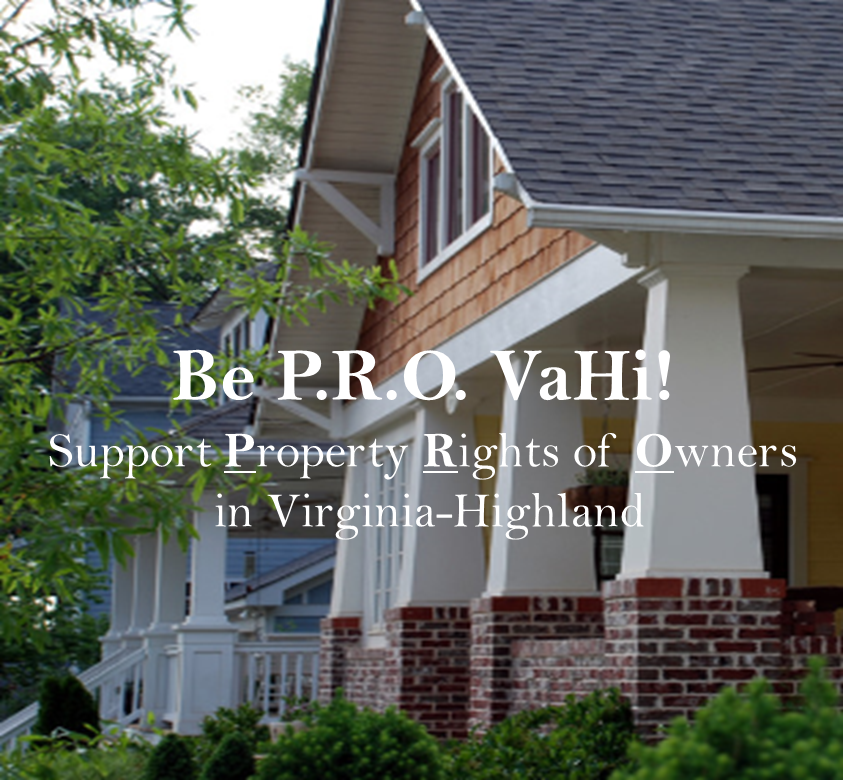
If you agree with any of this, please consider supporting PRO VAHI.
PRO VAHI needs your support to send a loud and clear message to the VHCA and other governing bodies that we reject style restrictions in Virginia-Highland and do not want Historic District Overlays that we believe are counter to our community’s cultural DNA. PRO VAHI supports addressing scale and size through the appropriate channels, not by adding unnecessary style overlays and renovation restrictions on almost 75% of homeowners. Please visit PRO VAHI at www.facebook.com/PROVAHI, sign the petition at www.change.org/petitions/residents-of-virginia-highland-support-the-property-rights-of-owners-in-virginia-highland, and share it with other Virginia-Highland residents who don’t want to lose property rights and individualism to style and renovation restrictions. Finally, please attend a meeting and learn for yourself.