Crime & Safety
2 Illinois Officer Deaths In 2016: FBI Report
The FBI released new law enforcement officer death and injury statistics for the year 2016.


The FBI on Monday released the number of law enforcement officers killed and injured in 2016. Numbers show Illinois is a relatively safe state in which to be a police officer, especially when it comes to violent — or what the FBI calls "felonious" — deaths. Still, two officers were killed in Illinois in 2016, both in accidents, according to the FBI.
Chester Police Officer Jason Irwin Brockmeyer, 22, was killed in a crash during a vehicle pursuit on Oct. 28, 2016. Brockmeyer, who had been an officer for just 10 months, became trapped in the wreckage after his vehicle left the roadway and overturned.
South Jacksonville Officer Scot Fitzgerald, 32, died March 4, 2016 when his patrol car crashed into an ambulance as he was responding to a medical call. The ambulance had been following Fitzgerald's car as they attempted to locate an address when Fitzgerald pulled over on the shoulder and attempted to make a U-turn before being hit by the ambulance. He is survived by a wife and two children, according to the Officer Down Memorial Page.
Find out what's happening in Across Illinoisfor free with the latest updates from Patch.
Not included on the FBI 2016 fatality list are Cook County Sheriff's Officer Jason Gallero, 45, who collapsed while participating in a colors run at the department’s training academy in Maywood on Sept. 15, 2016. A correctional officer with the Marion County Sheriff's Office, Adam Scott Conrad, 22, also died on Jan. 10, 2016, in a crash while transporting a prisoner.
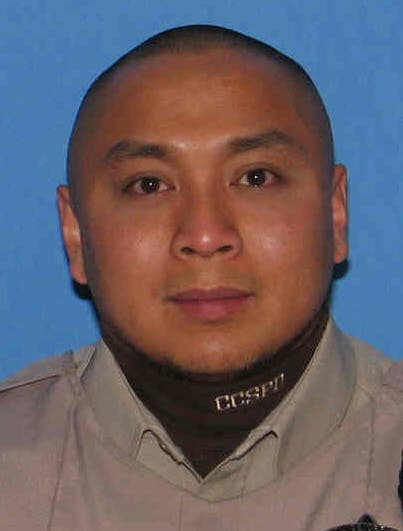
While the FBI report includes 2016 deaths, Illinois has seen several officer fatalities in 2017. One officer, Chicago Police Officer Bernie Domagala, died as a result of gunfire — nearly three decades after he was shot.
Find out what's happening in Across Illinoisfor free with the latest updates from Patch.
Domagala was just 37 years old when he was shot while responding to the home of a barricaded ex-cop on July 14, 1988. Shot in the forehead, Domagala endured nearly 30 years of traumatic brain injury complications, succumbing to his injuries at the age of 66 on Sept. 5, 2017.
Two Illinois officers were killed in crashes in 2017. Bloomingdale Police Officer Raymond Murrell, 27, was on the force for less than a year — during which time he received a life-saving commendation — when his SUV struck a pole as he was responding to a report of a crime in progress at a local store. He was killed on Jan. 19.
Illinois State Police Trooper Ryan Matthew Albin, 37, died on June 28 when his patrol vehicle collided with a box truck on I-74. His K9 partner was taken to a veterinarian for treatment after the crash. Albin was an 11-year veteran with the ISP.
Finally, a Forest Preserves of Cook County Police Department K-9 named Drago died on June 14 after being left unattended in a hot vehicle in 90-degree weather as his handler processed an offender who had been arrested. Drago had been with the forest preserve police for three years and had recently helped locate a disoriented man.
Nationwide data
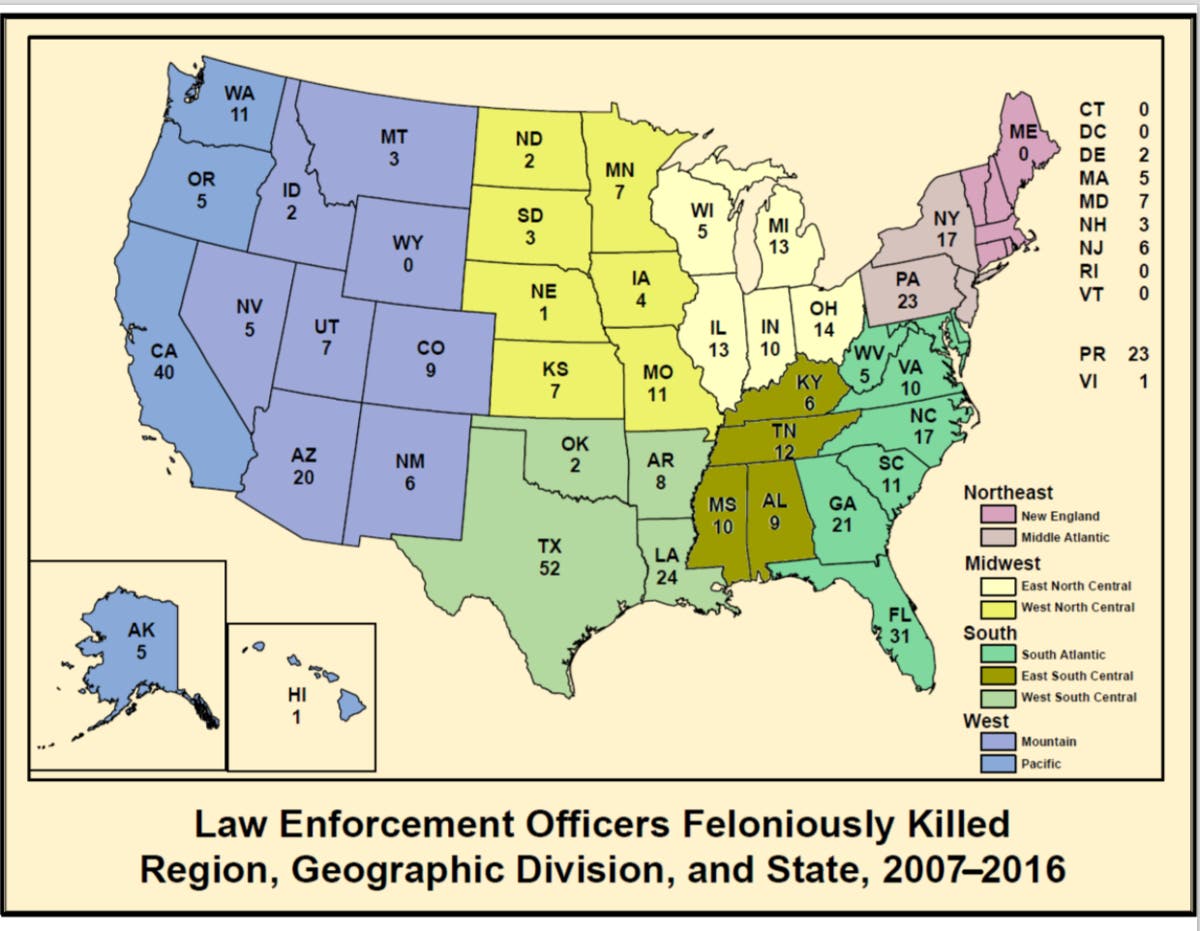
In the new report, the FBI reported 66 on-duty officer deaths during the commission of a crime across the United States.
- Line-of-duty deaths occurred in 29 states and in Puerto Rico.
- By region: 30 officers were feloniously killed in the South, 17 officers in the West, 13 officers in the Midwest, four officers in the Northeast and two officers in Puerto Rico.
- The average age of the officers who died in 2016 was 40 years old.
- The slain officers’ average length of law enforcement service was 13 years.
- Of the officers who died due to felonious incidents in 2016, 64 were male and two were female.
- By race: 61 of the victim officers were white, four were African American, and one was Asian/Native Hawaiian/Other Pacific Islander.
- Seventeen officers were killed in ambush situations.
- Thirteen officers who died had responded to disturbance calls.
- Nine officers died as a result of investigating suspicious persons or circumstances.
- Nine officers died as a result of arrest situations.
- Six officers were killed as a result of tactical situations (barricaded offender, hostage taking, high-risk entry, etc.).
- Five officers were conducting investigative activities (surveillance, search, interview, etc.).
- Four officers were fatally injured during traffic pursuits/stops.
- Three officers were killed in unprovoked attacks.
The report also measures the number of federal agents killed or assaulted. In 2016, a total of 1,447 federal law enforcement officers were assaulted. Of these officers, one was killed and 324 were non-fatally injured.
The overwhelming majority of felonious officer deaths are firearms related. Of those felonious officer deaths, 65 percent were attributed to handguns, 20.4 percent to rifles, 6.5 percent to shotguns, 5.9 percent to vehicles, 1 percent due to personal weapons and .4 percent each to bombs and knives or cutting instruments.
The FBI has been pushing for better data collection on crimes to make it easier to compare criminal incidents across different locations in the united states. The Uniform Crime Reporting statistic database — a measurement tool used since the 1930s to compare violent crime between cities, towns and counties — is problematic, the agency admits. The FBI is encouraging law enforcement agencies to employ a new reporting system.
"Currently, the UCR Program does not collect all of the comprehensive data that law enforcement, researchers, and policymakers need to effectively deal with crime in modern society," the FBI's website says. The agency is asking local police department and other law enforcement agencies to move to the National Incident-Based Reporting System (NIBRS). It is also encouraging more uniform reporting of use-of-force incidents.
Although homicides are generally reported without much variation, other incidents such as robberies, burglaries and assaults can vary wildly in how they are reported by local law agencies. This also applies to injuries reported to law enforcement officers. It is hoped that the new NIBRS system can smooth out some of that variation if it is uniformly adopted by agencies in the US. When agencies are all on board, the number and incident types of officer injuries could change.
Jean Lotus (Patch Staff) contributed to this report.
FBI logo
Get more local news delivered straight to your inbox. Sign up for free Patch newsletters and alerts.