Politics & Government
Judge Sends Challenge To Pritzker's Powers Back To Circuit Court
A federal judge found a state lawmaker's lawsuit challenging the governor's coronavirus executive orders belongs in state court.


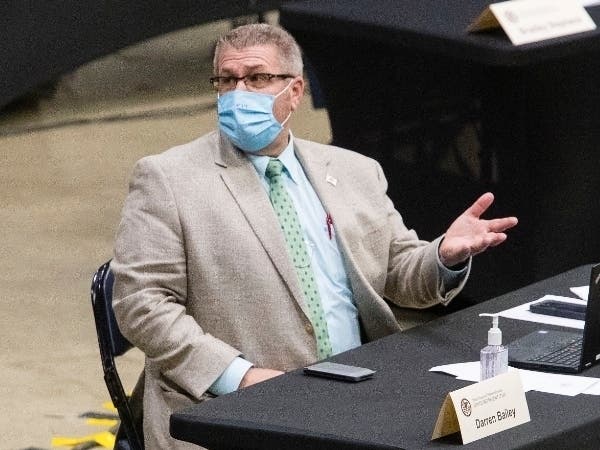
EAST ST. LOUIS, IL — A federal judge sent a state lawmaker's challenge to the governor's coronavirus emergency powers back to state court. Describing the decision as a "close call," U.S. Magistrate Judge Gilbert Sison ordered State Rep. Darren Bailey's lawsuit against Gov. J.B. Pritzker to be returned to Clay County Circuit Court, where it began more than two months ago.
After the suit was initially filed in April, Circuit Judge Michael McHaney granted a temporary restraining order preventing the state from enforcing the governor's stay-at-home executive orders on the lawmaker. Bailey, a Xenia Republican running unopposed for state senator in the 55th District, filed an amended version of his complaint on May 13.
The day before a hearing on the case in McHaney's courtroom scheduled for May 21, Pritzker filed paperwork to move the case to federal court, arguing that Bailey's complaint raised claims under the U.S. Constitution. Bailey's attorneys responded with an immediate emergency motion to return the case to Clay County, accusing Pritzker of "forum shopping" after he was rejected in the Illinois Supreme Court and in an effort to transfer the case to Sangamon County.
Find out what's happening in Across Illinoisfor free with the latest updates from Patch.
Sison was tasked with determining whether the state representative's claims establish federal jurisdiction. He granted Bailey's request to hear the case on an expedited schedule.
According to Bailey's complaint, Pritzker overstepped his authority under the Illinois Emergency Management Agency Act by repeatedly extending his March 9 disaster declaration. The representative also argued the governor's orders improperly bypassed the delegation of authority to local health departments.
Find out what's happening in Across Illinoisfor free with the latest updates from Patch.
The magistrate judge said in his order he understood the case takes place with the backdrop of turbulent and uncharted times.
"The stakes are high on both sides of this litigation," Sison said. "There is no easy balance between protecting the public from a silent, fast-spreading novel virus and preventing great social upheaval and the heavy strain of economic and financial uncertainty."
Sison said it was a close call to determine whether there was federal jurisdiction, in part because Bailey's complaint lacked clarity by referencing constitutional rights "vaguely and in passing."
Some rights, like the right to travel, are recognized by both the U.S. and Illinois constitutions, the judge notes, and Bailey elects not to specify in his complaint that it only seeks relief for violations of rights guaranteed by the state constitution.
Sison said the crux of the dispute was clearly the scope of Pritzker's power under a statutory scheme established by Illinois lawmakers.
"And, although federal constitutional rights may be impacted, it is ultimately incidental to the issue of whether the Governor exceeded those powers, which is a matter governed solely by state law."
Related:
Challenge To Stay-At-Home Order Belongs In State Court, DOJ Says
Pritzker Moves Bailey's Legal Challenge To Federal Court
Judge Blocks Pritzker From Enforcing Coronavirus Executive Order On Lawmaker
Pritzker, who was represented by the office of Illinois Attorney General Kwame Raoul, cited references that did not support its conclusions, pulling a phase out of context in one case and ignoring the conclusion of another in an effort to construe an expansive reading of a statute the Seventh Circuit has interpreted as having no legal effect since 1975, according to Sison.
The governor raised other arguments as to why the case should fall under the authority of federal courts, but Sison said he declined "to address each one individually because it is clear that it would be judicial overreach to read Bailey's claims as federal civil rights claims subject to Section 1343's jurisdictional grant."
The Justice Department also filed a brief in the case, but since the arguments offered by its attorneys were not substantially different from those raised by Bailey, the judge said he did not need to specifically address its position.
Bailey's attorney, Tom Devore, had described the governor's efforts as "vexatious" and said they would "perhaps be the most disreputable invocation of federal jurisdiction ever seen in modern times."
But the federal judge refused Bailey's request to order Pritzker to cover his legal fees and costs, disagreeing with the state representative's arguments that the governor's effort to move the case was in bad faith.
"The Court seriously considered whether Bailey unintentionally pleaded himself into federal jurisdiction by raising a claim under the United States Constitution with this lack of specificity, and the decision in his favor was a close call," Sison said. "As such, the Court does not find that Governor Pritzker lacked an objectively reasonable basis for seeking removal."
Get more local news delivered straight to your inbox. Sign up for free Patch newsletters and alerts.