Health & Fitness
WALKING WITH NATURE: Ten Things You May Not Know About Trees
How many acorns does one oak tree produce? What percent of tree species on earth are endangered? Where might you worship in a chapel built inside a tree struck by lightening in the 1600s?
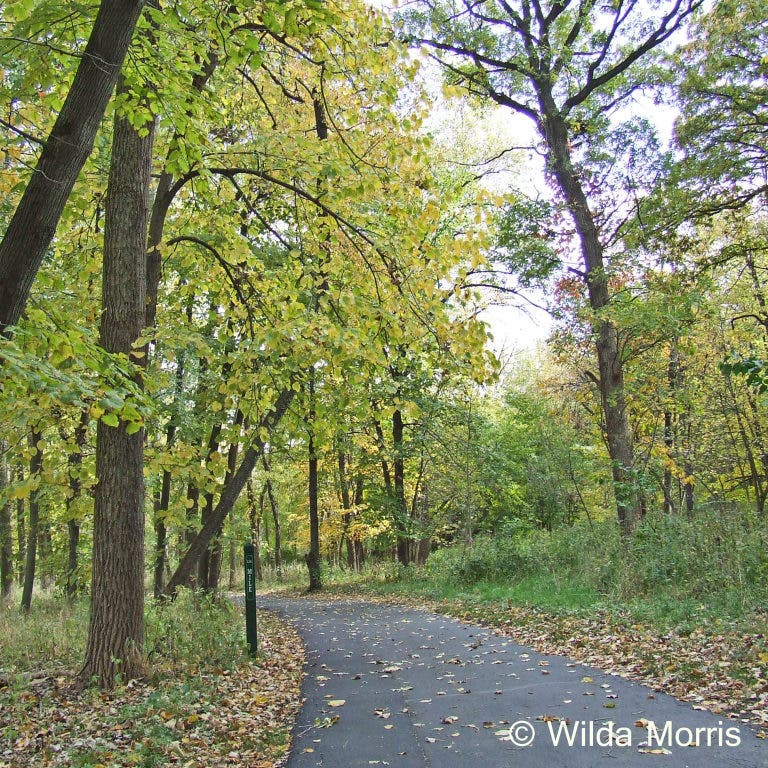


We think a lot about trees during the spring when they are leafing out and even more in the fall when the green turns to gold, red, orange or brown. So maybe October is a good time to learn a few things about trees. How many of the following facts are new to you?
- Ten percent of all tree species in the world are threatened with extinction, according to Morton Arboretum in nearby Lisle. As many as 1,000 species are “critically endangered.” The Arboretum is working to foster protection of these species. It also has a Scarecrow Trail this fall, featuring 50 “nature-themed scarecrows” on a trail around Meadow Lake. Check their website for hours and entrance fees (http://www.mortonarb.org/general-information.html.
- One mature tree produces enough oxygen for two people; two trees, enough for a family of four, according to scientists. Of course, this is an average; it depends on the species and size of the trees. Mature redwoods and sequoias produce more oxygen than other trees.
Find out what's happening in Bolingbrookfor free with the latest updates from Patch.
- One oak tree may produce as many as 50,000 acorns in a year. On the other hand, an oak generally does not produce acorns until it is at least 20 years old; some don’t do so until after their fiftieth birthday. Since an oak can live as long as 200 years, this doesn’t seem to be a problem. Most acorns are eaten by animals or destroyed in other ways; only a few grow into trees. In 2004, the oak was officially designated as our US national tree.
- The tallest known tree in the world is a California Redwood nicknamed Hyperion. It is over 379 feet tall. Hyperion was given the title of “tallest tree in the world” within the last couple of years, after it was discovered and then measured by scientists. Its exact location is kept a secret, in order to protect it. In order to measure the tree, scientists climbed it and dropped down a tape measure. National Public Radio took a camera to the site and videotaped someone climbing the tree. You can see the video at http://www.npr.org/blogs/krulwich/2011/04/08/135206497/the-worlds-tallest-tree-is-hiding-somewhere-in-california.
Find out what's happening in Bolingbrookfor free with the latest updates from Patch.
- The branches of conifers (evergreens) are more flexible than those of deciduous trees, so they don’t snap so easily when snow collects on the needles.
- The Coast Salish peoples, native to the Pacific North-West, traditionally wore clothing made of softened cedar bark, as did Hawaiians and Polynesians.
- Some trees, including the baobab and kapok trees, are pollinated by bats. The bats eat the pollen and nectar produced by the large flowers on these trees, and, in the process, move pollen from one flower to another.
- Seeds found within the cones of conifer trees provide food for crossbills, birds of the finch family. Each species of crossbill eats from a particular species of conifer. Since the cones of different trees are shaped differently, the beaks of different crossbills are shaped differently.
- The Eucalyptus deglupta, the only eucalyptus that grows in the Northern Hemisphere, is also called the rainbow eucalyptus because its trunk is multicolored. Strips of bark peel off, living the area green. As the new bark matures, it changes to blue, then purple, then orange and finally, maroon. Since different strips peel at different times, the trunk may exhibit bark of all these colors at once. The rainbow eucalyptus is used for making paper, and is sometimes grown as an ornamental element in large gardens. Check out the video of this beautiful tree at http://www.youtube.com/watch?v=wwXSHKdDM7Y.
- In the 1600s, in the small village of Allouville-Bellefosse in France, lightning struck an ancient tree and hollowed it out. The local abbot and priest built a shrine to the Virgin Mary inside the trunk; later another small chapel was added. The trunk is dying and now has to be held up with poles. Nevertheless, mass is still held in the original chapel twice a year.
Scientists estimate there are about 60,000 species of trees in the world today (an eleventh thing you might not have known about trees!). You can walk among trees on the DuPage River Greenway, in Winston Woods, and other natural areas in Bolingbrook and the surrounding area. Don’t neglect the opportunity!
© Wilda Morris