Health & Fitness
Walking with Nature: The Gateway Wetlands in April
American coots are birds with interesting vocalizations, weird feet, unusual take-offs, and strange (by human standards) parenting strategies. They prefer the north end of the Gateway Wetlands.
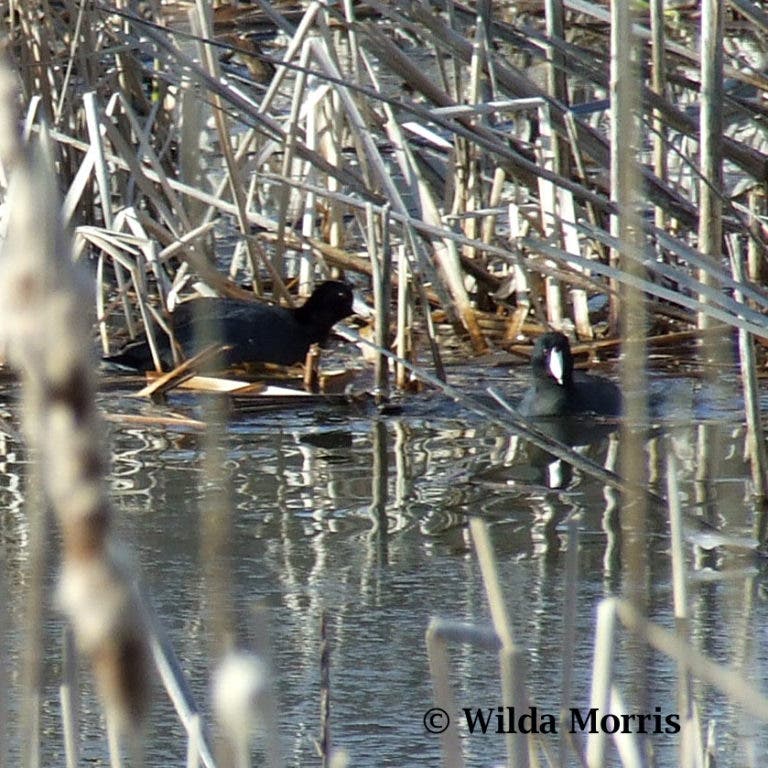


Walk the Gateway Wetlands at just the right moment with your eyes closed and you might think you are in a jungle. American coots, some of which inhabit the north end of the GW, have a number of vocalizations, some so eerie that they were used as background noise in Tarzan movies.
The American coot (Fulica Americana) is sometimes described as “duck-like” and sometimes as “chicken-like.” When swimming it looks as though it could be a black duck. When the coot gets out of the water to forage, its long legs and gate might convince you it is some kind of chicken—until you notice its toes!
Coots are black to dark gray with white bills, and white under-tail feathers. Their foreheads are white with a small patch of brownish-red (which is hard to see unless you are close to them). At the bottom of their yellow-green legs are long lobed or scalloped toes of silver-gray. They do not have webbed feet. There is a good picture of the feet at http://www.redorbit.com/education/reference_library/science_1/aves_birds/2582880/american_coot/.
Find out what's happening in Bolingbrookfor free with the latest updates from Patch.
Coots and other members of the Rallidae family are sometimes called mud hens, perhaps because the females sometimes make a clucking sound reminiscent of a chicken. Or perhaps it is because they frequent marshes, lake shorelines, reservoirs, and even waterlogged ditches. They prefer shallow water.
The coot’s menu includes aquatic plants, including algae, arthropods, small fish and other aquatic creatures. Coots also forage for insects and worms on land. Their long, lobed toes spread out, making it easier for them to walk without a waddle. During breeding season, coots crave insects and mollusks. They don’t often bother larger fish because their beaks, being short, are not suitable for a large catch.
Find out what's happening in Bolingbrookfor free with the latest updates from Patch.
If you have the good fortune of watching coots take off and fly, you will know right away that they are not ducks. They use their long toes to pedal across the water until they get up enough momentum to take off. Their feet and wings pound and splash the water. Once airborne, the coot is an excellent flyer. Though it is rare, a few American coots play Charles Lindberg and fly across the Atlantic Ocean, where they may meet European cousins.
Some coots stay in the northern states where the water doesn’t freeze during the winter. Most, however, migrate to warmer climates in the fall, sometimes as far south as Panama or northern South America. In the spring migration (February to mid-May), the males migrate first. Again in the fall (August to December), the males (along with non-breeding females) take off first.
Among American coots, a pair bond becomes permanent once they have established their territory. Their nests are built on the water, which makes them vulnerable to disintegration. They are hidden among tall reeds and basically are floating rafts. Most of the work is done by females; the males are busy defending their right to the real estate they have chosen.Some of the nests—more like platforms—are used primarily for courting.
Coots usually build several egg nests, each with a ramp leading down into the water so that they can walk in and out of the nest without damaging it with their claws or long toes. Most coot pairs have several egg nests. They may lay eggs in a couple of nests. If a brood fails for some reason (such as a predator stealing the eggs), the female will usually lay eggs again.
Coots practice "conspecific brood parasitism," which means a female may lay some of her eggs in another coot’s nest. This is often done by females lacking a permanent bond because of failure of a pair to secure their own territory. Mothers whose nests have been disturbed by predators have also engaged in this practice. However, coots—unlike most bird species—have developed ways of recognizing whether or not the chicks that hatch in their nests are their own. They have been known to peck them vigorously and exclude them from the nest. They may even drown a chick they have determined is not their own rather than to adopt it, and let it share the family food supply. This seems cruel, but starvation is a leading cause of infant mortality among American coots. Other waterfowl that practice interspecies parasitism seem to have learned not to drop eggs in coots’ nests.
Coot broods require more space than eggs, so coots either enlarge their nests or build new brood nests after the little ones hatch. The mothers tend to play favorites, giving more food to offspring with bright plume feathers. They are definitely not good examples for human mothers to follow! On the other hand, father and mother are both aggressive defenders of their nests and offspring.
Coots—especially the eggs and chicks—are targets for a number of predators, including bald eagles, golden eagles, great horned owls, skunks, raccoons, foxes, terns, magpies, crows, gulls, and (in some habitats) alligators. Muskrats destroy their nests. The most dangerous predator for adult coots, though, is the bald eagle. In his Life Histories of American Birds, Arthur Cleveland Bent described the strategy of coots protecting themselves from the onslaught of a bald eagle. You can read it in the section entitled “Enemies,” at http://birdsbybent.netfirms.com/ch1-10/coot.html. Coots do not always escape death at the hands of eagles, though, and you can see the result at http://www.cambridgeincolour.com/forums/thread25386.htm, if you are not too squeamish.
American coots congregate on the ponds with other waterfowl, especially ducks and geese. You can witness this at the Gateway Wetlands. This isn’t their form of social networking. Whether consciously or not, it is an interspecies alliance. It gives the birds more eyes to be on the lookout for predators.
Paleontologists have discovered coot fossils dating back to the Pleistocene Era (Ice Age). Today, the American coot is among species listed as “least threatened.” This may be due in part to the fact that, except where Cajun cooking prevails, their meat is not favored by hunters. As long as the Gateway Wetlands remains, it would likely be host to families of the American coot. See if you can spot some the next time you walk there.
© Wilda Morris