Health & Fitness
WALKING WITH NATURE: Walking the DuPage River Greenway in June
A June walk on the DuPage Greenway can be a treasure hunt. Look for butterflies, birds and wildflowers. You may find a few surprises!


My June 13 hike along the DuPage River Greenway was a treasure hunt—I enjoyed wildflowers, birds and butterflies as I walked from the Hidden Lakes to Indian Boundary Park.
Fluttering gold, in the form of a yellow butterfly, tantalized me. It flew down the path just ahead of me, never stopping on a leaf or flower close to the road. When it did land, it found a hiding place back in the greenery, out of sight. I never got a close enough look at it to make a firm identification. Maybe next time?
A female monarch was more cooperative. She paused along the side of the trail to gather nectar, allowing me to take her picture. The monarchs we see in June will mate and die here in Bolingbrook. Those born toward the end of the summer are the migrants who fly south to winter in Mexico.
Find out what's happening in Bolingbrookfor free with the latest updates from Patch.
If there were no milkweed plants, there would be no monarchs. These beautiful orange and black butterflies lay their eggs on milkweed. Four or five days later, the larvae (caterpillars) hatch. They eat only milkweed’s poisonous leaves. The toxin consumed by the rapidly-growing larvae remains in their bodies as they are transformed into the pupa stage (in a chrysalis) and as they become butterflies. This poison helps protect monarchs from predatory birds and animals. The sap of the milkweed is also toxic to human beings. Physical contact may result in a rash.
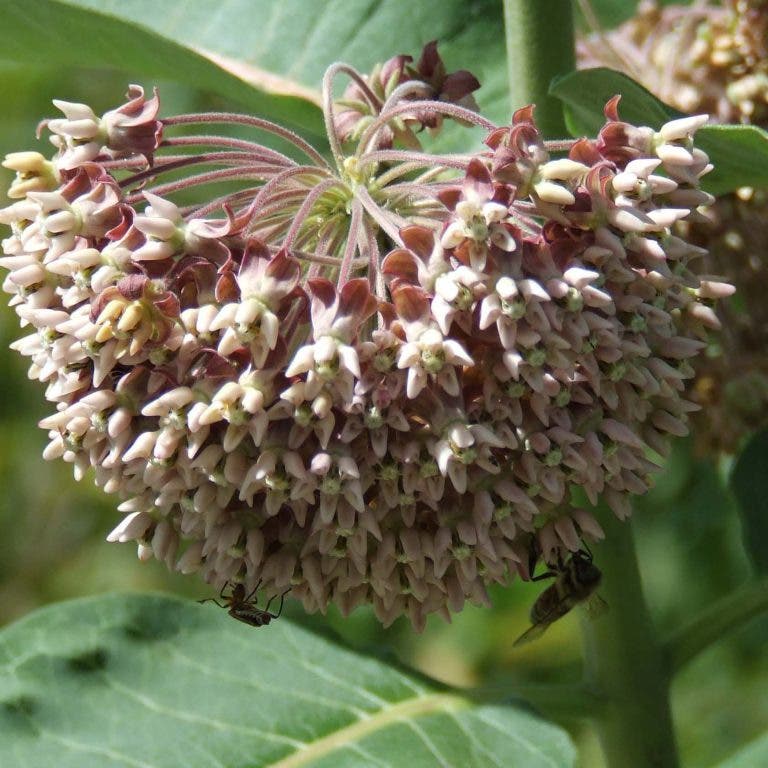
Many people recognize the pointed greenish milkweed pod; fewer recognize the flowers. There are a number of species of milkweed. The most common one has flowers made up of small florets grouped together at the top of the stem. The stem droops under the weight, so the florets form an upside-down umbrella. You can see milkweed plants, which grow to several feet tall, in bloom numerous places along the Greenway (and also at the Gateway Wetlands).
Find out what's happening in Bolingbrookfor free with the latest updates from Patch.
While walking the Greenway in June I also found another tall flower, Queen Anne’s lace. Queen Anne’s lace, which is in the carrot family, is a biennial plant. The first year it grows and gathers strength. The second year, tiny blossoms cluster together at the top of the stem. The blossoms are white, with tiny dark centers. Queen Anne’s lace appears in so many poems that Carolyn Kiser advises contemporary poets to avoid mentioning it.
Another gem blooming near the pond close to Indian Head Park is wild white indigo. Its blossoms grow sideways from tall stems. Wild white indigo is in the pea family, so the flowers look a lot like sweet peas. Like milkweed, it is toxic to children, as well as some animals.
Among other treasures I found along the Greenway were the thistles. I enjoy their beauty in the wild, but consider them a nuisance in my yard and garden. I have some Scottish ancestry, so I suppose I should have more respect for this humble plant. A thistle has been the national emblem of Scotland since the middle of the 1200s. According to one legend, an attacking Norse soldier stepped on a thistle. Since he was barefoot, the prickles penetrated his foot. He cried out, alerting the Scottish army of what was to have been a surprise attack.
As I approached the pond at the end of the Greenway (a protected wetland area), I was greeted by the songs and clicks of red-winged blackbirds. One of them acted like a kamikaze pilot. It flew from a tree on one side of the Greenway, diving down in my direction, then flew back up as it crossed to the other side. It turned and did the same thing in the other direction, scolding all the while. The bird was warning me that I was getting too close to a nest, so I moved back toward the other side of the trail.
The pond held a nice surprise: a great egret (also known as a white heron) was hunting in the water on the far side. It was so beautiful and graceful! A mother and two children sharing the path told me they frequently see two or three herons here, but only one was visible while I was there. It certainly was a visual treasure!
© 2012 Wilda Morris