Health & Fitness
Walking With Nature: Walking the Greenway in January
WALKING WITH NATURE. What is it like to walk the DuPage River Greenway in January? And what is that strange-colored duck among the Mallards?


Last December, I resolved to walk on the DuPage River Greenway at least once a month during 2012. On Jan. 26, the road to the Hidden Lakes parking lot was closed, so I drove to Royce Road to begin my hike there.
When I got to the first little bridge—one that crosses a small tributary—I thought about all those signs that say, “Beware of ice on the bridge.” I crossed the bridge very carefully, walking in tracks left by a car or truck. I soon discovered, however, that the bridge was not the iciest or most treacherous section of the road. I would not advise anyone to walk the Greenway alone at that time of year; it would be best to have a companion, should you slip and break a leg. The streets, sidewalks and even the yards of Bolingbrook were mostly clear, but the Greenway did not provide sure footing. Shade keeps snow from melting quickly, even when the temperature is above freezing. At a number of points the entire roadway was icy.
The melting snow had flooded sections of the Greenway, covering them with mud, which can be as slick as snow and ice. Other sections were covered with the detritus of 2011—dead leaves and twigs. Those sections, at least, provided traction. I managed to walk from Royce Road to a point just short of Hidden Lakes, where the walkway was so icy that I decided not to risk it.
Find out what's happening in Bolingbrookfor free with the latest updates from Patch.
When we have to watch where we step so carefully, it is easy to miss the treats nature has to offer. I was rewarded for my January walk in several respects, however. For one thing, when the trees and bushes are bare and the tall grasses are dormant, you can see a lot more of the river. Rules of the Greenway specify that you have to keep moving, so it is nice to have broader sections of the river in view. I enjoy watching the water rush by, tumbling over rocks and downed tree limbs.
At one place where the roadway was mostly clear, I came across the broken body of a deceased snowman. The poor fellow had fallen into pieces, some of which rolled off the grass onto the walkway—just a few yards from the emergency pole. The emergency pole, which stands about halfway between Royce Road and Hidden Lakes, has a button which hikers or bikers can press if they are having serious difficulties or if they see someone else in trouble. It was too late for the stricken snowman, however, so I left him lying there. I knew the vulture sun would eventually get rid of the remains.
Find out what's happening in Bolingbrookfor free with the latest updates from Patch.
On this January walk, I saw many mallard ducks. Some of them—especially those on the far side of the river—continued to sit nonchalantly on branches which had fallen into the river. Others took offense at my presence and winged their way downstream. When I neared a convocation of two dozen or more Mallards, they swam off in all directions—a strategy sometimes used by soldiers or thieves to avoid capture.
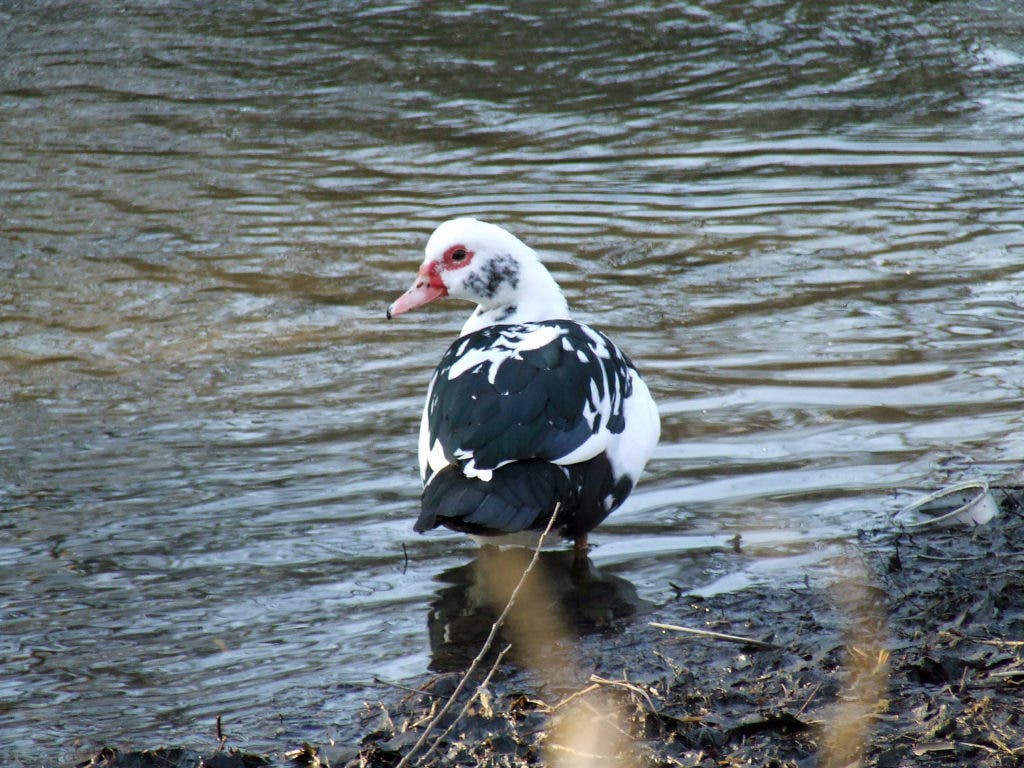
The biggest surprise of my January walk was the presence of a Muscovy duck socializing with that large group of Mallards. The Muscovy was slower to respond to the perceived threat, so I got a good look at it. The Muscovy is native to South and Central America, Mexico and the lower Rio Grande Valley of Texas. Except for three Texas counties, it is considered an invasive species in the United States.
The Muscovy (also called Muscovite or Barbary Duck) is black and white. The wild Muscovy is mostly black, with large white patches. The duck on the DuPage River shows the impact of breeding done to increase the proportion of white to black in its feathers. The large, black tail of the Muscovy is flat. It has claws on its webbed feet, but these were under water, and thus not visible. The Muscovy also has a dark red (or black) knob at the base of the bill.
The Muscovy often roosts in trees, usually near flowing water. The DuPage Greenway provides it a fine supply of groceries: insects (including mosquitoes and mosquito larvae, spiders, flies, and ants), small fish and reptiles, crustaceans, millipedes, and plant material. And despite being at home in warmer climates, the Muscovy adapts well to cold weather. It seemed right at home with its Mallard friends.
Next summer when I walk the Greenway, if I don’t get bitten by mosquitoes, I may need to remember to thank the Muscovy duck.
© 2012