Health & Fitness
Walking with Nature: June in the Gateway Wetlands with the Red-winged blackbirds
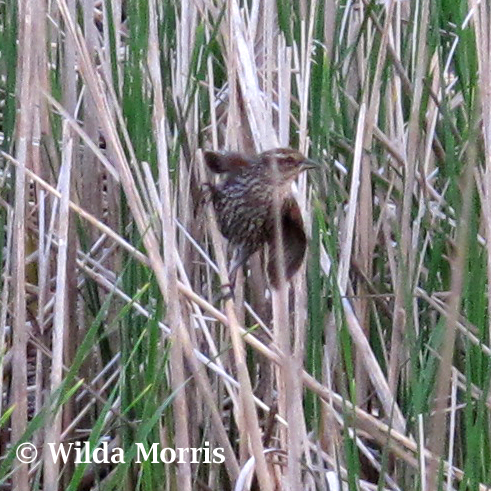
The Gateway Wetlands is full of Red-winged blackbirds. Can you identify a female of this interesting avian group? And how much do you know about their behavior?


I walked around the Gateway Wetlands early this morning. As usual, there were male red-winged blackbirds in trees and on cattails, announcing their presence. One redwing gave a warning call and flew over my head, then toward the next tree. He flew down toward my head, closer this time, then on to the next tree as I continued walking. Soon he decided I was harmless. Instead of dive-bombing me, he flew back in the direction from which he had come.
Redwings are generally not bothered by people unless they get too close to nesting sites. If a redwing does give you a warning, it is smart to distance yourself from the likely nests. If not, they might attack, but I have not heard of that happening at the Gateway Wetlands. Once when I got too close to a female, she called out her distress and nearly a dozen blackbirds rose like popcorn from the marsh. Instead of heading toward me, they all went deeper into the marsh, farther from the walkway.
Red-winged blackbirds are among the most numerous birds in the Gateway Wetlands—and in North America as a whole. The males are easily recognized. Who hasn’t spotted a male redwing in a ditch along a highway or one flying between cattails in a marsh? His shiny black features and the bright red and yellow epaulets on his shoulders easily catch our attention. The female, however, except for her size, looks more like an over-sized sparrow than like her mate. She is a brown or tan and streaky. Her breast is especially streaked, and is a lighter color than her back. She usually has a light stripe above her eye. Les Beletsky (see note below) says each female is somewhat distinctive in her coloration. She is considerably smaller than the male.
Find out what's happening in Bolingbrookfor free with the latest updates from Patch.
Unlike most bird species, redwings are polygamous—and even promiscuous. A male redwing may have up to 15 mates in one season, though the average harem is from 2-6. That number various greatly in different regions and habitats. Without a systematic, in-depth study of the local population, there is no easy way to guess how many mates the male redwings in the Gateway Wetlands average. Harem size probably depends in large part on how much food is available in the habitat where the redwings settle and the size of the territory controlled by the male. Older redwing males have brighter epaulets and attract more mates.
Although redwings have specific mates, researchers have discovered through genetic research that it is not unusual for eggs in one clutch to have more than one father. Although the female has one primary mate, other males succeed in breeding with her.
Find out what's happening in Bolingbrookfor free with the latest updates from Patch.
Many of the red-winged blackbirds you saw in the Wetlands last year are here again, and will be back next season, claiming the same small territory. Research shows that most red-winged blackbirds nest within 50 km (31 miles) from where they were hatched. Redwings are more faithful to their territory than to their mates.
Redwing eggs have to be incubated for 12-14 days. Once the babies are born, they are brooded constantly for 2-3 days before the mother forages for food. In some regions the males help to feed nestlings; in other regions they don’t. I’m not sure whether the males in the Gateway Wetlands help their mates with this task or not. The nestlings generally fledge when they are 9½ to 12 days old, but the parent or parents still feed them for another 2-3 weeks.
Red-winged blackbirds like to nest in marshes where the vegetation provides good hiding places for their nests. Another advantage is the many insect larvae emerging in the marsh—it provides food for the nestlings. The larvae of different insects come at different times, providing what Beletsky calls a “long harvest season.” The parents do not have to go far from the nest to find an adequate amount of food for their young.
Redwings are beloved by many people—but hated by some farmers. In the fall, after the molt (when they lose feathers and get new ones) the males and females form separate flocks. A flock can do a lot of damage to crops as they pick places to eat along the way. Males migrate as much as 600 miles; females even farther. Some males stay closer to their summer homes, perhaps to give them an advantage in reclaiming their breeding territory the following spring.
If you spend enough time in the Gateway Wetlands, you may sometimes see a male redwing chasing another out of his territory, or a group of males chasing a female. Or you might even see several redwings attacking a hawk or heron, trying to drive it away. Bob Levy says redwing males are “hyperactive.”
There is no guarantee that you will see something that exciting on any particular day, but you will doubtless see the males, at least, in the tops of trees or cattails, or flying from one looking post to another. And you will always hear the redwings announcing their presence (if you take those buds out of your ears). One woman whose home is near the Wetlands complained that the red-winged blackbirds are too noisy. They do like to make their presence known! Redwings have at least six vocalizations, which you can hear at http://www.learner.org/jnorth/tm/spring/RedwingDictionary.html.
Come walk the wetlands this summer and enjoy this interesting and colorful bird. If you come soon, you can also enjoy numerous wildflowers in bloom. You can access the Gateway Wetlands off of Feather Sound (across the street from Macy’s) or by going north of Boughton Road on Janes, and turning left onto Anne Lane. You can check out the map at http://www.alltravels.com/united-states/illinois/bolingbrook/photos/current-photo-85102712.
NOTE: One of the most thorough studies of red-winged blackbirds is Les Beletsky’s book, The Red-winged Blackbird: The Biology of a Strongly Polygynous Songbird (Academic Press; Harcourt Brace & Company, Publishers, 1996), which is the source of some information in this article. If you would like a less academic—and very enjoyable—book, I recommend Club George: The Diary of a Central Park Bird-Watcher by Bob Levy (New York: Thomas Dunne Books, St. Martin’s Press, 2006)—but please do not interfere with nature by trying to get the birds in the Wetlands to eat out of your hand.
© Wilda Morris