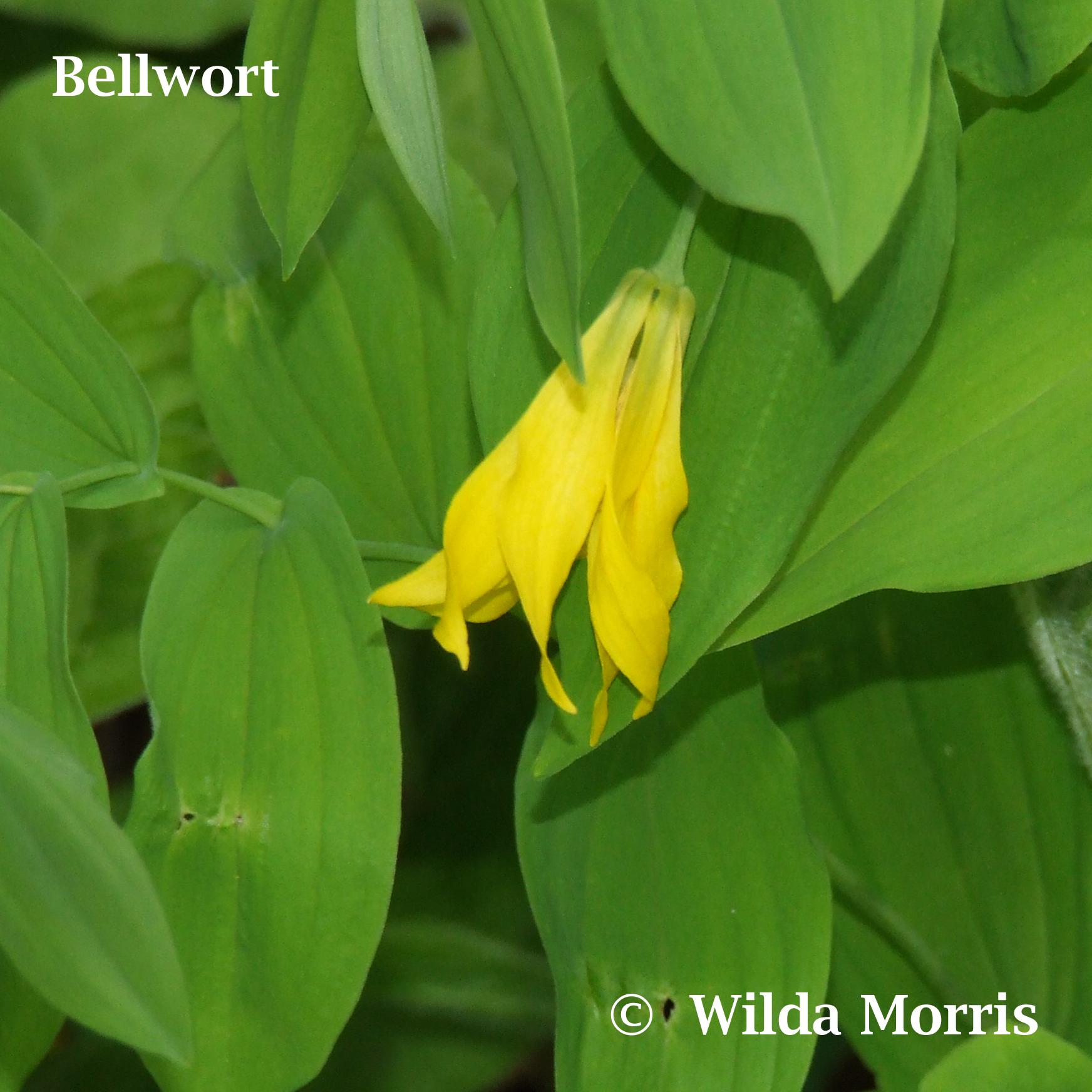


Bellwort and large-flowered white trillium (both in the lily family) filled the woods when I arrived at The Clearing Folk School in Ellison Bay, Wisconsin, on May 26. I saw more trillium than I’ve ever seen in one place and bigger blooms than I have seen before. By the time I headed back to Bolingbrook on June 1, the woods were filled with yellow lady slippers. I had come to Door County at just the right time.
At The Clearing, I met Larry Morrison, who was there to lead a week-long class on “Spring Wildflowers.” He arrived a day or two early with his list of 97 species that might be located. During the week, he led participants on walks at The Clearing and at parks and beaches in the area. This year, they identified 53 wildflowers in bloom, several more in bud—and three species not on the list. I was there for other reasons so I did not attend his wildflower class, but I did take a nature walk one morning with Michael Schneider, Executive Director of The Clearing. I also spent some of my free time wandering in the woods alone with my camera. (You can learn more about The Clearing at http://theclearing.org/current/index.shtml.)
Bellwort
Bellwort (or merrybell) is named for the yellow bell-shaped blooms that hang down. It is also called “wild oats.” The suffix “wort” refers to a woody plant thought to have medicinal value. Colonists learned from the peoples who were in North America ahead of them to use various parts of the bellwort to treat ulcers, sore throat, backache, aching muscles, inflamed eyes and various kinds of wounds.
Find out what's happening in Bolingbrookfor free with the latest updates from Patch.
Trillium
Trillium gets its name from its three white petals which rise above its three large leaves. It is sometimes called wake-robin, perhaps because its arrival is an early sign of spring. Christians in Europe considered the white trillium a symbol of the Trinity. As the white trillium ages, the petals turn pink or lavender.
Many of the native peoples of the Americas used the trillium as food and medicinally as an astringent, antiseptic and expectorant. Some considered it especially helpful to women who were giving birth. Fortunately it did not get the name trilliumwort!
Find out what's happening in Bolingbrookfor free with the latest updates from Patch.
Someone who hiked with Morrison told me about a “mutant trillium” and showed me where to find it. This trillium had five layers of petals directly on top of one another. Thus, instead of the traditional three petals, it had a total of fifteen. I was told it had 8 layers of petals last year. Mutations of this kind have been noted in other parts of the country from time to time.
Lady Slippers
The little orchids called lady slippers or moccasin flowers look like doll shoes. According to a legend preserved by the Ojibwa Peoples, a terrible disease spread through a village, killing even the medicine man. The tribal messenger prepared to go to a far village to get the medicine that was needed—despite the fact that it was winter, and he had no moccasins. Just before he was to leave, he was stricken by the dread disease. Although it was unheard of for a woman to be the messenger, his wife went in his place. She ran as quickly as she could through the snow drifts and succeeded in getting the medicine. On her return, before she reached her own village, she was heard crying out. Villages went into the woods, where they found her lying in the snow. Her feet were frost-bitten and swollen. They carried her back to the village with the life-saving medicine. When she died, the wrappings they had put around her feet became flowers. They bloom early every spring in honor of her sacrifice. (See more details of this legend at http://www.firstpeople.us/FP-Html-Legends/LadysSlippers-Ojibwa.html).
More Door County Wildflowers
I enjoyed many other wildflowers during my week in Door County, including pussytoes, forget-me-nots (which are an invasive species in Door County), several varieties of violets, Solomon seal, false Solomon seal, Virginia bluebells, lousewort, columbine, and asarum or wild ginger (the blossoms of which hide on the ground beneath the leaves).
I’m always delighted when I spot a jack-in-the pulpit, so imagine how thrilled I was as I examined a clump of seven. I must confess, however, I didn’t actually see jack-in-the-pulpit flowers. The flowers, which are tiny, are hidden within the spathe. The spathe, shaped like a high-church pulpit, surrounds and covers the stem and tiny blooms. Jack-in-the-pulpit could also have the suffix of “wort” but the roots are poisonous, so I don’t advise the amateur to try it! Among other uses, it was believed to be an effective contraceptive.
There were also dandelions, of course, including one intrepid bloom sticking up between dolomite rocks on the beach beneath a cliff.
Door County is unique because it is on a peninsula between Lake Michigan and Green Bay. It’s geography and geology were largely formed by ancient glaciers. The Clearing is built above a dolomite cliff above a rocky beach, looking out over Green Bay. Other landscapes in the county include sandy beaches, sand dunes, lakes, sinkholes, caves and wetlands. When European settlers moved into the county, it was mostly forested with hardwood and conifer trees. Sawmills and farming began to change the land in the 1800s. The county is working hard to preserve some of its natural features for future generations.
Dwarf Lake Iris
One wildflower that only grows in the Great Lakes area is the dwarf lake iris. I always look for it when I’m in Door County in the spring, usually at The Ridges Sanctuary in Bailey’s Harbor. I was delighted to find this beautiful miniature blue flower in bloom during my visit last month. A threatened species, it is the state flower of Michigan.
If you want to walk with nature in Door County, consult the list of natural areas at http://dnr.wi.gov/topic/Lands/naturalareas/county.html#Door or the list and descriptions of state and county parks in Door County at http://dnr.wi.gov/topic/Lands/naturalareas/county.html#Door. You have to go north to see dwarf lake iris, but you can walk with nature right here in Bolingbrook. There are many wildflowers and other pleasures to enjoy.
© Wilda Morris