Crime & Safety
'Everyone Should Be Troubled' By Expressway Gunfire
We're on pace to shatter the Chicago-area highway shooting record, and the hot summer months have yet to begin.


CHICAGO, IL - We know our highways by name, not by number: the Dan Ryan, the Kennedy, the Stevenson, the Edens and Lake Shore Drive.
But one number is alarming the droves of people who drive those routes every day.
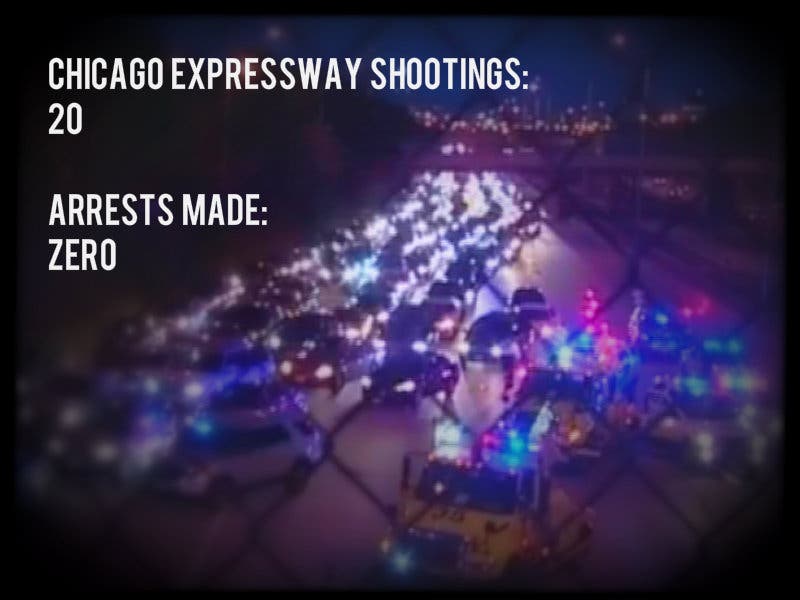
20.
Find out what's happening in Chicagofor free with the latest updates from Patch.
As of Friday, May 27, 20 shootings have taken place on Chicago’s expressways this year. That’s already more than double the total from all of 2012 and on pace to shatter the record of 37 reported just last year.
Violence on the city’s highways is on the rise, and everyone knows it. But not everyone agrees on its primary cause and how to react to the alarming number of shootings even before the official start of summer.
Find out what's happening in Chicagofor free with the latest updates from Patch.
“I want everyone to know that they will be safe on the expressways,” said Leo Schmitz, director of the Illinois State Police, the law enforcement body that holds jurisdiction on interstate highways. “We will not tolerate shootings on the expressways. (Chicago Police Department) detectives and our investigators are sharing information. We got meetings set up and we will be following up and prosecuting anybody shooting on the expressways.”
Get Patched In
Do you actually feel safe?
Brian Althimer, a WGN radio producer, spends many of his nights moonlighting as a security manager on Chicago's North Side. He’s not afraid of what goes on during the overnight hours on that side of town, but the dangers of that job require him to wear a bulletproof vest.
His vest was tucked away in the trunk of his car early in the morning last Saturday while driving home from his night gig on Lake Shore Drive. He now wishes he was wearing that vest.
While driving south on Lake Shore Drive nearing Jackson Boulevard, Althimer said, he noticed a tan SUV following closely behind him.
“As I got close to Roosevelt, the SUV pulled up beside me and the guy (black male dreads) looked at me and pointed a gun at me,” he later wrote on Facebook. “Luckily, I broke quickly and made a right on Roosevelt and called the police.”
'Sick Game of Initiation'
Althimer told Patch in an interview later in the week that everything “happened so suddenly” and that he wonders, in retrospect, what would have happened had he stayed on Lake Shore Drive and not made a quick break to lose the pursuers in the SUV.
A lifelong resident of Chicago, Althimer said he has never before been a victim of violence.
“This was random,” he said. “Totally random. Back in the '90s, violence was bad but nothing like it is today.”
He wonders whether the reason behind the rise in expressway gun violence is that it's “easier for them to get away” or whether it's part of “some sick game of initiation.”
Eddie Johnson, superintendent of the Chicago Police Department, doesn't dismiss the idea that some highway shootings are an initiation.
“That’s always a possibility. I couldn’t tell you 100 percent … I’m sure there is a very small percent that could be, but for the most part it’s two people out there with guns willing to use them.”
From now on, Althimer will be wearing his vest whenever he drives within city limits overnight or in the early morning hours.
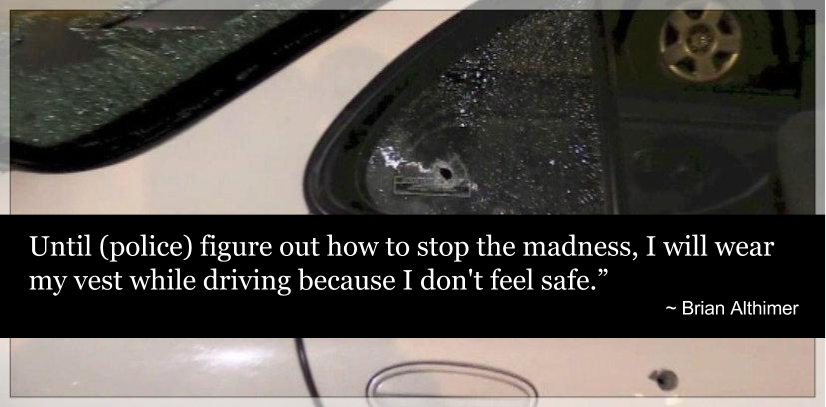
“I honestly don't feel safe in my own city,” he said. “I'm a big guy, but these dudes out here are on some other agenda. ... Until (police) figure out how to stop the madness, I will wear my vest while driving because I don't feel safe.”
Gang-Related
Schmitz, the State Police director, said most of this year's expressway shootings are the result of gang-related conflicts.
“Some of those conflicts may start in neighborhoods and end up on the expressway — that way our Chicago detectives and [ISP] investigators can work together,” he said. “We may have information that Chicago police may not have and CPD may have information we don’t have.”
Earlier this month, a man was shot on a street parallel to I-57 near 111th Street on the South Side, then drove onto the Interstate where he died when his minivan rolled over in a grassy embankment.
The increased number of shootings on the expressways also comes at a time when police in Chicago are facing heightened scrutiny and have been making far fewer stop and frisks than in previous years.
“I think a lot of expressway shootings result from verbal confrontations that are happening inside the city and the folks involved are getting on the expressways and going after each other,” Johnson said. “We have to do a better job and have entered into agreement with state police to have our detectives help them in these investigations in these expressway shootings.”
The confrontations that take place in the neighborhoods are nothing new to Chicago.
But the ramp-up in expressway violence is new.
“There was a time when shootings in city parks was a new thing,” said Jacqueline Battalora, a professor of sociology and criminal justice at Saint Xavier University in the city’s Mount Greenwood neighborhood. “The fact that we are seeing a new site is not surprising, but it is always shocking to see spaces that seem safe become the new site for violence.”
"Everyone should be troubled.”
Battalora, an attorney and former Chicago police officer who served in the city’s Uptown neighborhood, said the increased public attention shown to the expressway shootings as opposed to the ones in the neighborhoods comes down to one factor.
Millions of white people drive the expressways.
'Hitting These White Spaces'
“In this country, when white people are harmed, threatened and made to feel like their space is not safe, the country reacts,” Battalora said. “It’s troubling that that reaction is not similar when a black or brown person is harmed.”
Gun violence is endemic in some Chicago neighborhoods, primarily populated by African-American residents. Reports of gunfire are heard throughout the day, every day in Englewood and Roseland. Many Chicagoans and most suburban dwellers are unmoved by this.
But expressway shootings are “hitting these white spaces,” Battalora said, and commuters from the suburbs are feeling vulnerable.
“Sadly, many black and brown communities, not just in Chicago but across the country, are exposed to that all the time,” she said. “But when you upset white people, things change.”
Earlier this year, the Illinois State Police announced they would be ramping up patrols on expressways, beginning the “Chicago Expressway Anti-Violence Surge.”
“People should not have to worry about their safety while driving on the expressways,” Col. Tad Williams, ISP Division of Operations deputy director, said at the time. “Our number one priority is to ensure the safety of the motoring public. We will utilize all available resources to locate and arrest offenders who commit violent acts on our expressways.”
Chicago Police and State Police say helicopters are being used to monitor the expressways.
“We typically have a helicopter out there so that’s something we always do,” Johnson said.
Schmitz added that if there is “any problem and if there is a car that got away or something we can pick it up from the air and can radio down the information to our cars to Chicago Police.”
'A Good and Scary Story'
So, what's at the root of this phenomenon?
The interactions at neighborhood bars and clubs that precede shootings on the expressways are linked to the violence associated with masculinity, Battalora explained.
“It’s about how we are teaching boys to resolve problems and through messages in the mass media. We show Teenage Mutant Ninja Turtles and G.I. Joe and yet we wonder why this is the result.”
But John Hagedorn, a professor of criminology, law and justice at the University of Illinois-Chicago, doesn't believe this is a phenomenon at all. He brushes off the expressway shooting outrage as “sensationalism.”
"I know it could be a good and scary story, but I don't see any deeper reason for an increase in this kind of shooting," he said in a Chicago Tribune interview.
And while shootings in city neighborhoods result in a low percentage of arrests, the number is even lower when looking at apprehending expressway offenders. No arrests have been made in any of the 20 such incidents this year.
“Our eventual goal is to get an arrest,” Schmitz said. “Good citizens are the eyes and ears of people on these expressways. Please continue to call us so we can place people under arrest that are committing violence on the expressways.”
Patch Editor Lorraine Swanson contributed to this report.

Patch Weekly
Visit the Patch Weekly hub for another good read from our compendium of features and perspective for Illinois Patch fans. » turn the page to keep reading
Get more local news delivered straight to your inbox. Sign up for free Patch newsletters and alerts.