Health & Fitness
Here's How Well Illinois Is Complying With The Stay-At-Home Order
Cell phone tracking data shows how Illinois is doing compared to the nation as a whole.


ILLINOIS — As the spread of the new coronavirus has accelerated in recent weeks, more and more Americans have come under state or local stay-at-home orders and advisories. As of the past weekend, more than 95 percent of the population was affected.
The purpose of these orders and advisories is to minimize the spread of the virus, which is highly contagious, although the scope of the orders varies by state and locality. Compliance with them varies widely, too, as Google has demonstrated with its community mobility reports, as well as business data firm Cuebiq, which compiled its COVID-19 Mobility Insights. Both aggregate location data from cell phones to track the movements of large numbers of people.
The data is aggregated and anonymized, Google said, so individuals are not tracked by identity.
Find out what's happening in Chicagofor free with the latest updates from Patch.
As of March 29, Google reports that nationwide movement to retail and recreational locations — including restaurants, shopping centers, movie theaters and the like — dropped 47 percent against a baseline set for the weeks Jan. 3 to Feb. 6.
Find out what's happening in Chicagofor free with the latest updates from Patch.
Travel to groceries and pharmacies fell 22 percent; to parks, beaches and gardens, 19 percent; to transport hubs such as bus and train stations, 51 percent; and to workplaces, 42 percent. Mobility to places of residence showed the only increase, 16 percent.
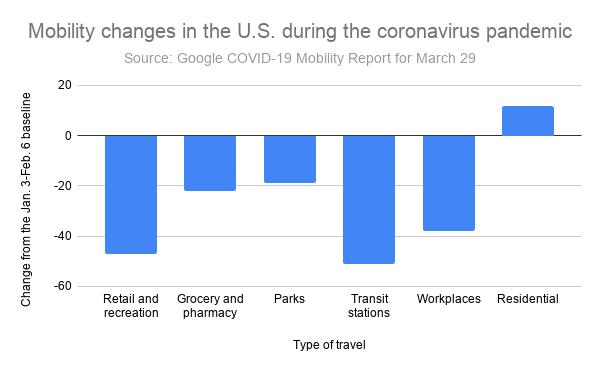
In Illinois, which has been under a stay-at-home order since March 21, compliance is a bit higher. On March 31, Gov. J.B. Pritzker extended the statewide stay-at-home order through April 30, keeping all schools and nonessential businesses closed until May.
As of March 29, Google reports that statewide movement to retail and recreational locations dropped 53 percent against the baseline. Travel to groceries and pharmacies fell 24 percent; to parks, beaches and gardens, 29 percent; to transport hubs and similar locations, 55 percent; and to workplaces, 39 percent. Mobility to places of residence increased 13 percent.
— Don't miss updates about precautions in the Chicago area as they are announced — Sign up for Patch news alerts and newsletters.
In general, compliance is higher in urban areas of the Northeast, upper Midwest and West Coast than in rural areas, the South and the Great Plains.
The data comes with several important caveats:
- Tracking location does not show how often or how closely people come into contact with each other and is not necessarily a predictor of infection.
- Rural residents often must travel farther to get groceries or other necessities, while city dwellers don't have to move far to infect others.
- Higher-income residents often are able to comply more easily than low-income residents, whose jobs do not always allow them to work from home.
But public health experts agree that abiding by stay-at-home orders and advisories is critical to slowing the spread of the virus and "flattening the curve" of infection. Such measures are deemed so important that authorities have instructed police to break up large gatherings of people, and they have even begun arresting those who violate stay-at-home orders.
The methodology of the Google report can be found at the end of this document.
Get more local news delivered straight to your inbox. Sign up for free Patch newsletters and alerts.